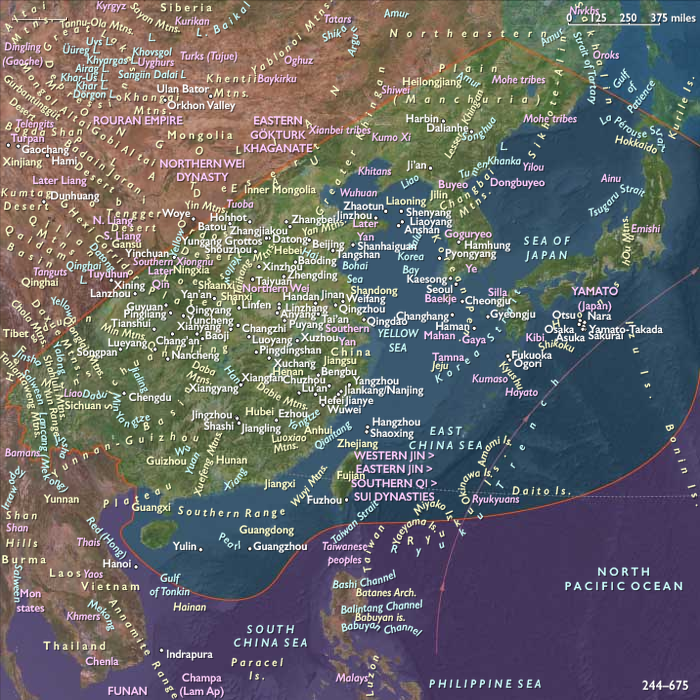
…ending at Shanhaiguan in the east.
Years: 579 - 579
…ending at Shanhaiguan in the east.
Locations
People
Groups
Topics
Commodoties
Subjects
Regions
Subregions
Related Events
Filter results
Showing 10 events out of 57380 total
Bidatsu rules during a tense period between the Soga and Mononobe clans regarding acceptance of Buddhism in Japan.
During his reign, he will have two empresses.
The first empress, Hirohime, had died in 577, the fifth year of his reign.
To replace her, he had elevated one of his consorts, Princess Nukatabe, to the rank of empress.
Nukatabe, his half-sister by their father Kimmei, will later ascend to the throne in her own right and is today known as Empress Suiko.
In external affairs, Bidatsu seeks to reestablish Japanese influence in Korea but is largely unsuccessful; according to Nihonshoki, his court establishes relations with Baekje and Silla.
Northern Zhou has taken over Northern Qi's territory.
However, Emperor Wu's death in 578 has doomed the state, as his womanizing son, the apparently deranged and irresponsible Emperor Xuan, is an arbitrary and violent ruler whose unorthodox behavior has greatly weakened Northern Zhou.
In 579, in order to prevent invasions of the Northern Zhou kingdom by the T'u-chüeh (a group of eastern Turks) and the Ch'i-tan, …
…the emperor starts a massive rebuilding program on areas of the wall located in the former Northern Ch'i kingdom, starting at Yen-men in the west and …
Development and learning have flourished during Khosrau’s forty-eight-year reign and Persian literature has enjoyed a Golden Age.
Khosrau seems about to make a settlement on Constantinople's terms when he dies in the early spring of 579.
His eldest son and successor kills his brothers, according to the oriental fashion, and takes the throne as Hormizd IV.
He rejects Tiberius's proposals, however, refusing to surrender any of the territories conquered by his father, and hostilities resume.
Leander, brother of the encyclopedist Isidore of Seville, enjoying an elite position in the secure surroundings of tolerated Catholic culture here, had become at first a Benedictine monk, and in 579 is appointed bishop of Seville.
In the meantime he has founded a celebrated school, which soon becomes a center of Catholic learning.
As Bishop, he has access to the princess Ingunthis and works tirelessly with her to convert her husband, an act of court intrigue that cannot honestly be divorced from a political context.
Under Ingund's influence, and that of Leander, Hermenegild is in 579 converted to Catholicism.
His family demands that he return to the Arian faith, but he refuses.
As a result, he leads a revolt against his father, inspiring Spanish Romans to proclaim him their king.
He asks the Empire for aid, but none is forthcoming.
After some time he seeks sanctuary in a church.
Liuvigild will not violate the sanctuary, and sends Reccared inside to speak with Hermenegild and offer peace, which Hermenegild accepts.
Leander, exiled by Liuvigild, beats a hasty retreat to Constantinople.

One Gregory, born around 540 to a wealthy patrician family in Rome, had chosen to follow a public career.
At the age of 30 he had been named prefect of Rome but, unfulfilled by worldly success, had soon embraced a life of piety and contemplation.
He had become a monk in about 574 in one of the seven monasteries he had constructed with his own money, following the Rule of Saint Benedict, and has spent several years cloistered there until summoned around 578 by Pope Benedict to serve as cardinal deacon in Rome.
Famine had followed the devastation wrought by the Lombards, and from the few words the Liber Pontificalis has about Benedict, it appears that his death on July 30, 579, comes in the midst of his efforts to cope with these difficulties.
His successor, Pope Pelagius II, seemingly a native of Rome, is of Gothic descent, as his father's name was Winigild.
Pelagius makes Gregory permanent ambassador at the court of Emperor Tiberius in Constantinople.
Chilperic I: The "Nero and Herod of His Time"
Despite his ruthless political and military campaigns, Chilperic I of Neustria also pretends to a certain literary and intellectual culture, attempting to engage in poetry, linguistic reform, and ecclesiastical affairs. However, his heavy-handed rule, conflict with the clergy, and controversial policies earn him the bitter condemnation of Gregory of Tours, who brands him "the Nero and Herod of his time" (Historia Francorum, Book VI, 46).
1. Chilperic as a Patron of Literature and Language Reform
- Chilperic dabbles in poetry, composing halting verse in imitation of Sedulius, a prominent Christian Latin poet of the fifth century.
- He attempts to reform the Latin alphabet, adding new letters and ordering manuscripts to be rewritten using these characters.
- His linguistic ambitions, however, fail to gain acceptance, and his alphabetic reforms disappear after his death.
2. Conflict with the Church: The Wrath of Gregory of Tours
Chilperic’s seizure of ecclesiastical property and interference in Church affairs create lasting hostility between him and Gregory of Tours, a staunch defender of episcopal authority.
- He wrests control of Tours from Austrasia, consolidating his power but provoking outrage among the clergy.
- He seizes Church lands and wealth, using them for royal administration and military campaigns.
- He appoints lay nobles, including palace counts, as bishops, ignoring canonical procedures and further alienating the ecclesiastical elite.
3. Gregory of Tours’ Fierce Condemnation
-
Gregory, who views Chilperic’s actions as an affront to both religion and tradition, compares him to the infamous Roman emperors Nero and Herod, accusing him of:
- Religious persecution and sacrilege
- Arbitrary rule and greed
- Tyrannical behavior toward the Church
-
This portrayal is deeply biased, as Gregory himself was a bishop of Tours, one of the cities Chilperic seized and controlled.
4. Conclusion: A Ruler with Literary Ambitions but a Legacy of Controversy
Chilperic I’s attempts at intellectualism and linguistic reform contrast sharply with his political ruthlessness and Church antagonism. Though he sought to shape Frankish culture, his legacy is marred by his conflicts with the clergy, particularly with Gregory of Tours, who ensured that posterity viewed him as a cruel and sacrilegious tyrant.
Chilperic I: The Archetypal Merovingian Sovereign and His Quest for Absolute Power
Chilperic I of Neustria embodies the stereotypical Merovingian king, relentlessly seeking to expand royal authority through taxation, fiscal reforms, and centralization of power. However, his greedy financial policies provoke widespread unrest, culminating in a major sedition at Limoges in 579 CE.
1. Chilperic’s Efforts to Strengthen Royal Power
- Chilperic is obsessed with enhancing the monarchy's control, consolidating both secular and ecclesiastical power under his rule.
- He seeks to undermine the nobility and Church, which traditionally wielded great autonomy in Frankish governance.
- His rule is marked by heavy taxation and increased levies, which he justifies as necessary to expand the royal treasury and fund military campaigns.
2. Excessive Taxation and Unrest in Limoges (579 CE)
- Chilperic’s greedy fiscal measures include new taxes, fines, and confiscations, disproportionately affecting the local population.
- His tax officials and administrators, implementing these burdensome policies, provoke outrage in the city of Limoges, leading to open sedition in 579 CE.
- The rebellion at Limoges demonstrates the limits of royal authority, as excessive demands lead to violent resistance rather than obedience.
3. The Consequences of Chilperic’s Rule
- While his taxation policies enrich the royal treasury, they alienate both the nobility and the peasantry.
- His heavy-handed rule contributes to his reputation as a tyrant, further reinforced by Gregory of Tours, who portrays him as an oppressive, power-hungry king.
- Despite his ambition, his reign is ultimately overshadowed by internal strife, and his assassination in 584 CE suggests that his authoritarian rule had made him many enemies.
Conclusion: Chilperic as the Quintessential Merovingian Ruler
Chilperic I is the archetypal Merovingian sovereign, blending ruthless ambition, economic policies, and centralized rule with heavy taxation and oppression. His uncompromising fiscal measures lead to popular uprisings, demonstrating the fragile nature of royal power in the early Frankish kingdom.
Little is known of Theodric's life and reign, although Urien, the king of Rheged, is said to have subjected Theodric and his sons to a three day siege on the island of Lindisfarne.
According to medieval Welsh poetry (such as the poem Gweith Argoed Llwyfain [The Battle of Argoed Llwyfain or Battle of Leeming Lane] from the Book of Taliesin), Theodric is killed in battle by Urien's son, Owain mab Urien, after Theodric demands hostages and Owain refuses to give in.
Theodric is succeeded by his brother Frithuwald. (The earliest authorities differ widely on the order and the regnal years of the kings between the death of Ida in 592/593 and the beginning of Æthelfrith's rule.)
Cham king Sambhuvarman, seeing an opportunity in the anarchic conditions obtaining under China’s new Sui dynasty, ends Champa’s subjugation to the Chinese, but, when confronted by the newly vigorous empire and its soldiers, renews tribute payments to the empire.