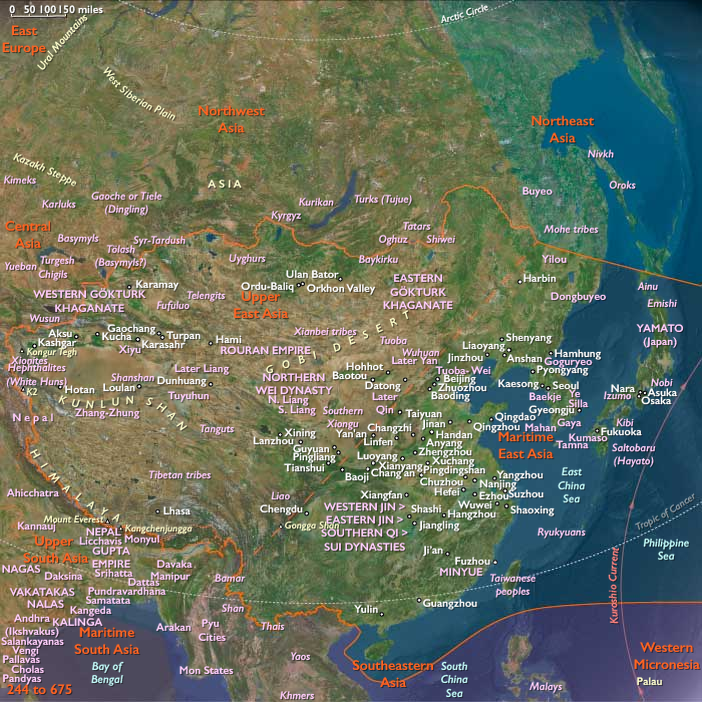
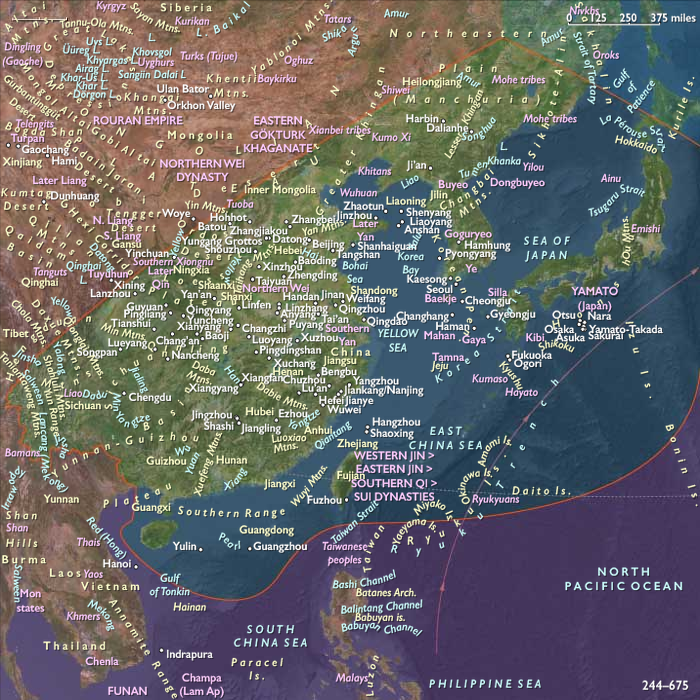
Emperor Yang visits Jiangdu again in 610, …
Years: 610 - 610
Emperor Yang visits Jiangdu again in 610, and this time elevates Jiangdu's importance so that it effectively becomes a third capital.
Locations
People
Groups
Topics
Commodoties
Subjects
Regions
Subregions
Related Events
Filter results
Showing 10 events out of 57023 total
The Visigoths have fought the imperial forces in Spania during the reign of the usurper Witteric, although Isidore of Seville is dismissive of Witteric's accomplishments, writing that "although he frequently fought battles against the Roman soldiers, he did not win any adequate glory except for capturing some soldiers at Sagunto with the help of his generals."
The campaign against Sagunto probably took place in 605.
It was probably during his reign, as well, that Bigastrum (near Cartago Nova) is taken, for its bishop appears in a council of Toledo in 610.
In the twelfth year of his reign, Theuderic II, Frankish King of Burgundy, had sent bishop Aridius of Lyons and the constable Eborin to ask Witteric for his daughter's hand in marriage.
Although the envoys had given their word that she would not be disowned by Theuderic, and she had been received by the king in Chalon-sur-Saône in 606, the regent (the queen-grandmother) Brunhilda and Theodoric's sister Teudila (or Teudilana) had alienated him from her.
Theuderic had then disgraced her by sending her back without her dowry.
Incensed, Witteric had entered into a quadruple alliance with Theodebert II of Austrasia, Clothar II of Neustria, and Agilulf of the Lombards to effect his deposition and death.
Despite their mutual fear of Theuderic, their alliance had not accomplished anything; according to Fredegar, "Theuderic got wind of it [the alliance] but treated it with utter contempt."
In April 610, a faction of Catholic nobles assassinates Witteric during a banquet, and has his body dragged ignominiously through the streets (Witteric is buried without honor).
The nobles then proclaim Gundemar, duke of Narbonne, king.
Gundemar continues a policy of amity with Clothar and Theudebert.
To this end, he sends grand sums of money to support their cause against their relative (cousin and brother, respectively) Theuderic .. At other times, he demonstrates a politic of hostility against Brunhilda.

Phocas' persecution of the Monophysite Christian sect and of the Jews brings him the hatred of the Eastern provinces, and in the capital, he grows increasingly tyrannical.
To contemporaries, the coincidence of pestilence, endemic warfare, and social upheaval seems to herald the coming of the Antichrist, the resurrection of the dead, and the end of the world.
Heraclius the Elder had been a key general during Emperor Maurice's war with Bahrām Chobin, usurper of the Sassanid Empire, during 590.
After the war, Maurice had appointed him to the position of Exarch of Africa.
Fear of the Persians, together with general discontent, lead to an appeal to the Exarch, who in 610 equips an expeditionary force commanded by Heraclius the Younger, the Exarch’s eldest son by Epiphania, of an Armenian family from Cappadocia, probably of Arsacid descent.
The devout Heraclius places his fleet under the protection of an icon of the Virgin against Phocas, stigmatized in the sources as the “corrupter of virgins.” In the course of his voyage along the northern shores of the Mediterranean, Heraclius adds to his forces.
Heraclius arrives at Constantinople in October 610 to be hailed as a savior.
With the warm support of the Green faction, he quickly bests his enemy, decapitating Phocas and, with him, those whom Phocas had advanced to high civil and military office.
There are, in consequence, few experienced counselors to aid Heraclius, for few among the men of prominence under Phocas—and earlier under Maurice—survive to greet the new emperor of the crumbling state, occupied by invaders and wracked with internal dissension.
Slavs are swarming over the Balkan Peninsula; the Persians have occupied extensive parts of Anatolia; the Avars, who rule over the Slavic and other tribes that occupy the region between the Don and the Alps, exact tribute.
With its economy disrupted, its administration disorganized, its army depleted and demoralized, its factions engaging in civil strife, its peasants enfeebled by excessive exactions, its religious dissenters alienated by persecution, and its authority challenged by a powerful aristocracy, the empire lacks the strength necessary to expel the invaders, and possibly even to survive.
A messenger from Goguryeo's King King Yeong-yang to Ashina Rangan happened to be present when Emperor Yang was visiting Ashina Rangan in 607, and Ashina Rangan had introduced him to Emperor Yang.
Emperor Yang had ordered Gao Yuan to come visit him, offering to reward him if he did so and to punish him if he did not do so.
Gao Yuan had not responded, and by 611, Emperor Yang, insulted by the lack of response, is preparing a campaign against Goguryeo.
With Sui appearing to be in its prime, both governmental officials and the people are initially in support of a campaign to conquer Goguryeo.
Emperor Yang goes to Zhuo Prefecture in spring 611 and announces the campaign against Goguryeo.
Several hundred men are conscripted, and it is said that even before they could get to Zhuo Prefecture, disease and fatigue had already caused much loss of life.
In response, a number of conscripted soldiers desert and become agrarian rebels.
Emperor Yang, angry that Western Tujue's khan Ashina Daman, while nominally submissive, had refused to visit him, has Pei Ju persuade Ashina Daman's subordinate khan Ashina Shegui to rebel in 611 against Ashina Daman, promising to give him a Sui princess in marriage.
Ashina Shegui thus rebels against Ashina Daman, forcing Ashina Daman to flee, first to Gaochang, then to Sui.
Emperor Yang accepts Ashina Daman's submission, and thereafter divides his people into three groups, while leaving Ashina Daman as titular khan, although he will never allow Ashina Daman to return to his people.
The ruler of Gaochang, Qu Boya, had in 607 begun paying tribute to the Sui Dynasty.
Emperor Yang in winter 612 arranges the marriage of a daughter of a clansman, whom he creates the Princess Huarong, to Qu Boya, the king of Gaochang.
Witteric, among later Visigothic kings, had campaigned frequently against Spania, though his generals were more successful than he.
The latter had captured the small town of Gisgonza.
Gundemar, who had moved the primatial see of Carthaginiensis from imperial Cartagena to Visigothic Toledo in 610, campaigns against Spania in 611, but to no effect.
Dukes Gisulf II of Friuli and Gaidoald of Trent had been at odds with King Agilulf until they made peace in 602 or 603.
Gisulf had also allied with the Avars to make war on Istria.
Gisulf is involved in the local church.
The bishops of "the schismatics of Istria and Venetia," as Paul the Deacon calls them, had fled to the protection of Gisulf.
Gisulf had also taken part in the confirmation of the succession of Candidianus to the patriarchate of Aquileia in 606.
The most significant event of his reign occurs probably in 611.
When the Avars invade Italy, Gisulf's territory is the first they pass through.
Gisulf summons a large army and goes to meet them.
The Avars are a larger force, however, and they soon overwhelm the Lombards.
Gisulf dies in battle, and his duchy is overrun.
He leaves four sons and four daughters by his wife Romilda (or Ramhilde).
His elder two sons, Tasso and Kakko, along with their younger brothers Radoald, and Grimoald, escapes the Avars and evade capture, successfully setting themselves up as Gisulf's successors.
Of two of Gisulf’s daughters, Appa and Geila (or Gaila), Paul the Deacon says that one married the King of the Alemanni (uncertain) and another the Prince of the Bavarians, probably Garibald II of Bavaria, but he does not identify who married whom.
The Sui soldiers have been gathered at Zhuo Prefecture by 612, and …