Emperor Wen is assassinated by Crown Prince …
Years: 453 - 453
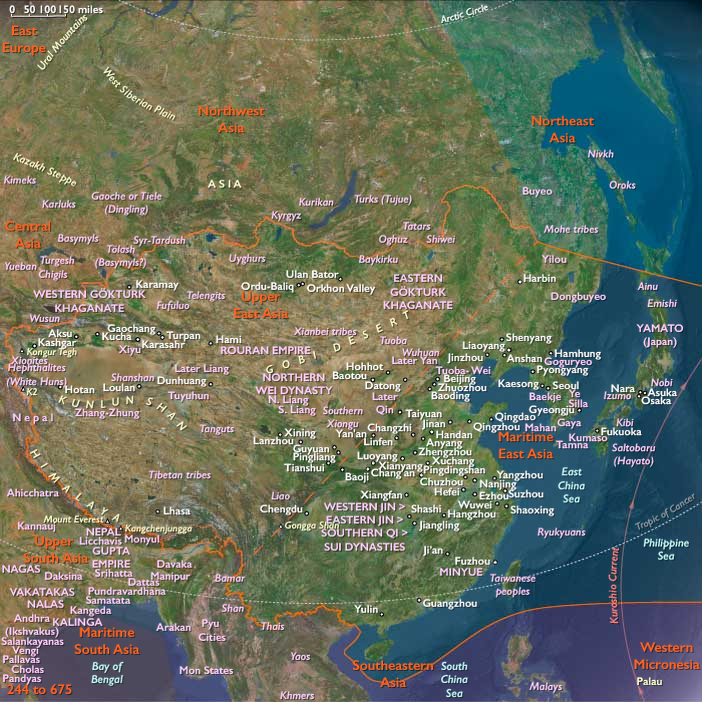
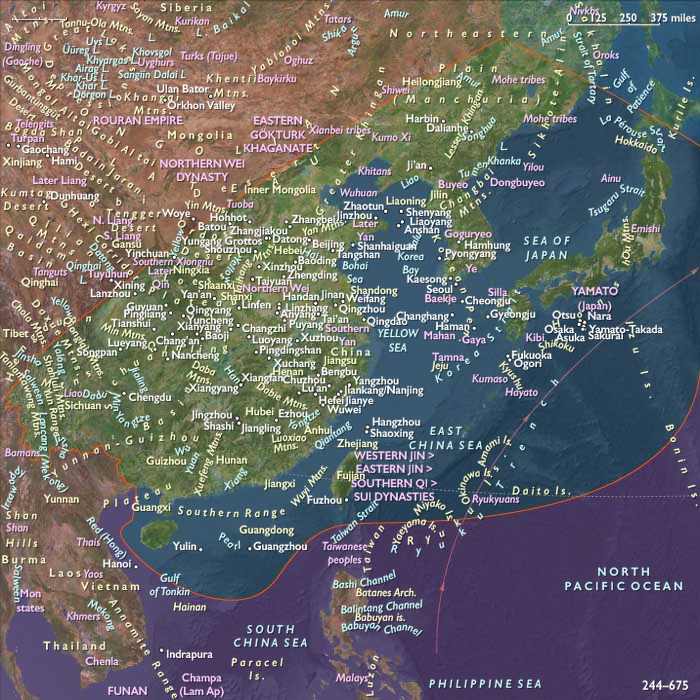
Emperor Wen is assassinated by Crown Prince Shao and the second prince Jun in 453 after planning to punish them for consorting with witchcraft.
However, they are both defeated by the third prince Jun (spelled with a different character than the aforementioned Jun), who becomes Emperor Xiaowu of Liu of Song.
Locations
People
Groups
Topics
Commodoties
Subjects
Regions
Subregions
Related Events
Filter results
Showing 10 events out of 58700 total
Attila is in 453 intending to attack the Eastern Empire, where Marcian maintains his refusal to pay the subsidies agreed upon by his predecessor, Theodosius II.
During the night following Attila’s marriage to the Goth princess Ildica, he dies of a nosebleed at his stronghold along the Tisza, drowning in his own blood at age forty-seven (approximate).
An alternative theory is that he succumbed to internal bleeding after heavy drinking, possibly a condition called esophageal varices, where dilated veins in the lower part of the esophagus rupture leading to death by hemorrhage.
The Huns celebrate a strava (lamentation) over his burial place with great feasting.
Legend says that he was laid to rest in a triple coffin made of gold, silver, and iron, along with some of the spoils of his conquests.
His men reportedly diverted a section of the river, buried the coffin under the riverbed, and then were killed to keep the exact location a secret.
His sons Ellac (his appointed successor), Dengizich, and Ernakh fight over the division of his legacy, specifically which vassal kings would belong to which brother.
Empress Pulcheria, who has commissioned many new churches in Constantinople during her reign, dies of natural causes in July 453.
Her death leaves Flavius Aspar (magister militum) as the dominant influence on her husband, Marcian.
Anthemius marries Marcia Euphemia, daughter of Marcian, and is elevated to the rank of comes.
He is sent to the Danubian frontier to rebuilt the border defenses, left in bad condition after Attila's death in 453.
Theodoric of the Visigoths murders his older brother Thorismund in 453 to become king Theodoric II, justifying this act, according to Gibbon, “by the design which his predecessor had formed of violating his alliance with the empire."
The Visigoths aid the Romans against rebels in Spain in 453.
Refugees from Aquileia, a city sacked so ruthlessly by the Huns in 452 that it is essentially uninhabitable, establish the city of Venice to the southwest, the residents having fled to small islands in the Venetian Lagoon.
Attila's sons had at once begun quarreling among themselves and now begin a series of costly struggles with their subjects, who have revolted; the Huns are finally routed in 454 by a combination of Gepidae, Ostrogoths, Heruli, and others in a great battle on the unidentified river Nedao (Nedad) in Pannonia.
Their coalition’s main leader is Ardaric, who had been Attila's most prized chieftain.
Ellac is killed during the battle and succeeded by his brother Dengizich.
Hunnic dominance in Central and Eastern Europe is broken as a result.
The remnant Hunnic forces are expelled by Ardaric after a long siege.
The Eastern Roman government thereupon closes the frontier to the Huns, who return to the steppes north of the Black Sea and cease to play any significant part in history, beginning a gradual disintegration as a social and political unit.
The Rugi, a Germanic tribe that migrated from southwest Norway to Pomerania around CE 100 and from there to the Danube River valley, had been allies of Attila until his death; they have settled in what is now Austria.
The Gepids, after the Battle of Nedao and the consequent disintegration of the Hunnic Empire, become the dominant power in the eastern regions of the Carpathian Basin.
Ardaric unites the Gepids with other Germanic tribes and founds in the Pannonian Basin the Kingdom of the Gepids.
According to Jordanes, the Gepids "by their own might won for themselves the territory of the Huns and ruled as victors over the extent of all Dacia, demanding of the Roman Empire nothing more than peace and an annual gift" after their victory.
Emperor Marcian confirms their status as allies of the empire and grants them an annual subsidy of one hundred pounds of gold.
The late-fifth-century treasures excavated at Apahida and ...
…Someșeni show that the Gepid rulers accumulated great wealth in the second half of the century.
The powerful patricius and magister militum of the West Aëtius is now at the height of his power.
The enmity between Aetius and Petronius Maximus, prefect of Rome in 420 and twice consul, clearly leads to the events that will gradually bring down the Western Roman Empire.
Initially however, the principal beneficiary of this will be Maximus, who, according to the historian John of Antioch, poisoned the mind of the Emperor against Aëtius, resulting in the murder of his rival at the hands of Valentinian III.
John’s account has it that Valentinian and Maximus placed a wager on a game that Maximus ended up losing.
As he did not have the money available, Maximus left his ring as a guarantee of his debt.
Valentinian then used the ring to summon to court Lucina, the chaste and beautiful wife of Maximus, whom Valentinian had long lusted after.
Lucina went to the court, believing she had been summoned by her husband, but instead found herself at dinner with Valentinian.
Although initially resisting his advances, the Emperor managed to wear her down and succeeded in raping her.
Returning home and meeting Maximus, she accused him of betrayal, believing that he had handed her over to the Emperor.
Although Maximus swore revenge, he was equally motivated by ambition to supplant "a detested and despicable rival," so he decided to move against Valentinian.
According to John of Antioch, Maximus was acutely aware that while Aëtius was alive he could not exact vengeance on Valentinian, so Aëtius had to be removed.
He therefore allied himself with a eunuch of Valentinian's, the primicerius sacri cubiculi Heraclius, who had long opposed the general with the hope of exercising more power over the emperor.
Although in 453 Aetius had been able to betroth his son Gaudentius to Valentinian's daughter Placidia, Valentinian feels intimidated by Aetius, who had once supported Joannes against him and who, Valentinian believes, wanted to place his son upon the imperial throne.
Maximus and Heraclius are therefore able to enlist Valentinian in a plot to assassinate Aetius.
The ancient historian Priscus of Panium reports that on September 21, 454, while Aëtius was at court in Ravenna delivering a financial account, Valentinian suddenly leaped from his seat and declared that he would no longer be the victim of Aëtius's drunken depravities.
He held Aëtius responsible for the empire's troubles and accused him of trying to steal the empire from him.
When Aëtius attempted to defend himself from the charges, Valentinian drew his sword and together with Heraclius, struck Aëtius on the head, killing him.
Later, when Valentinian boasted that he had done well in disposing of Aëtius, someone at court responded, "Whether well or not, I do not know.
But know that you have cut off your right hand with your left."
Edward Gibbon credits Sidonius Apollinaris with this famous observation.
Heraclius’s alliance with Petronius ends, however, with the death of Aëtius: when Maximus asks to be conferred the consulship and the patriciate, Heraclius advises Valentinian to refuse.
Heraclius, in fact, has advised the Emperor not to allow anyone to possess the power that Aëtius had wielded.

The Maltese Islands had become a thriving part of the Roman Empire by 117, being promoted to the status of municipium under Hadrian.
When the Roman Empire split into Eastern and Western divisions in the fourth century, Malta had fallen under the control of the Greek-speaking Eastern Roman (Byzantine) Empire from 395,which rules from Constantinople.
Although Malta will be under Byzantine rule for four centuries, not much is known from this period.
There is evidence that Germanic tribes, including the Goths and, in 354, the Vandals, briefly took control of the islands before the Empire launched a counterattack and retook Malta.