
Emperor Taizu, who has established the core …
Years: 974 - 974
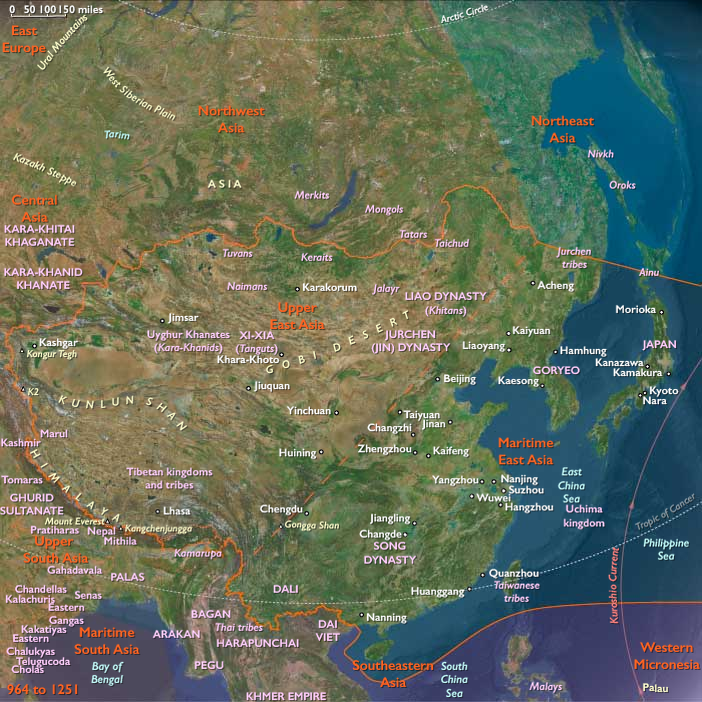
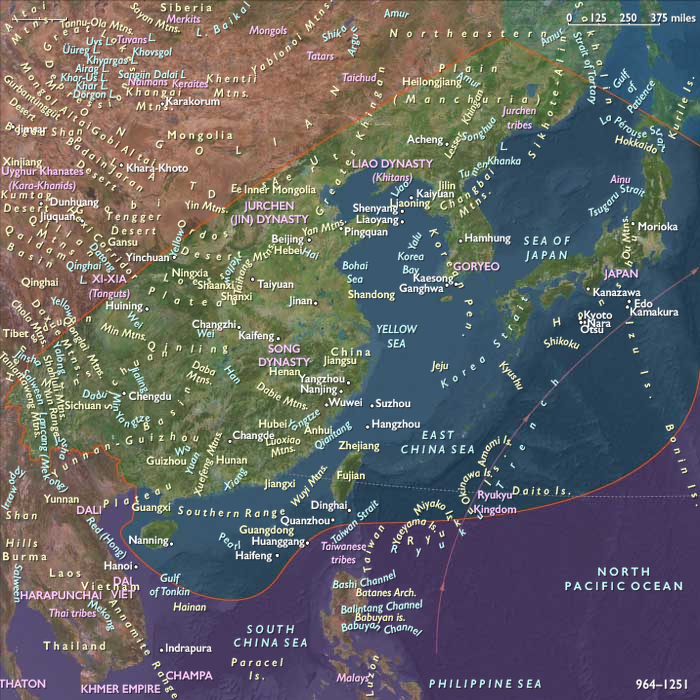
Emperor Taizu, who has established the core Song Ancestor Rules and Policy for future emperors, has expanded the examination system such that most of the civil service are recruited through the exams (in contrast to the Tang where less than ten percent of the civil servants had come through exams).
He has also created academies that allow a great deal of freedom of discussion and thought, which facilitate the growth of scientific advance, economic reforms as well as achievements in arts and literature.
He is perhaps best known for weakening the military and so preventing anyone else rising to power as he did.
Locations
People
Groups
- Khitan people
- Chinese (Han) people
- Liao Dynasty, or Khitan Empire
- Tang, Southern
- Northern Han
- Chinese Empire, Pei (Northern) Song Dynasty
Subjects
Regions
Subregions
Related Events
Filter results
Showing 10 events out of 52444 total
The Later Zhou Dynasty had been the last of the Five Dynasties that had controlled northern China after the fall of the Tang Dynasty in 907.
Zhao Kuangyin, later known as Emperor Taizu, had usurped the throne with the support of military commanders, initiating the Song Dynasty.
Upon taking the throne in 960, his first goal had been the reunification of China after half a century of political division.
This included the conquests of Nanping, Wu-Yue, Southern Han, Later Shu, and Southern Tang in the south as well as the Northern Han and the Sixteen Prefectures in the north.
During the first couple decades of rule, relations between the Song and the Liao dynasty, a Khitan empire in northern China that rules over the regions of Manchuria, Mongolia, and parts of northern China proper, have been relatively peaceful, the two outstanding issues of the Northern Han—the remnant of the Later Han Dynasty that had been toppled in 950—and Sixteen Prefectures—a disputed region in northern China stretching from present-day Beijing westward to Datong—notwithstanding.
The two begin exchanging embassies on New Years Day, 974.
However, this peace is an illusion as the Song state is more concerned with consolidating the south.
With capable military officers, the Song military has become the dominant force in China.
Techniques of warfare such as defending supply lines across floating pontoon bridges have led to success in battle; such is the case in the Song assault against the Southern Tang state while crossing the Yangtze River in 974.
Otto II will spent his reign continuing his father's policy of strengthening imperial rule in Germany and extending it deeper into Italy.
Difficulties arise for Otto in southern Germany, probably owing to his refusal to grant the duchy of Swabia to his cousin Henry II of Bavaria, who had succeeded his father at the age of four, under the guardianship of his mother Judith, and eventually married Gisela of Burgundy, a niece of the empress Adelaide, who is perhaps the most prominent European woman of the tenth century.
In 974, Judith sets up a conspiracy against the emperor, which includes Henry, Bishop Abraham of Freising, the dukes of Bohemia and Poland, and several members of the clergy and the nobility who are discontented by the previous emperor's policies.
The plan is discovered and easily suppressed, however.
Henry, known as the Wrangler, is taken captive in Ingelheim, but escapes and instigates a revolt in Bavaria.
In 974 also, Otto's forces successfully had opposed an attempt by Harald Bluetooth of Denmark to throw off the German yoke.
Otto’s expedition against the Bohemians in 975 is a partial failure, however owing to the outbreak of further trouble in Bavaria.
Record of Benedict’s reign as pope is scant.
There is a letter dated to Benedict’s reign from Piligrim, Bishop of Passau, asking for Benedict to confer on him the Pallium, and make him a Bishop so that he could continue his mission to convert the Hungarian people to Christianity.
However, the response from Benedict is considered to be a forgery.
He is also known to have confirmed privileges assumed by certain monasteries and churches.
At the request of King Lothair of France and his wife, Benedict placed the monastery of Blandin under papal protection.
There is also a papal bull from Benedict in which Frederick, Archbishop of Salzburg and his successors are named Papal vicars in the former Roman provinces of Upper and Lower Pannonia and Noricum; however, the authenticity of this bull is disputed.
Otto I had died soon after Benedict's election in 973, and with the accession of Otto II, troubles with the nobility emerged in Germany.
With the new emperor so distracted, a faction of the Roman nobility opposed to the interference of the German emperors in Roman affairs, took advantage of the opportunity to move against Benedict VI.
Led by Crescentius the Elder and the Cardinal-Deacon Franco Ferrucci (who had been the preferred candidate of the anti-German faction), Benedict is taken in June 974, and imprisoned in the Castel Sant'Angelo, at this time a stronghold of the Crescentii.
Ferrucci is then proclaimed as the new pope, taking the name Boniface VII.
Hearing of the overthrow of Benedict VI, Otto II sends an imperial representative, Count Sicco, to demand his release.
Unwilling to step down, Boniface orders a priest named Stephen to murder Benedict while he is in prison, strangling him to death.
Benedict is succeeded, after the overthrow of the Antipope Boniface VII, by Pope Benedict VII.
An offensive by the Spain-based Umayyads brings the Maghribi Idrisid dynasty to an end in 974.
The flow of Islamic silver through Russia to Scandinavia had dried up at the exhaustion of the Muslim’s world’s silver mines in about 965, prompting the Scandinavians to seek new sources of silver—the main fuel of the Scandinavian economy for the last century—through raiding in the west.
Hedeby, the largest Nordic city during the Viking Age and the oldest city in Denmark, had developed as a trading center at the head of a narrow, navigable inlet known today as the Schlei which connects to the Baltic Sea. With no silver to coin, the mint at Hedeby had sonn ceased operations.
The location of Hedeby is favored because there is a short portage of less than fifteen kilometers to the Treene River which flows into the Eider with its North Sea estuary, making a convenient place where goods and Viking ships can be ported overland for an almost uninterrupted seaway between the Baltic and the North Sea and avoiding a dangerous circumnavigation.
The Saxons in 974 take Hedeby from the Danes.
Haakon goes to Denmark around 973-974 to help Harald Bluetooth in his defense against the Emperor Otto I, whose forces successfully oppose an attempt by Harald to throw off the German yoke.
After this, Haakon pays no taxes to Denmark.
When Haakon is in Denmark, Harald Bluetooth forces him to accept baptism and assigns him clergymen to take to Norway to spread Christianity.
When a favorable wind comes for Haakon to leave, he commands the clergymen to return ashore.
The Song army has crisscrossed China, conquering one kingdom after another; the Southern Tang kingdom falls in 975.
Within two decades, the Song state has been able to incorporate the southern kingdoms into its realm, unifying nearly all of traditional Chinese lands.
Southern Tang poet-king Li Yu, reportedly virtuous and skilled in letters, calligraphy, and painting, has passed his idyllic life in his palace in Nanjing (Nanking), reading Buddhist texts, drinking with his officials, and watching dancing girls.
Following his kingdom’s defeat by the Song in 975, he is imprisoned in the Song capital, and begins writing a series of lyrically beautiful poems in the ci style (forty-five of which survive) expressing his deep longing for the life that could no longer be.
It is not known when and how the kingdom of Sweden was born, but the list of Swedish monarchs is drawn from the first kings known to have ruled both Svealand (Sweden) and Götaland (Gothia) as one province, beginning with Eric the Victorious.
Sweden and Gothia were two separate nations long before that into antiquity.
It is not known how long they existed: the epic poem Beowulf describes semi-legendary Swedish-Geatish wars in the sixth century.
"Götaland" in this sense, mainly included the provinces of Östergötland (East Gothia) and Västergötland (West Gothia).
The island of Gotland is disputed by other than Swedes, at this time (Danish, Hanseatic, and Gotland-domestic).
Småland is at this time of little interest to anyone due to the deep pine forests, and only city, Kalmar with its castle, is of importance.
The southwest parts of the Scandinavian peninsula consist of three Danish provinces (Scania, Blekinge and Halland).
North of Halland, Denmark has a direct border to Norway and its province Bohuslän.
There are Swedish settlements in southwest Finland, and along the southern coastline of Norrland.
The culture and history of Svealand has been preserved better than that of Götaland.
The Imperial abbeys and the Imperial court have become the centers of religious and spiritual life, led by the example of women of the royal family.
A limited renaissance of the arts and architecture has depended on court patronage of Otto I and his immediate successors.
The "Ottonian Renaissance" is manifest in some revived cathedral schools, such as that of Bruno I, Archbishop of Cologne, who died in 965, and in the production of illuminated manuscripts, the major art form of the age, from a handful of elite scriptoria, such as that at Quedlinburg Abbey, founded by Otto in 936.
Ottonian illuminators are less concerned with naturalism and more with expression through sober, dramatic gesture and heightened coloration.
Years: 974 - 974
Locations
People
Groups
- Khitan people
- Chinese (Han) people
- Liao Dynasty, or Khitan Empire
- Tang, Southern
- Northern Han
- Chinese Empire, Pei (Northern) Song Dynasty
