Emperor Taizong issues a decree throughout China …
Years: 642 - 642
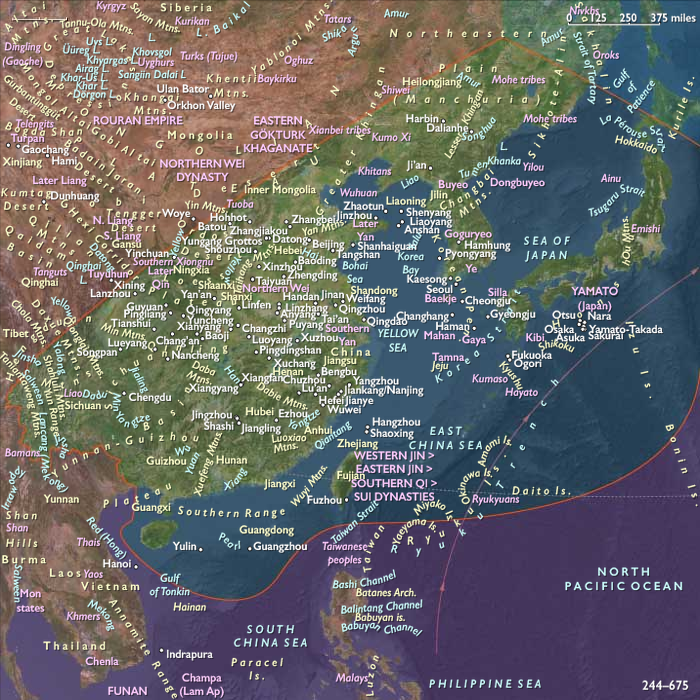
Emperor Taizong issues a decree throughout China that increases the punishment for men who deliberately inflict injuries upon themselves (most commonly breaking their own legs) in order to avoid military conscription.
This decree is an effort to eradicate this practice, which has grown as a trend since the time of the rebellion against the Sui Dynasty.
Locations
People
Groups
Topics
Subjects
Regions
Subregions
Related Events
Filter results
Showing 10 events out of 56521 total
King Yeongnyu of Goguryeo, apprehensive about his general Yeon Gaesomun, is plotting with his other officials to kill him in the winter of 642.
When Yeon receives the news, he arranges a lavish banquet to celebrate his rise to the position of Eastern Governor to which one hundred of the opposing politicians of the kingdom are invited.
Yeon's soldiers ambush and kill all one hundred ministers present.
Yeon then proceeds to the palace and murders the king.
According to traditional Chinese and Korean sources, Yeon's men dismembered the dead king's corpse and discarded it without proper ceremony.
After placing a nephew of King Yeongnyu on the Goguryeo throne as King Bojang, Yeon appoints himself Dae Mangniji (Generalissimo).
Subsequently, in this role Yeon goes on to assume de facto control over Goguryeo affairs of state until his death around 666.
Radulf rebels in 642 against Sigebert of Austrasia and defeats his army, taking the title of rex or king of Thuringia.
His success is usually considered an indicator of the roi fainéant phenomenon and of undoing of the Merovingians' accomplishments.
Radulf dies soon after this; his sons, Theotbald and Heden I, succeed him.
Valentinus is by early 642 the most powerful man in the Empire, and is apparently rendered quasi-imperial honors, most notably by being allowed to wear the imperial purple.
At the same time, he is appointed commander-in-chief of the imperial army, and his daughter Fausta is married to the young Emperor Constans II and proclaimed Augusta.
The regime establishes a new civil-military defensive organization based upon geographical military districts called themes, or thema.
Imperial forces maintain the frontier along the line of the Taurus Mountains in southern Anatolia.
Under Constans, the imperial forces completely withdraw from Egypt in 642, and Caliph Uthman launches numerous attacks on the islands of the Mediterranean Sea and Aegean Sea.
The Muslim Arabs seize Egypt from the Empire in the second year of Constans’ reign.
Hormuzan, a wealthy nobleman from Mihragan-kadag, serves as satrap of Khuzestan, one of the richest in Iran.
He is from one of the seven Parthian clans of the Sasanian Empire and is the brother-in-law of Khosrau II and the maternal uncle of Kavadh II.
Being proud of this rich heritage, Hormuzan is permitted to wear a crown upon his head; however, it is smaller than the king's.
At the battle of al-Qādisiyyah, he had commanded the right flank of the army and was defeated.
Hormuzan, however, had regrouped and fought at the battle of Jalula but also suffered defeat.
He then escaped from the region, while many of his forces had been captured and killed by the Arab Muslims.
In 642, he leads the resistance in Shushtar against the Arabs but later surrenders.
Hormuzan is then given a pension, but initially refuses to convert to Islam for some time.
He only converts after being told that he should choose between death and Islam.
The Muslim Arab army in Persia, supposedly outnumbered five to one, feigns defeat on the battlefield, withdraws with the Persians in hot pursuit, surprises them amid two mountain passes, and decisively defeats them in 642 at the Battle of Nahavand, killing about one hundred thousand.
Various versions are told about Nahāvand and how the battle was ensued in the early stages.
Some note that the Muslim Arabs, under Sa`d ibn Abi Waqqas, managed to deceive the Persians through a ruse, that Caliph Umar had died.
The Persian cavalry, full of confidence, mounted an ill-prepared pursuit of the Bedouins who swiftly retreated to a safe area and eventually surrounded and trapped the Persian force before assailing it from all sides, and decisively defeating it.
As the historian Tabari mentions, the Persians were never again able to unite their men in such numbers and many were already talking of dissolving the Empire and going their separate ways when the battle was commencing.
Many of Yazdegerd's military and civilian officials have abandoned him.
Nahāvand marks the dissolution of the Sassanian Imperial army, with the fall of the last of the grand marshals of the army and the rise of warlordism among the Persians.
Yazdegerd attempts to raise troops by appealing to other neighboring areas, such as the princes of Tukharistan and Sogdia, and will eventually send his son Peroz III to the Tang court, but without any success.
The Muslim Arabs follow their victory at Navahand with the conquest of Isfahan, located on the north bank of the Zayandeh River (about two hundred miles/three hundred and twenty kilometers south of present Tehran), and make it a provincial capital.
Pulakesi’s brother Vishnuvardhana rules over a kingdom extending from Nellore to Visakhapatnam.
He assumes the title of Vishamasiddhi (conqueror of difficulties).
Vishnuvardhana participated in the wars between his brother and the Pallava Narasimhavarma I and probably lost his life in battle in 641.
On the death of Pulakesi II, the Vengi Viceroyalty develops into an independent kingdom under Vishnuvardhana’s son Jayasimha.
Narasimhavarman, still seething at the Chalukyas’ seizure in 624 of the Visnukindin east coast kingdom of Vengi, which the Pallavas had themselves coveted, raids the Deccan area from 641 to 647, capturing large areas of Chalukya territory, conquering the temple-fort of Vatapi (Badami) in 642 and killing Pulakesi.
There is a period of confusion following the crushing defeat of the Chalukyas and the burning of Badami.
The five sons of Pulakesi fight among themselves and try to divide the kingdom into independent kingdoms.
Pulakesi's third son Vikramaditya I becomes the Chalukya king around 642 and eventually restores order after defeating his brothers.
The Christian Ethiopian kingdom centered at Axum is severed from the outside world by the Muslim conquest of Egypt.
Amr ibn al-'As sends an Arab expedition of twenty thousand horsemen under his cousin Uqba ibn Nafi to Makuria.
The Nubians strike hard against the Muslims near Dongola with hit-and-run attacks.
According to historian Al-Baladhuri, the Muslims found that the Nubians fought strongly and met them with showers of arrows.
The majority of the Arab forces returned with wounded or blinded eyes.
It is thus that the Nubians are called 'the pupil smiters'.
The Nubian victory at Dongola is one of the Rashidun Caliphate's rare defeats during the mid-seventh century.
With their archers' deadly accuracy plus their own experienced cavalry forces, Makuria is able to shake the Amr's confidence enough for him to withdraw his forces from Nubia.
Arab sources claim that the expedition into Nubia was not a Muslim defeat while at the same time acknowledging it was not a success.
The expedition into Nubia, like as the more successful expedition into the imperial lands of North Africa, is undertaken by 'Amr ibn al-'As on his own accord.
He believes that they will be easy victories and will inform the caliph after the conquests.
The Arab sources also make it clear there were no pitched battles in Nubia.
Yet, they do mention an encounter whereupon Uqba ibn Nafi and his forces happened upon a concentration of Nubians that promptly gave battle before the Muslims could attack.
In the ensuing engagement, he claims two hundred and fifty Muslims lost their eyes.
Arab sources lend more credit to Nubian guerrilla tactics than a single decisive engagement.
They claim that the Nubians would call out to their Muslim adversaries from afar where they would like their arrow wound.
The Muslims would jokingly respond, and the arrow would strike them there invariably.
This statement, along with a claim that Nubian horsemen were superior to Muslim cavalry in hit-and-run tactics, was used to support their position that the Nubians were besting them in skirmishes and not all-out battles.
Regardless of the situation, Uqba ibn Nafi was unable to succeed with his expedition and wrote back to his cousin that he could not win against such tactics and that Nubia was a very poor land with no treasure worth fighting for.
Uqba may not have been exaggerating, since Nubia is surrounded by formidable deserts.
Upon receiving this news, Amr bin al-As asks his cousin to withdraw, which he does.