Emperor Manuel II Palaiologos withdraws from state …
Years: 1421 - 1421
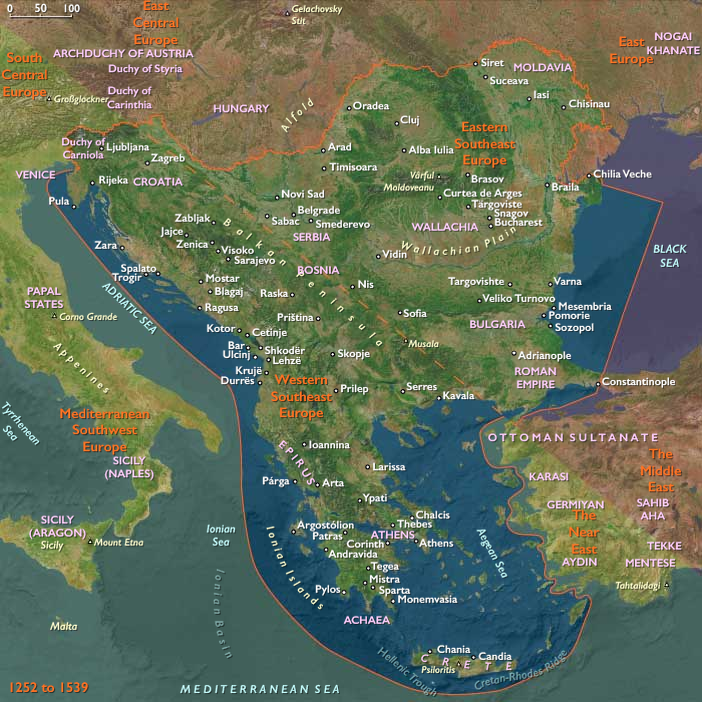
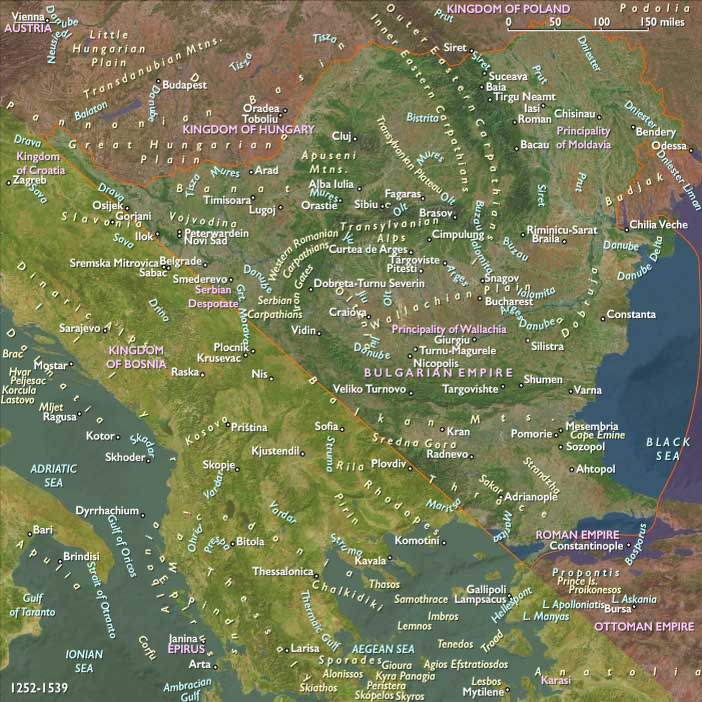
Emperor Manuel II Palaiologos withdraws from state affairs to pursue his religious and literary interests.
His son John VIII, crowned co-emperor in 1421, ignores the tenuous bond with the Ottomans that has been established and in this year supports the pretender Mustafa against the rightful heir to the Turkish throne, Murad II, in hope of causing disruption within the ranks and leadership of the Ottoman Empire.
However, …
Locations
People
Groups
Topics
Commodoties
Subjects
Regions
Subregions
Related Events
Filter results
Showing 10 events out of 42174 total
The Ming dynasty’s Yongle Emperor orders principal envoy grand eunuch Li Xing and grand eunuch Zhou Man of Zheng He's fleet to convey an imperial edict with hats and robes to bestow on the king of Aden in 1421.
The envoys board three treasure ships and set sail from Sumatra to the port of Aden.
This event is recorded in the book Ying-yai Sheng-lan by Ma Huan, who accompanies the imperial envoy.
Yongle moves the Ming capital northward to Beijing in 1421 and begins a grand reconstruction of the city, erecting a group of imperial buildings within Beijing’s Inner City.
Walls up to thirty-five feet (eleven meters) high enclose the complex, called the Forbidden City, whose buildings consist of palaces, shrines, and halls with white marble terraces, yellow-tiled roofs, and formal gardens.
…Murad is placed on the throne by non-Ottoman but politically powerful Turkish notables who had joined the Ottoman state during the first century of its existence.
Murad, only eighteen when he becomes sultan, soon begins to resent the power they have gained in return.
He counters by beginning to build up the power of various non-Turkish groups in his service, particularly those composed of Christian slaves and converts to Islam, whose military arm is the Janissary corps.
Peaceful relations persist between Constantinople and the Ottoman Empire until May 26, 1421, when Mehmed dies.
The reign of Mehmed I as sultan of the reunited empire had lasted only eight years before his death, but he had also been the most powerful brother contending for the throne and de facto ruler of most of the empire for nearly the whole preceding period of elevenyears of the Ottoman Interregnum that passed between his father's captivity at Ankara and his own final victory over his brother Musa Çelebi at the Battle of Çamurlu.
Mehmed is buried in Bursa, in a mausoleum erected by himself near the celebrated mosque which he built there, and which, because of its decorations of green porcelain, is called the Green Mosque.
Mehmed I also completed another mosque in Bursa, which his grandfather Murad I had commenced but which had been neglected during the reign of Bayezid.
Mehmed had founded in the vicinity of his own Green Mosque and mausoleum two other characteristic institutions, one a school and one a refectory for the poor, both of which he has endowed with royal munificence.
The death of Kara Koyunlu ruler Qara Yusuf in 1420 had left his sons Ispend bin Yusuf, Qara Iskander, Jahan Shah and Abu Sa’id bin Yusuf fighting over the succession.
The Sa’dlu tribe, one of the main sub-tribes of the Kara Koyunlu, had declared Ispend as the new chief.
Abu Sa’id had to flee and Jahan Shah had gone to Baghdad.
Qara Iskander was thus left with Azerbaijan and Tabriz as its capital while Ispend was left with Iraq with Baghdad as his capital.
Iskander and Ispend had joined together to fight the Ak Koyunlu who were invading from the west, and defeated them.
The Timurid Shah Rukh takes advantage of the weakened state of the Kara Koyunlu to invade their land, crossing the Aras River and defeating the forces of Iskander and Ispend in a battle at Yahsi on July 28–29, 1421.
He briefly occupies Azerbaijan and Armenia, then withdraws once more to Khorasan.
At this point, Ispend quickly reoccupies Tabriz.
However, Iskander follows him and fights with him, taking the city and establishing himself as ruler of the Kara Koyunlu.
Bern had expanded and become a major city-state north of the Alps by the fifteenth Century.
To celebrate the city’s growing power and wealth, plans have been made to build a new and larger church.
On March 11, 1421 construction begins on the cathedral under the direction of the Strasbourg master builder Matthäus Ensinger, who has already built three other cathedrals.
During construction, services will be held in the old chapel while the new cathedral is built up around it.
The first church on the site of the present Bern Minster probably was a small chapel built during the founding of Bern (1191).
The first church of Bern was a romanesque building which was probably built between 1155-1160, but is first mentioned in 1224.
This church is outside the city walls, near what is now Kreuzgasse.
The nave of this first church was about 16.5 meters (fifty-four feet) long by six meters (twenty feet) wide.
Bern had broken away from the parish of Köniz in 1276 to become an independent parish.
For this new role, a larger church would have been necessary.
It appears likely that construction on the second church began immediately.
However, it isn't mentioned until 1289 in writings of Bishop Benvenutus von Eugubio.
This new church was a three nave building, with a length of 29.5 meters (ninety-seven feet), a width of 24.5 m (eighty feet) of which the middle nave was 11.1 m (thirty-six feet) wide.
The bell tower was located in the middle of the northern side nave, and filled part of the central nave.
An earthquake on October 18, 1356, caused extensive damage to the church walls, arches and tower.
Repairs proceeded slowly.
The choir was rebuilt in 1359 and the roof was rebuilt in 1378-80.
During the early stages of construction of the Minster, this church is still being used.
The nave will finally be demolished between 1449–51 and the tower will remain until 1493.

Filippo Brunelleschi had designed the massive octagonal dome of Florence’s Gothic cathedral of Santa Maria del Fiore in about 1420.
The Florentine architect intends the vast dome, left unfinished in the fourteenth century because of seemingly insoluble structural problems, to be a self-supporting double shell using new and lighter masonry, and devises new scaffolding and hoists to accomplish this.
The first Italian patent is awarded by the Republic of Florence in 1421, when Brunelleschi receives a three-year patent for a barge with hoisting gear, that carries marble along the Arno River.
He astonishes his contemporaries by completing the soaring structure—one hundred and thirty feet (thirty-nine meters) in diameter and three hundred feet (ninety-one meters) high, with a fifty-two-foot (sixteen-meter) lantern crowning it—without centering (supporting scaffolding).
Brunelleschi begins work in 1421 on the church of San Lorenzo, created, like his Ospedale degli Innocenti, in a new style, employing the details of classical architecture—columns, arches, and pilasters—with a fresh approach, each element being distinctly and visibly in proportion with all other elements.
Brunelleschi designs the church as a three-aisled, Latin cross plan with transept; the unifying elements in it are the square module on which all of the church is designed and the consistent application of the classical orders.
Thomas of Lancaster, Duke of Clarence: Military Leadership and Political Divisions (1387–1421)
Thomas of Lancaster, Duke of Clarence (1387–1421), was the second son of King Henry IV of England and Mary de Bohun. He played a key role in English politics and military campaigns in France during the Hundred Years' War, particularly under his older brother, Henry V.
I. Early Life and Political Conflicts
- Thomas was born before November 25, 1387, as evidenced by a payment recorded in his father’s accounts to his nurse on that date.
- In November or December 1411, he married Lady Margaret Holland, widow of John Beaufort, 1st Earl of Somerset, and daughter of Thomas Holland, 2nd Earl of Kent.
- Although they had no children, Thomas became stepfather to Margaret’s six children from her first marriage.
- He had one illegitimate son, Sir John Clarence ("the Bastard of Clarence"), who would fight alongside him in France.
- Thomas became politically involved during his father’s illness (1411), when conflicts arose between his elder brother Henry, Prince of Wales (the future Henry V), and their father, King Henry IV.
- Henry, as Prince of Wales, sought to declare war on France, but his father opposed it.
- When Henry defied the king and persuaded the royal council to declare war, he was removed from the council, and Thomas took his place, aligning with his father’s peace policy.
II. Military Role Under Henry V
- When Henry V launched his French campaign (1415), Thomas joined him in securing English dominance in Normandy.
- Siege of Rouen (July 1418 – January 1419)
- Thomas commanded the besieging forces during the English capture of Rouen, one of the most crucial victories of the Hundred Years’ War.
- The fall of Rouen solidified English control over Normandy, bringing Henry closer to his goal of securing the French throne.
- Treaty of Troyes (1420)
- Thomas played a role in the negotiations of the Treaty of Troyes, in which Henry V was declared heir to the French throne and married Catherine of Valois, daughter of King Charles VI of France.
III. The French Resistance and the Role of the Scots
- The French Dauphin Charles (the future Charles VII), disinherited by the Treaty of Troyes, refused to accept English rule and continued to lead resistance in southern France.
- The French cause was strengthened by a Scottish army, led by John Stewart, Earl of Buchan, which provided critical reinforcements to the Dauphin’s forces.
- Thomas of Clarence, now one of England’s top commanders in France, would soon face his greatest challenge in battle against these combined forces.
IV. Legacy and the Continuing Conflict
- Thomas was one of England’s most experienced military leaders, but his impulsiveness in battle would ultimately lead to his downfall in 1421 at the Battle of Baugé.
- His rivalry with the Scottish forces, particularly under John Stewart, Earl of Buchan, played a key role in the next phase of the war.
- His death would be a major setback for the English, marking the first major French victory since Agincourt and shifting momentum toward the Dauphin’s forces.
By 1421, Thomas of Lancaster had risen to great prominence as an English military leader, but his impending fate in battle would mark a turning point in the Hundred Years’ War.
The Bedford Master and the Evolution of Portraiture in Manuscript Illumination (15th Century)
During the early 15th century, actual portraits began appearing in illuminated manuscripts, marking a significant shift in medieval art toward individualized representation. This development can be seen in the works of the Limbourg brothers, particularly in Très Riches Heures du Duc de Berry, and in the Bedford Workshop, named after the illuminations commissioned by John of Lancaster, 1st Duke of Bedford.
The Bedford Master, the principal illuminator of the Bedford Hours (British Library, Add. MS 18850) and the Salisbury Breviary (Bibliothèque nationale de France, MS lat. 17294), was a key figure in this artistic evolution.
I. The Bedford Master and His Workshop
- The Bedford Master was an illuminator active in Paris between 1415 and 1435, producing works for English and French noble patrons.
- His name comes from two major commissions for John, Duke of Bedford, the English regent of France during the Hundred Years’ War:
- The Bedford Hours (before 1422) – A luxurious book of hours featuring portraits within initials.
- The Salisbury Breviary – Another highly detailed manuscript, now housed in the Bibliothèque nationale de France.
- His workshop was a large collaborative enterprise, employing numerous assistants, including the Chief Associate of the Bedford Master.
II. The Evolution of Portraiture in Manuscripts
- The Bedford Hours (executed before 1422) features portraits of donors and noble patrons within decorated initials.
- This trend reflected a new emphasis on individual identity and dynastic representation, coinciding with:
- The rise of personal piety among nobility.
- The growing interest in realism and naturalistic depictions in art.
- The influence of contemporary panel painting and sculpture, which also saw a shift toward individualized portraiture.
III. The Bedford Trend and Later Developments
- Art historians now refer to the "Bedford Workshop" rather than a single "Bedford Master", acknowledging the collaborative nature of manuscript production.
- Millard Meiss (1967) introduced the term "Bedford Trend", recognizing a wider stylistic period leading up to the Bedford manuscripts.
- A "Master of the Bedford Trend" has been proposed for some of the later works.
IV. The Identity of the Bedford Master
- One potential candidate for the Bedford Master is Haincelin of Hagenau, a documented Alsatian illuminator active in Paris between 1403 and 1424.
- His son, Jean Haincelin, was active from at least 1438 to 1449 and may have been the "Dunois Master,"associated with a group of late Bedford-style manuscripts.
V. The Impact of the Bedford Workshop on 15th-Century Art
- The Bedford Workshop’s innovations in portraiture influenced later Netherlandish and French manuscript illumination.
- The trend toward realism and individuality in manuscripts mirrored developments in panel painting, leading toward the Renaissance tradition of portraiture.
The Bedford Master and his workshop played a crucial role in the emergence of individualized portraiture in manuscripts, bridging medieval decorative traditions with the realism of early Renaissance art.
The Battle of Baugé (March 21, 1421): The English Defeat and the Death of the Duke of Clarence
The Battle of Baugé, fought on March 21, 1421 (Easter Saturday), was a decisive Franco-Scottish victory during the Hundred Years’ War, marking England’s first major defeat since Agincourt (1415). The battle was largely determined by the rash leadership of Thomas, Duke of Clarence, brother of King Henry V of England, who led a reckless charge with insufficient forces and was killed in battle.
I. The English Chevauchée and the Approach to Battle
- Clarence, following King Henry V’s orders, led 4,000 men in a devastating chevauchée through Anjou and Maine, encountering little resistance.
- By March 21, 1421 (Good Friday), his forces camped near the town of Vieil-Baugé.
- Meanwhile, a Franco-Scottish force of around 5,000 men, commanded by:
- John Stewart, Earl of Buchan (leading the Scots).
- Gilbert Motier de La Fayette, the new Constable of France.
- The Franco-Scottish force moved into the area to block further English advances.
II. The Dispersed English Forces and Clarence’s Rash Decision
- The English army was scattered, as many of the archers had ridden off in search of plunder and forage.
- On Easter Saturday, Clarence’s scouts captured a Scottish man-at-arms, revealing the presence of the Franco-Scottish army.
- Clarence faced a dilemma:
- A battle on Easter Sunday was unthinkable due to its religious significance.
- A two-day delay was also unacceptable, as it would allow the Franco-Scots time to strengthen their position.
- Walter Bower’s chronicles suggest that a brief truce was agreed upon, but battle nevertheless commenced that same day.
III. The Reckless Charge and the Battle at the Bridge
- Ignoring the advice of his lieutenants, Huntingdon and Gilbert Umfraville, Clarence ordered the Earl of Salisbury to round up the archers and follow as soon as possible.
- With only 1,500 men-at-arms and virtually no archers, Clarence charged the Franco-Scottish lines, underestimating their strength.
- A hundred Scottish archers, led by Sir Robert Stewart of Ralston, along with the retinue of Hugh Kennedy, held the bridge long enough for the Earl of Buchan to rally the main force.
- When Clarence finally forced his way across, he was confronted by the bulk of the Franco-Scottish army, whose men-at-arms had dismounted and were protected by archers.
IV. The Death of the Duke of Clarence
- In the melee, John Carmichael of Douglasdale broke his lance unhorsing Clarence.
- Several versions exist of how Clarence met his death:
- Bower’s account: Scottish knight John Swinton wounded Clarence in the face, but Alexander Buchanan struck the fatal blow with a mace, then raised Clarence’s coronet on his lance in triumph.
- Another tradition states Alexander Macausland of Lennox killed Clarence.
- French chronicler Georges Chastellain attributes Clarence’s death to a Frenchman.
V. Salisbury’s Counterattack and the English Retreat
- Later that evening, the Earl of Salisbury regrouped the remaining English forces, using his archers to cover the retreat.
- He managed to rescue the surviving English troops and retrieve Clarence’s body.
- Despite this, the battle ended in a decisive Scottish-French victory.
VI. Consequences of the Battle
- First major English defeat since Agincourt (1415), shattering the illusion of English invincibility.
- Boosted Franco-Scottish morale, securing Charles VII’s resistance against English occupation.
- Clarence’s death weakened English leadership in France, as he had been one of Henry V’s most experienced commanders.
- Strengthened the reputation of the Scottish forces, who were crucial in defending the French Dauphin’s cause.
The Battle of Baugé (March 21, 1421) was a turning point, demonstrating that the English war machine was not invincible and that the Franco-Scottish alliance could effectively challenge English advances.