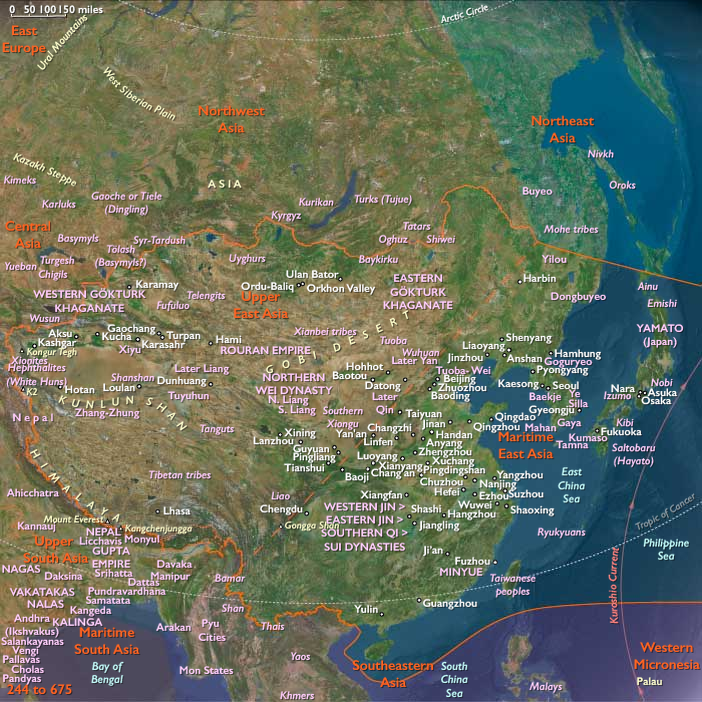
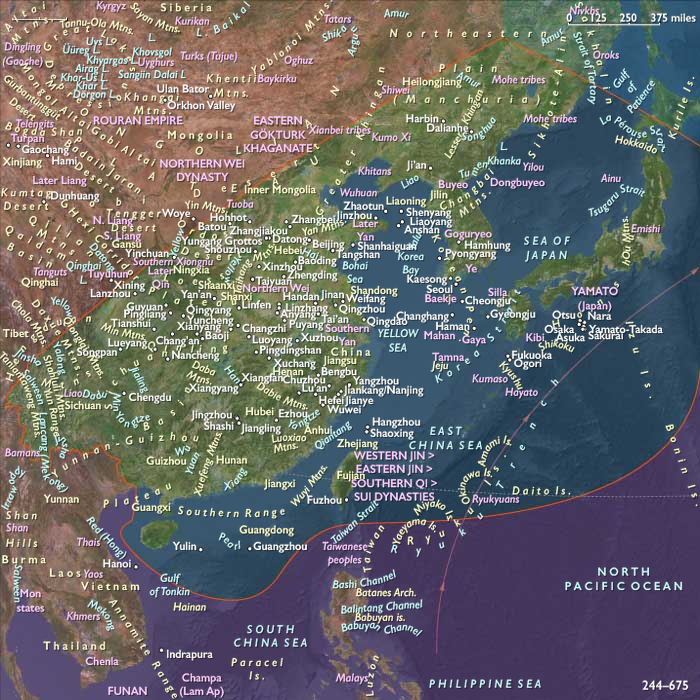
Emperor Kōtoku has Soga no Kurayamada accused …
Years: 649 - 649
July
Emperor Kōtoku has Soga no Kurayamada accused of treason; Kurayamada strangles himself at the temple of Yamada-dera.
Other relatives of the Soga clan are captured and executed.
Locations
People
Groups
Topics
Subjects
Regions
Subregions
Related Events
Filter results
Showing 10 events out of 56440 total
Constans, who had not approved the election of Pope Martin as the successor to Pope Theodore I, holds to the old conception of a single Roman Empire comprising East and West: he orders the pope's arrest.
Arab naval forces under Abdullah ibn Sa'ad conquer Cyprus, sacking the capital Constantia after a short siege and pillaging the rest of the island.
The Cypriots agree to pay the same revenue as they have done to emperor Constans II.
The destruction of the capital causes the permanent abandonment of the city, whose inhabitants move to Arsinoë (Famagusta).
Muawiyah had been appointed as the governor of Syria in 639, by the second caliph, Umar, after his brother the previous governor Yazid ibn Abi Sufyan, and the governor before him Abu Ubaidah ibn al-Jarrah, had died in a plague along with twenty-five thousand other people.
'Amr ibn al-'As had been sent to take on the Roman Army in Egypt.
With limited resources, Muawiyah’s marriage to Maysum had been politically motivated, as she is the daughter of the chief of the Kalb tribe, a large Jacobite Christian Arab tribe in Syria.
The Kalb tribe had remained largely neutral when the Muslims first went into Syria.
After the plague that killed much of the Muslim Army in Syria, Muawiyah, through marrying Maysum, had started to work in cooperation with the local Christian population, using the Jacobite Christians against the Romans.
He has left the Roman and Persian administrative structures intact, being sure not to give his largely non-Muslims subjects any incentive to revolt.
The postal system, which had been created by Umar for military use, was now opened to the public by Muawiya.
When Uthman dismissed 'Amr ibn al-'As from the governorship of Egypt in 642, Muawiyah had asked him to join him in Syria.
Muawiya is one of the first in the Rashidun Caliphate to realize the full importance of having a navy; as long as the imperial fleet can sail the Mediterranean unopposed, the coast line of Syria, Palestine and Egypt will never be safe.
Muawiyah, along with Adbullah ibn Saad, the new governor of Egypt, had successfully persuaded Uthman to give them permission to construct a large fleet in the dockyards of Egypt and Syria Muawiyah in 649 sets up a navy manned by Christian sailors of the Monophysite, Coptic, and Jacobite Syrian persuasion, and Muslim troops.

Chindasuinth, smothering all opposition, has lent the Visigothic realm a peace and order not before known.
To continue this, he has his son Recceswinth, at the urging of Braulio of Zaragoza, crowned co-king on January 20, 649, and attempts to establish, as many before had, a hereditary monarchy.
His associate-son is from this date until his death the true ruler of the Visigoths, in name of his father until 653, the date of the old man's passing.
Despite his implacable politics, Chindasuinth is recorded in ecclesiastical annals as a great benefactor of the church, donating many lands and bestowing privileges.
He has improved the public estates with the confiscated goods of the dispossessed nobility and through improved taxation methods.
In the military arena, he has undertaken campaigns against rebellious Basques and Lusitanians.
As a legislator, he has promulgated many laws dealing with civil matters.
With the assistance of Braulio, bishop of Zaragoza, he has began the elaboration of a territorial code of law to cover both the Gothic population and the Hispano-Roman.
Thiswork, the Liber Iudiciorum, will be promulgated, in a rough form, in his second year.
It will undergo refinement throughout the rest of his reign and will be finished by his son in 654.
In 643 or 644 it had superseded both the Breviary of Alaric used by the natives and the Code of Leovigild used by the Goths.
Pope Martin, after succeeding Pope Theodore in July 649, convokes and presides over the Lateran Council of 649, a synod held in the Basilica of St. John Lateran to condemn Monothelitism, a Christology espoused by many Eastern Christians.
The council does not achieve ecumenical status in either East or West, but represents the first attempt of a pope to convene an ecumenical council independent of the Roman emperor.
Constans II orders Olympius, exarch of the Exarchate of Ravenna, to arrest pope Martin I on the grounds that the pope's election had not been submitted to the emperor for approval.
Constans is upset with Martin's condemnation of the Monothelite heresy; he fears that it will resurrect the religious conflict that has plagued the empire.
Olympius attempts to gain the support of the citizenry of Rome, as well as the bishops; he also allegedly considers ordering the assassination of Martin.
None of his actions, however, meet with much success.
The Tang campaign against Kucha ends on January 19, 649, after the forces of Kucha surrender following a forty-day siege led by general Ashina She'er, establishing Chinese control over the northern Tarim Basin.
Emperor Taizong is seriously ill by summer of 649—with some believing that his illness is caused by his taking pills given to him by alchemists.
Believing Li Shiji to be capable but fearing that he would not be submissive to Li Zhi, he demotes Li Shiji out of the capital to be the commandant at remote Die Prefecture (roughly modern Gannan Tibetan Autonomous Prefecture, Gansu), with instructions to Li Zhi that if Li Shiji hesitates, to execute him immediately, and if he does not, to recall him after Emperor Taizong's death and make him chancellor.
Li Shiji, when receiving the order and realizing that his life is at stake, immediately departs for Die Prefecture.
(After Emperor Taizong's death, Li Zhi will indeed recall Li Shiji and make him chancellor.)
Soon thereafter, Emperor Taizong, after entrusting Li Zhi to Zhangsun Wuji and Chu, dies at his summer palace Cuiwei Palace.
His death is initially kept a secret, and three days later, after his casket has been returned to Chang'an, his death is announced, and Li Zhi takes the throne as Emperor Gaozong.
Cymbals, drums, and Persian harps with upper sound chests begin to enrich China’s music, following the Chinese conquest of the Kingdom of Kucha in eastern Turkestan.
The Karluks had allied with the Tiele and their leaders the Uyghurs against the Turkic Kaganate, and had participated in enthroning the victorious head of the Uyghur (Toquz Oghuz).
After that, a smaller part of the Karluks had joined the Uyghurs and settled around Bogd Khan Mountain in Mongolia, …