Emperor Justinian II, having formed the theme …
Years: 689 - 689
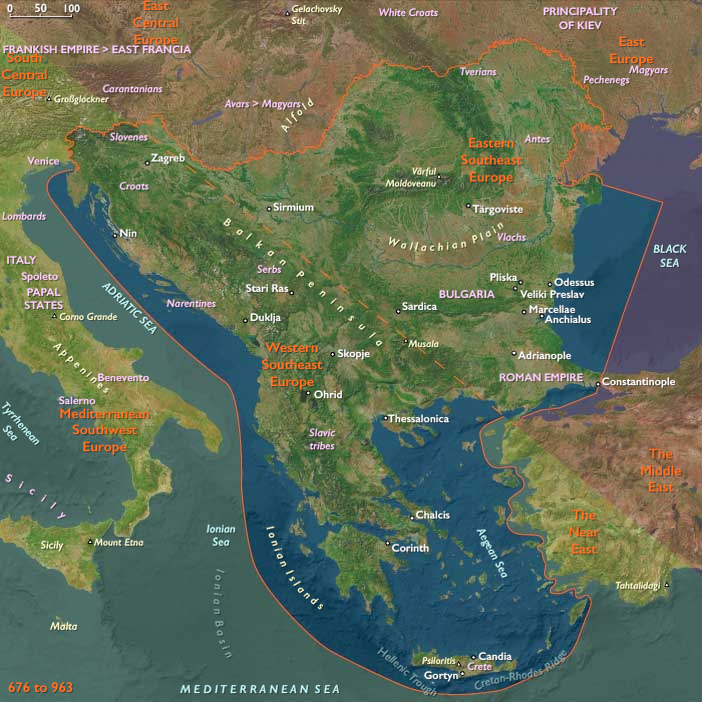
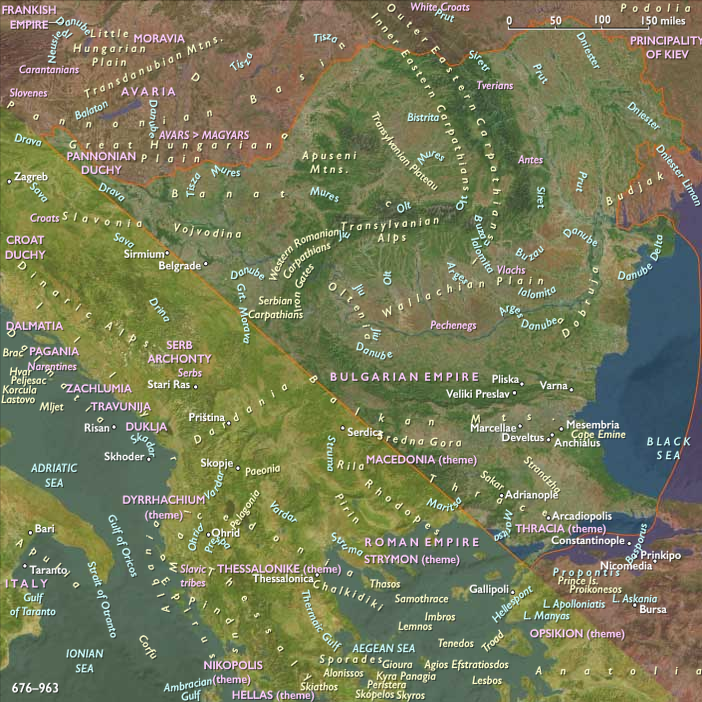
Emperor Justinian II, having formed the theme of Thrace in 687, leads a successful expedition in 688/689 into Slav-occupied territory in Thrace, drafting many Slavs into the imperial army or settling them as soldier-farmers in Asia Minor.
Locations
People
Groups
Topics
Subjects
Regions
Subregions
Related Events
Filter results
Showing 10 events out of 55954 total
'Abd al-Malik first takes the field against Mus'ab ibn al-Zubayr, governor of Iraq for his brother, the Meccan anti-Caliph Abdallah ibn al-Zubayr, but has to turn back to quell a rebellion in Damascus in 689.
Justinian II defeats the Bulgars of Macedonia with a great military campaign in 688–689, and is finally able to enter Thessalonica, the second most important imperial city in Europe.
Cunipert returns from exile and ousts Alahis from the Lombard capital, Pavia.
Alahis flees towards the east, into Austria, where he assembles an army to march against the king.
Within the same year, Alahis crosses the River Adda, the border between Neustria and Austria, and faces Cunipert in the plain of Coronate.
Wishing to spare the Lombard blood of so many, Cunipert offers to engage Alahis in single combat, but Alahis refuses and both camps prepare or battle.
Fearing for Cunipert’s life, a deacon named Seno begs the king to lend him his armor, so that he, the deacon, appears to be the king and distract all troubles from Cunipert.
Finally, Cunipert agrees to that plan and battle is joined.
Once Alahis spots the supposed king, he charges and kills him.
When Alahis is about to take off the helmet, and present to his troops the dead king, he realizes that he has only slain a cleric.
In fury, Alahis swears a horrible oath, as Paul the Deacon recorded, to “fill a whole well with the members of churchmen” if victorious.
Cunipert’s men are horrified by the news that the King had been killed, but Cunipert assures them all that he is alive and well.
Again the two hosts draw together for the battle, and again Cunipert renews his offer to settle the quarrel by single combat and spare the lives of the people, but Alahis again refuses to accept the challenge, this time alleging that he sees among the standards of his rival the image of the Archangel Michael.
The trumpets sound again for the charge, neither side giving way to the other, and a terrible slaughter is made of Lombard warriors, but at length Alahis falls, and the victory remains with Cunipert.
Of the fleeing troops of Alahis, those who are not killed by the sword drown in the River Adda.
The head and legs of Alahis are cut off, leaving only his trunk.
The body of the brave deacon Seno, however, is buried by the king’s order before the gates of the church of St. John.
Cunipert returns to Pavia in great triumph and afterward founds a monastery in honor of St. George the Martyr on the battlefield of Coronate in memory of his victory.

Dorestad: The Trading Hub of Northwestern Europe
Between the 7th and 9th centuries, Dorestad emerges as the largest emporium in northwestern Europe, thriving as a major North Sea trading center. Stretching three kilometers along the confluence of the Rhine and Lek rivers, southeast of Utrecht, it occupies a strategic position near the modern town of Wijk bij Duurstede in the Netherlands. Goods from the Middle Rhineland, including wine from vineyards south of Mainz, pass through its bustling markets, reinforcing its prominence in regional commerce.
A Contested Stronghold
Dorestad’s strategic and economic value makes it a frequent battleground. Between 600 and 719, the Frisians and the Franks repeatedly clash over control of the city. A Roman fortress, originally constructed during the Roman era, remains in use throughout the Early Middle Ages, providing a defensive stronghold for whichever power holds the settlement.
The Frisian rulers, whose exact titles vary by source, are often referred to as dukes in Frankish records, while other sources call them kings—reflecting the differing perspectives of Christianized Latin chroniclers and the Germanic pagan Frisians who likely viewed their leaders as monarchs.
The Fall of Frisian Control
In the late 7th century, Frisian ruler Radbod, who had sought to expel Christian influence from his realm and resist Frankish dominance, suffers a decisive defeat at the Battle of Dorestad (689) against Pepin of Herstal. As a result, Radbod is forced to cede West Frisia (Frisia Citerior)—the territory between the Scheldt and the Vlie—to the Franks, bringing a significant portion of the Frisian lands under Frankish rule.
Despite the changing political landscape, Dorestad remains a key economic hub, its mint further enhancing its influence across the region. However, its prosperity will eventually decline in the mid-9th century, as Viking raids and shifting trade routes weaken its prominence in European commerce.
The Battle of Tertry and the Ascendancy of Austrasia
In 681, Theuderic III, the Merovingian king of Neustria, and his mayor of the palace, Waratton, establish a fragile peace with Pepin of Heristal, the mayor of the palace of Austrasia. This temporary truce, however, unravels following Waratton’s death in 686, when his successor, Berthar, adopts an aggressive stance against Austrasia.
In 687, Berthar, alongside Theuderic III, leads the Burgundo-Neustrian army against Pepin of Heristal in a decisive confrontation at the Battle of Tertry, near Péronne. The result is a crushing Austrasian victory, cementing Pepin’s control over Neustria and Burgundy and effectively shifting the balance of power within the Frankish realm. With this triumph, Austrasia emerges as the dominant force in Francia, with its mayor now the true ruler of the kingdom.
Following Theuderic III’s death, his nine-year-old son, Clovis IV, inherits the throne of Austrasia in 691, though his rule is entirely nominal. Real authority rests with his uncle, Pepin of Heristal, who governs as the de facto ruler of the Frankish state, further solidifying the decline of Merovingian royal power and the rise of the Arnulfing dynasty.
...Cædwalla's departure in 688 appears to have led to instability in the south of England.
Ine, Cædwalla's successor, will abdicate in 726, and the West Saxon Genealogical Regnal List says that he reigned for thirty-seven years, implying his reign began in 689 instead of 688.
This could indicate an unsettled period between Cædwalla's abdication and Ine's accession.
The kingship had also changed in Kent in 688, with Oswine, who was apparently a Mercian client, taking the throne; and there is evidence of East Saxon influence in Kent in the years immediately following Cædwalla's abdication.
Northumbria and …
…Mercia conclude a truce in 689.
Empress Dowager Wu had been set to make sacrifices in 688 to the deity of the Luo River (flowing through the Henan province city of Luoyang, at this time the "Eastern Capital").
Wu had summoned senior members of Tang's Li imperial clan to Luoyang.
The imperial princes, worried that she planned to slaughter them and secure the throne for herself, plotted to resist her.
However, before a rebellion could be comprehensively planned out, Li Zhen and his son Li Chong the Prince of Langye rose first, at their respective posts as prefects of Yu Prefecture (roughly modern Zhumadian, Henan) and Bo Prefecture (roughly modern Liaocheng, Shandong).
The other princes were not yet ready, however, and did not rise, and forces sent by Empress Dowager Wu and the local forces crushed Li Chong and Li Zhen's forces quickly.
Empress Dowager Wu took this opportunity to arrest Emperor Gaozong's granduncles Li Yuanjia the Prince of Han, Li Lingkui the Prince of Lu, and Princess Changle, as well as many other members of the Li clan and forced them to commit suicide.
Even Princess Taiping's husband Xue Shao is implicated and starved to death.
In the subsequent years, there will continue to be many politically motivated massacres of officials and Li clan members.
In 690, Wu takes the final step, taking the regnal name Wu Zetian, and the title huangdi, as the monarch of the newly proclaimed Zhou Dynasty.
Traditional Chinese order of succession (akin to the Salic law in Europe) does not allow a woman to ascend the throne, but Wu Zetian is determined to quash the opposition, and the use of the secret police does not subside, but continued, after her taking the throne.
However, while her organization of the civil service system is criticized for its laxity of the promotion of officials, Wu Zetian is considered capable of evaluating the performance of the officials once they are in office.
The campaign against Mus'ab again proves fruitless in 690.