
Joseph II had started issuing edicts when …
Years: 1782 - 1782
Joseph II had started issuing edicts when Maria Theresa died—over six thousand in all, plus eleven thousand new laws designed to regulate and reorder every aspect of the empire.
The spirit of Josephinism is benevolent and paternal.
He intends to make his people happy, but strictly in accordance with his own criteria.
Joseph sets about building a rationalized, centralized, and uniform government for his diverse lands, a hierarchy under himself as supreme autocrat.
The personnel of government are expected to be imbued with the same dedicated spirit of service to the state that he himself has.
Recruiting is done without favor for class or ethnic origins, and promotion is solely by merit.
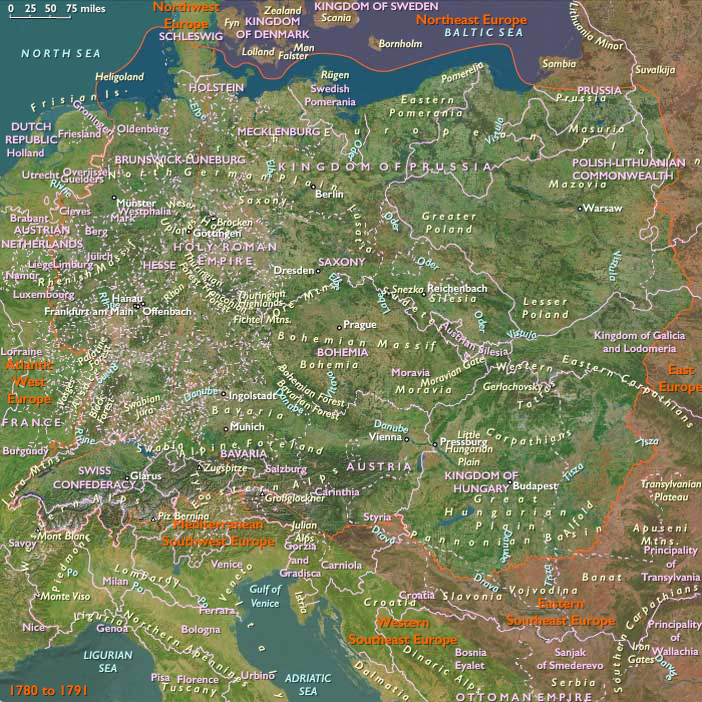
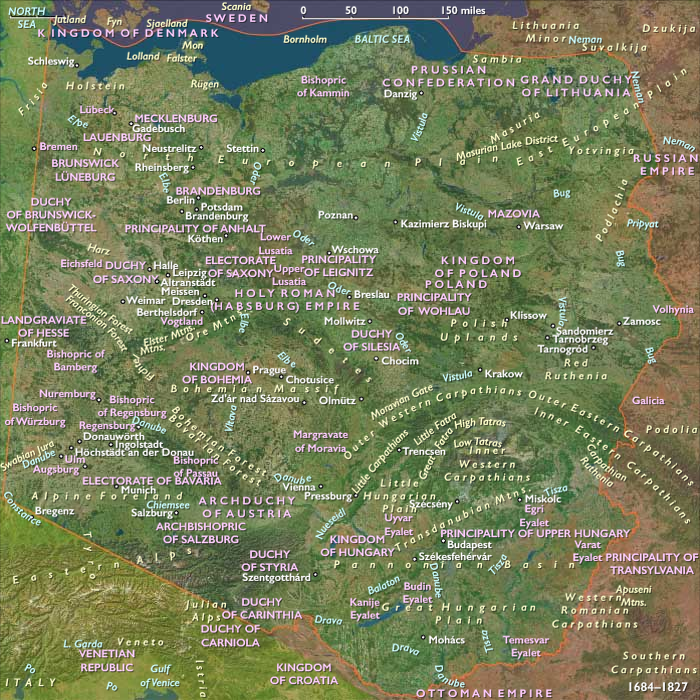
To further uniformity, the emperor has made German the compulsory language of official business throughout the Empire, which affects especially the Kingdom of Hungary.
The Hungarian assembly is stripped of its prerogatives, and not even called together.
The busy Joseph inspires a complete reform of the legal system, abolishes brutal punishments and the death penalty in most instances, and imposes the principle of complete equality of treatment for all offenders.
He ends censorship of the press and theater.
In 1781–82 he extends full legal freedom to serfs.
Rentals paid by peasants are to be regulated by officials of the crown and taxes are levied upon all income derived from land.
The landlords, finding their economic position threatened, will eventually reverse the policy.
Indeed, in Hungary and Transylvania, the resistance of the magnates is such that Joseph has to content himself for a while with halfway measures.
Of the five million Hungarians, forty thousand are nobles, of whom four thousand are magnates who own and rule the land; most of the remainder are serfs legally tied to particular estates.
Locations
People
Groups
- Germans
- Hungarian people
- Austria, Archduchy of
- Hungary, Kingdom of
- Transylvania, (Austrian) Grand Principality of
Topics
Commodoties
Subjects
Regions
Subregions
Related Events
Showing 10 events out of 24832 total
Years: 1782 - 1782
Locations
People
Groups
- Germans
- Hungarian people
- Austria, Archduchy of
- Hungary, Kingdom of
- Transylvania, (Austrian) Grand Principality of
Topics
Commodoties
Subjects
Regions
Subregions