Emperor Huizong sends a gift of Chinese …
Years: 1114 - 1114
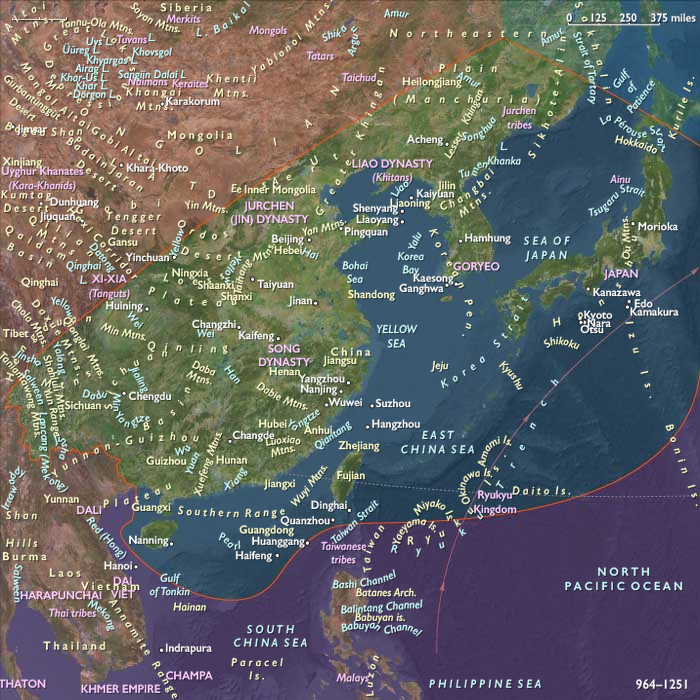
Emperor Huizong sends a gift of Chinese musical instruments for use in royal banquets to the Goryeo court of Korea, by request from the Goryeo king Yejong.
Locations
People
Groups
Subjects
Regions
Subregions
Related Events
Filter results
Showing 10 events out of 49459 total
Corruption and intrigue have weakened Emperor Huizong’s government.
Huizong, the eighth emperor of the Northern Song dynasty of the Han, promotes Taoism, and is one of the three Chinese emperors to prohibit Buddhism.
Also a skilled poet, painter, calligrapher, and musician, he gains renown for his painstakingly rendered bird-and-flower paintings and for his so-called slender-gold calligraphy style.
An avid collector whose patronage extends to music, poetry, and the minor arts, Huizong acquires more than sixty-three hundred paintings for the imperial gallery and presides over a new imperial academy of outstanding painting.
A true artist, Huizong has neglected the army, and Song China has become increasingly weak and at the mercy of foreign enemies.
Ramon Berenguer III of Barcelona and his Pisan allies conquer Ibiza and …
…Mallorca.
They become his tributaries and many Christian slaves here are recovered and set free.
The Almoravid governor of Zaragoza, Muhàmmad ibn al-Hajj, launches an offensive against the County of Barcelona but is defeated at the Battle of Martorell by Ramon Berenguer III.
Envoys from Henry V, the King of the Romans, had visited Normandy in late 1108 or early 1109 to propose that Matilda marry their master, and Henry V had also written separately to Queen Matilda on the same matter.
The match is attractive to Henry: his daughter would be marrying into one of the most prestigious dynasties in Europe, reaffirming his own, slightly questionable, status and gaining him an ally in dealing with France.
In return, Henry V would receive a dowry of ten thousand marks, which he needed to fund an expedition to Rome for his coronation as the Holy Roman Emperor.
The final details of the deal had been negotiated in June 1109 at Westminster and, as a result of her changing status, Matilda that October had for the first time attended a royal council.
She had left England in February 1110 to make her way to Germany.
The couple had met at Liège before traveling to Utrecht where on April 10 they had become officially betrothed.
Matilda on July 25 ad been crowned Queen of the Romans in a ceremony at Mainz.
There was a considerable age gap between the couple, as Matilda was only eight years old while Henry was twenty-four.
After the betrothal she had been placed into the custody of Bruno, the Archbishop of Trier, who was tasked with educating her in German culture, manners and government, in Trier on the French border.
It is unclear if her retinue from England stayed with her, or whether they were sent home by her husband.
Matilda is ready in 1114 to be married to Henry, and their wedding is held at the city of Worms amid extravagant celebrations.
Matilda now enters public life in Germany, complete with her own household.

Haakon and Magnus have a falling-out in 1114 and the two sides meet at the Thing (assembly) on the Orkney mainland, ready to do battle.
Peace is negotiated and the Earls arrange to meet each other on the island of Egilsay, each bringing only two ships.
Magnus arrives with his two ships, but then Haakon treacherously turns up with eight ships.
Magnus takes refuge in the island's church overnight, but the following day he is captured and offers to go into exile or prison, but an assembly of chieftains insists that one earl must die.
Haakon's standard bearer, Ofeigr, refuses to execute Magnus, and an angry Haakon makes his cook Lifolf kill Magnus by striking him on the head with an ax.
It is said that Magnus first prayed for the souls of his executioners.
According to the sagas, the martyrdom took place after Easter, on April 16.
The year is often given as 1115, but this is impossible, as April 16 fell before Easter that year.
The situation in Wales is meanwhile deteriorating.
Henry had conducted a campaign in South Wales in 1108, pushing out royal power in the region and colonizing the area around Pembroke with Flemings.
Some of the resident Norman lords are under attack by 1114, while in Mid-Wales, Owain ap Cadwgan has blinded one of the political hostages he is holding, and in North Wales Gruffudd ap Cynan threatens the power of the Earl of Chester.
In an attack mainly aimed against Gruffydd ap Cynan, Henry sends three armies into Wales this year, with Gilbert Fitz Richard leading a force from the south, Alexander, King of Scotland, pressing from the north and Henry himself advancing into Mid-Wales.
Owain and Gruffudd sue for peace, and Henry accepts a political compromise.
Henry reinforced the Welsh Marches with his own appointees, strengthening the border territories.
After peace terms have been agreed, Henry takes Owain with him when he visits Normandy later this year and knights him.
Duke Lothair has to attend Henry's wedding with Matilda of England in a hairshirt.
Subdued though not deposed, he has continued intriguing against Henry, who sees himself confronted with the increasing opposition of the Imperial princes.
Tthe conflict again culminates in violence in October 1114 when Rhenish insurgents led by Archbishop Frederick I of Cologne attack the Imperial troop at Andernach.
Nomadic tribes constantly threaten China's borders.
The eleventh century-Jurchen tribes of northern Manchuria had descended from the Tungusic Mohe, or Malgal tribes who had been subjects of the ethnically Goguryeo/Balhae state during the Tang era.
By the eleventh century, the nomadic Jurchens, who inhabit the region of present Manchuria, had become vassals of the Khitan Liao Dynasty to the south.
This changes in 1114-1115, when the Jurchen chieftain Wanyan Aguda, having unified his people, abruptly severs relations with his Liao overlord, declares himself Emperor, and leads his tribesmen in a sweeping conquest of southern Manchuria, quickly seizing Shangjing, also known as Huanglongfu, the Northern Capital of Liao.
As the Jurzhen attack from the north, the Han Chinese of the Song imperium attack the Khitans, their longtime enemies, from the south.
Huizong’s misguided alliance against the Khitan Liao with the Jurzhen and their subsequent treachery will result in the Song court’s total loss of North China.
Duke Boleslaw III of Poland, who had blinded his rebellious brother, Zbigniew, causing his death, "undertook a journey of pilgrimage to St. Gilles and St. Stephen the King" —that is to the Somogyvár Abbey and to the holy king's shrine at Székesfehérvár in Hungary—in 1113.
Coloman had received the Polish monarch cordially in Somogyvár Shortly afterwards—between 1113 and 1115—Coloman had discovered that his brother, Álmos, was again conspiring to seize the throne.
Having lost his patience, Coloman has Álmos and Álmos's young son, Béla, blinded in order to secure a peaceful succession for his own son.
On the same occasion, many of his brother's partisans are likewise mutilated.