Emperor Guangwu, turning his attention to Chengjia, …
Years: 35 - 35
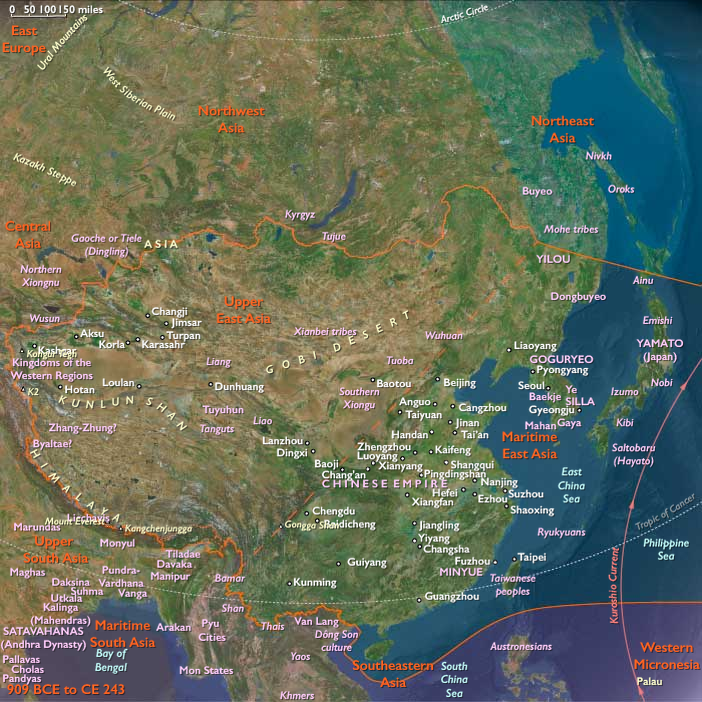
Emperor Guangwu, turning his attention to Chengjia, commissionshis generals Wu Han, Cen Peng, Lai She, and Gai Yan to mount a two-pronged attack on Chengjia—Wu and Cen leading an army and a navy up the Yangtze river from modern Hubei, while Lai and Gai lead an army south from modern Shaanxi.
Instead of fighting the Eastern Han expedition on the battlefield, Gongsun tries to repel them by assassinating their generals—and he is initially successful, assassinating Cen and Lai and temporarily causing the Eastern Han forces to halt.
Locations
People
Groups
Topics
Commodoties
Subjects
Regions
Subregions
Related Events
Filter results
Showing 10 events out of 61868 total
Marcus Julius Agrippa, the son of Antipater, whose suspicious father, Herod the Great, had put him to death, had been sent for education and safety to Rome, where he had grown up in company with the future emperor Tiberius' son Drusus.
After the death of his mother, Agrippa had quickly spent his family's wealth and acquired serious debts.
Agrippa had been obliged to flee Rome in 23 when Drusus died and had settled near Beersheba.
After a brief seclusion, through the mediation of his wife Cypros and his sister Herodias, he had been given a sum of money by his uncle, Herodias' new husband, Herod Antipas, Tetrarch of Galilee and Perea, and had been allowed to take up residence in Tiberias, receiving the rank of aedile in this city, with a small yearly income.
Eventually quarreling with his brother-in-law, he had fled to Flaccus, proconsul of Syria.
Agrippa is convicted soon afterwards through the information of his brother Aristobulus, of having received a bribe from the Damascenes, who wish to purchase his influence with the proconsul, and is again compelled to flee.
The Eastern Han forces regroup, and in 36 they have Gongsun surrounded in his capital Chengdu (modern Chengdu, Sichuan).
However, initial attempts to besiege the city are unsuccessful, and Wu, then in command of the expeditionary force, considers withdrawing.
Persuaded by his lieutenant Zhang Kan that Gongsun is in desperate straits, however, Wu tricks Gongsun into believing that the Eastern Han forces are collapsing from fatigue, drawing him out of the city and engaging in battle.
Gongsun is mortally wounded in battle, and Chengdu surrenders in winter 36.
Liu's general Wu Han subsequently kills more than ten thousand people.
(Hou Han Shu by Fan Ye, vol.
13 [Biography of Emperor Guangwu])
Dou turns over the lands under his control to Emperor Guangwu in 36 after Chengjia's fall, and is made prime controller.
An account of John the Baptist is found in all extant manuscripts of the Jewish Antiquities (book 18, chapter 5, 2) by Flavius Josephus (37–100): "Now some of the Jews thought that the destruction of Herod's army came from God, and that very justly, as a punishment of what he did against John, that was called the Baptist: for Herod slew him, who was a good man, and commanded the Jews to exercise virtue, both as to righteousness towards one another, and piety towards God, and so to come to baptism; for that the washing [with water] would be acceptable to him, if they made use of it, not in order to the putting away [or the remission] of some sins [only], but for the purification of the body; supposing still that the soul was thoroughly purified beforehand by righteousness.
Now when [many] others came in crowds about him, for they were very greatly moved [or pleased] by hearing his words, Herod, who feared lest the great influence John had over the people might put it into his power and inclination to raise a rebellion, (for they seemed ready to do any thing he should advise,) thought it best, by putting him to death, to prevent any mischief he might cause, and not bring himself into difficulties, by sparing a man who might make him repent of it when it would be too late.
Accordingly he was sent a prisoner, out of Herod's suspicious temper, to Macherus, the castle I before mentioned, and was there put to death.
Now the Jews had an opinion that the destruction of this army was sent as a punishment upon Herod, and a mark of God's displeasure to him.” (Translation by William Whiston).
As with other passages in Josephus relating to Christian themes, concern remains over whether the passage was part of Josephus's original text or instead a later addition—it can be dated back no further than the early third century, when it is quoted by Origen in Contra Celsum.
According to this passage, the execution of John was blamed for a defeat Herod suffered around CE 36.
Divergences between the passage's presentation and the Biblical accounts of John include the notion that baptism for those whose souls who have already been "purified beforehand by righteousness" is for purification of the body, not general repentance of sin (Mark 1:4).
The Gospel of Luke states that when Jesus was brought before Pontius Pilate for trial, Pilate handed him over to Antipas, in whose territory Jesus had been active.
However, Antipas sent him back to Pilate.
Antipas had divorced his first wife Phasaelis, the daughter of King Aretas IV of Nabatea, to marry his sister-in-law Herodias, the widow of his brother Philip.
According to the New Testament Gospels, it was John the Baptist's condemnation of this arrangement that led Antipas to have him arrested; John was subsequently put to death.
In the Gospels of Mark and Matthew, Herodias plays a major role in John the Baptist's execution, using her daughter's dance before Antipas and his party guests to ask for the severed head of the Baptist as a reward.
Antipas did not want to put John the Baptist to death, for Antipas liked to listen to John the Baptist preach (Mark 6:20) Furthermore, Antipas may have feared that if John the Baptist were to be put to death, his followers would riot.
The name "Salome" is given to the stepdaughter of Herod Antipas (unnamed in the Gospels of Matthew and Mark) in Josephus's Jewish Antiquities (Book XVIII, Chapter 5, 4):
“Herodias, [...], was married to Herod, the son of Herod the Great, who was born of Mariamne, the daughter of Simon the high priest, who had a daughter, Salome; after whose birth Herodias took upon her to confound the laws of our country, and divorced herself from her husband while he was alive, and was married to Herod, her husband's brother by the father's side, he was tetrarch of Galilee; but her daughter Salome was married to Philip, the son of Herod, and tetrarch of Trachonitis; and as he died childless, Aristobulus, the son of Herod, the brother of Agrippa, married her; they had three sons, Herod, Agrippa, and Aristobulus;...”
Besides provoking his conflict with the Baptist, the tetrarch's divorce adds a personal grievance to previous disputes with Aretas over territory on the border of Perea and Nabatea.
The result is a war that is to prove disastrous for Antipas.

The procurators' and prefects' primary functions are military, but as representatives of the empire they are responsible for the collection of imperial taxes, and also have limited judicial functions.
Other civil administration lies in the hands of local government: the municipal councils or ethnic governments such as—in the district of Judaea and Jerusalem—the Sanhedrin and its president the High Priest, but in Pontius Pilate's day the power of appointment of the High Priest will until 41 reside in the Roman legate of Syria or the prefect of Judaea.
Caiaphas, for example, was appointed High Priest of Herod's Temple by Prefect Valerius Gratus and deposed by Syrian Legate Lucius Vitellius.
The Roman prefect Pontius Pilate, who governs Judaea from 26 to 36, is nominally in charge of Judaea, Samaria, and Idumaea, but does not govern his area directly; instead, he relies on local leaders.
The prefect and his small army live in the predominantly Gentile city Caesarea, on the Mediterranean coast, about two days' march from Jerusalem.
They come to Jerusalem only to ensure peace during the pilgrimage festivals—Passover, Weeks (Shabuoth), and Booths (Sukkoth)‚ when large crowds and patriotic themes sometimes combine to spark unrest or uprisings.
Pilate's term as prefect of Judaea ends after an incident recounted by Josephus.
A large group of Samaritans had been persuaded by an unnamed man to go to Mount Gerizim in order to see sacred artifacts allegedly buried by Moses.
But at a village named Tirathana, before the crowd could ascend the mountain, Pilate sent in "a detachment of cavalry and heavy-armed infantry, who in an encounter with the firstcomers in the village slew some in a pitched battle and put the others to flight. Many prisoners were taken, of whom Pilate put to death the principal leaders and those who were most influential."
The Samaritans complain to Vitellius, who sends Pilate to Rome to explain his actions regarding this incident to Tiberius, who dies before Pilate reaches Rome.
The Jewish high priest governs Jerusalem on a day-to-day basis.
Assisted by a council, he has the difficult task of mediating between the remote Roman prefect and the local populace, which is hostile toward pagans and wants to be free of foreign interference.
His political responsibility is to maintain order and to see that tribute is paid.
Caiaphas holds the office from about CE 18 to 36, longer than anyone else during the Roman period, indicating that he is a successful and reliable diplomat. (Since he and Pilate are in power together for ten years, they must have collaborated successfully.)
Galilee continues to be governed by the tetrarch Antipas, who is sovereign within his own domain, provided he remains loyal to Rome and maintains peace and stability within his borders.
Antipas' closeness to the imperial family results in his choice as a mediator in the Roman-Parthian talks of 36.
To his credit, the conference is a success, but his haste to report the news to Rome arouses the hostility of Aulus Vitellius, legate of Syria, later emperor.
Agrippa is arrested as he is about to sail for Italy, for a sum of money which he owes to the treasury of Tiberius, but makes his escape, and reaches Alexandria, where his wife succeeds in procuring a supply of money from Alexander the Alabarch.
He then sets sail, and lands at Puteoli.
Agrippa, having raised a sizable loan in Alexandria, returns in 36 to Rome, where the emperor Tiberius receives favorably at Puteoli but refuses to allow him to stay at the court until his debt is paid.
A new loan covers the obligation, and he secures a post as tutor to Tiberius' grandson Tiberius Gemellus.
He also forms an intimacy with Caligula, at this time a popular favorite among the Roman people.
Agrippa is one day overheard by his freedman Eutyches expressing a wish for Tiberius' death and the advancement of Caligula, and for this he is cast into prison, but Caligula remains his friend.