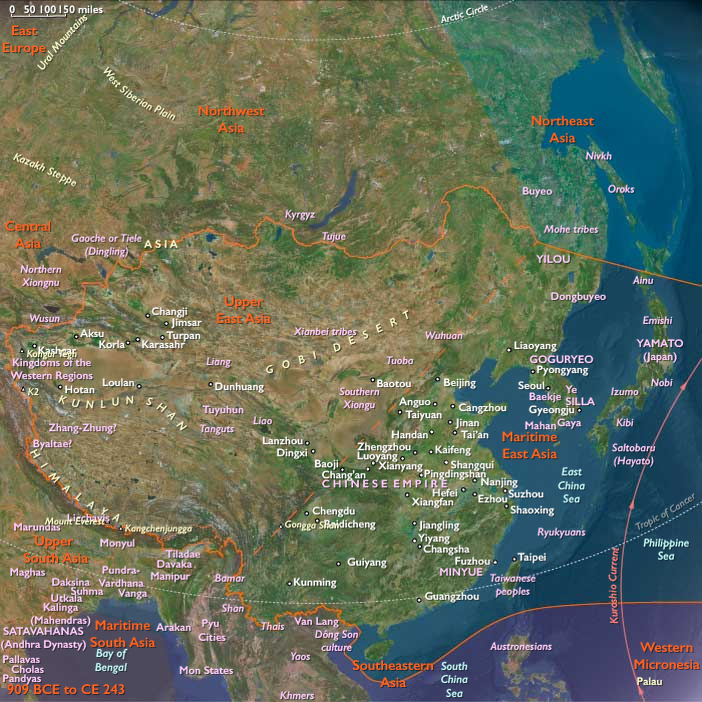
Emperor Gengshi's forces cause the death of …
Years: 25 - 25
Emperor Gengshi's forces cause the death of the former Western Han emperor-designate, Emperor Ruzi (Liu Ying), in 2.
Two co-conspirators—Fang Wang, the former strategist for the local warlord Wei Xiao, and a man named Gong Lin—and their group of several thousand men, after kidnapping the former Duke of Ding'an, occupy Linjing (in modern Qingyang, Gansu).
Emperor Gengshi sends his prime minister Li Song to attack them, and wipes out this rebel force, killing Liu Ying.
Locations
People
Groups
Topics
Commodoties
Subjects
Regions
Subregions
Related Events
Filter results
Showing 10 events out of 61920 total
Liu Xiu finally makes a formal break with Emperor Gengshi in summer 25, after his generals and Emperor Gengshi's generals fight over control of the Henei and Luoyang regions.
He declares himself emperor (establishing the regime known later as the Eastern Han Dynasty), and soon his general Deng Yu also captures the modern Shanxi, further reducing Emperor Gengshi's strength.
A number of Emperor Gengshi's generals, feeling trapped, conspire to kidnap him and flee back to their home region of Nanyang (in modern Henan).
They are discovered, and many are executed, but one, Zhang Ang occupies most of Chang'an, forcing Emperor Gengshi to flee, just as Chimei forces are approaching.
The Chimei leaders, deciding that they also need their own emperor, find three descendants of Liu Zhang, Prince of Chengyang, who was very popular with the people of his principality (from which many Chimei soldiers come) and who was worshiped as a god after his death.
After drawing lots, the youngest, the fifteen-year-old Liu Penzi, is chosen and declared emperor.
However, the young "emperor" is not given any power, but is effectively a puppet who continues to serve as a cattle herder within the army.
Generals still loyal to Emperor Gengshi are eventually able to evict Zhang from the capital, but by this time the situation is desperate.
Zhang and his allies surrender to Chimei and, working with them, attack Chang'an, which falls quickly, and Emperor Gengshi flees, followed only by several loyal followers, including Liu Zhi, the Prince of Dingtao and Liu Gong, the Marquess of Shi—who, incidentally, is Liu Penzi's older brother.
They are eventually taken in by one of Emperor Gengshi's generals, Yan Ben, who, however, is in actuality holding them as bargaining chips.
When Liu Xiu hears about the fall of Chang'an, he creates Emperor Gengshi the Prince of Huaiyang, in absentia, and decrees that anyone who harms the Prince of Huaiyang will be severely punished and that anyone who protects and delivers him to the Eastern Han dynasty will be rewarded.
(This appears to be basically political propaganda on Liu Xiu's part.)
When news of Chang'an's fall arrives in Luoyang, Luoyang surrenders to Liu Xiu, who enters the city and makes it his capital.
In winter 25, after being held by Yan a few months, Emperor Gengshi sees the futility of his situation and requests Liu Gong to negotiate surrender terms.
A promise is made that he will be created the Prince of Changsha.
Emperor Penzi's general Xie Lu arrives at Yan's camp and escorts Emperor Gengshi back to Chang'an to offer his seal (seized from Wang Mang) to Emperor Penzi.
Chimei generals, notwithstanding the earlier promise, want o execute him.
It is only Liu Gong's final intercession (in which he threatens to commit suicide at the execution site) that allows Emperor Gengshi to be spared at this point, and he is created the Prince of Changsha.
He, however, is forced to stay in Xie's headquarters, and Liu Gong protects him on a number of occasions.
Meanwhile, Emperor Penzi is installed on the Han throne in Chang'an.
Initially, the people of the Guanzhong (modern central Shaanxi) region submit and offered tributes—and are surprised when the Chimei soldiers continuously rob them on the way to Chang'an.
The locals soon resume maintaining and defending their outposts.
They also start to look forward to the rule of Liu Xiu, who by now has declared himself as an emperor as well (establishing the Eastern Han Dynasty), and his general Deng Yu, whose forces are stationed nearby but not confronting the Chimei forces, content to consolidate his control over the prefectures of Shang, Beidi, and Anding (modern northern Shaanxi and eastern Gansu) and waiting for the Chimei to collapse by themselves.
Chimei generals are even less able to govern the capital than Emperor Gengshi, as they are unable to control their soldiers from pillaging the residents, who begin to yearn for the return of Emperor Gengshi.
Zhang Ang and his allies, afraid of what might happen if Emperor Gengshi returns to power, persuade Xie to strangle Emperor Gengshi.
Liu Gong hides his body in a secure location.
Years later, after the Eastern Han dynasty has securely captured the Chang'an region, Liu Xiu has Emperor Gengshi's body buried with princely honors at Baling, near the tomb of Emperor Wen.

Tiberius, although owing his throne, in part, to his mother’s influence-wielding, has thwarted her attempts to gain greater personal power during his reign.
Liu Gong, seeing the dangers of the situation for his brother the emperor, decides in 26 to make one attempt to either put the situation under control or disengage his brother from the mess.
At the New Year's Day imperial gathering, Liu Gong first speaks and asks that Emperor Penzi be allowed to yield the throne, and Emperor Penzi jumps off the throne, removes from his person the the imperial sea, and speaks while crying: “Now there is an emperor, but everyone continues to act as robbers.
The people hate us and do not trust us.
This is because you chose the wrong Son of Heaven.
Please return my body to me.
But if you want to kill me to divert blame, then I must die.” Fan and the other leaders are ashamed, and they leave their seats and bow down to Emperor Penzi, apologizing for their failures.
They physically force Emperor Penzi back onto the throne and restore the imperial seal onto his person.
For weeks after the incident, the generals restrain their soldiers from unlawful acts, and the people praise Emperor Penzi as a merciful and brilliant emperor.
However, the lawlessness returns before long.
Soon, the food supplies are completely depleted, and the Chimei forces burn many Chang'an palaces and other buildings and pillage the city, then march west into the modern eastern Gansu region.
In autumn 26, The Chimei forces attack the territory held by the regional warlord Wei Xiao, but are repelled by Wei.
At this time, they suffer from a sudden cold spell that freezes many soldiers to death.
They head back east and reenter Chang'an and engage in a series of battles with Deng and, despite their reduced strength at this time, continue to defeat Deng regularly.
The wars lead to a severe famine in the Guangzhong region, which affects not only the people of the region but also both Chimei and Deng's forces.
The Chimei, lacking food, eventually abandon Chang'an and head east.
Liu Xiu sets up two forces at Xin'an in modern Luoyang, Henan) and Yiyang (also in modern Luoyang) to block their progress, as his forces under Deng and Feng Yi, whom he had sent to relieve Deng, continue to battle the Chimei.
Pontius Pilate, becoming, under Tiberias, the fifth Roman procurator (governor) of Judea in 26, also has jurisdiction over Samaria and part of Idumaea.
Pilate's title was traditionally thought to have been procurator, since Tacitus speaks of him as such.
However, a damaged dedication by a Pilate of a Tiberieum on a limestone block known as the Pilate Stone—a dedication to Tiberius Caesar Augustus—that will be discovered in 1961 in the ruins of an amphitheater at Caesarea Maritima, the capital of the province of Judaea (Iudaea), refers to Pilate as "Prefect of Judaea".
The dedication states that he was [...]ECTVS IUDA[...] (usually read as praefectus Iudaeae), that is, prefect of Judaea.
Thus, the early governors of Judaea appear to be of prefect rank, whereas the later are of procurator rank, beginning in CE 44 with Cuspius Fadus.
The inscription, discovered by a group led by Antonio Frova and dated to CE 26–37, is currently housed in the Israel Museum, Jerusalem, while a replica stands at Caesarea.
Tiberius finally retires from Rome altogether in CE 2 to the island of Capri, where he will spend the remainder of his life until his death in 37.
With Tiberius's withdrawal, Sejanus is left in charge of the entire state mechanism and the city of Rome.
Guarded by the Praetorians, Sejanus easily controls all information that passes between Tiberius and the capital.
The Chimei win a great victory against both Deng and Feng at Hu (in modern Sanmenxia, Henan) in spring 27—a rarity in the records regarding them in that the battle tactics demonstrating Chimei generals' brilliance are recorded in historical accounts.
The Chimei general engages in the tactic of feigning defeat and retreat—abandoning what appeared to be supplies of food.
Deng's forces, also hungry, try to take the food, which turns out to only contain one layer of beans with dirt underneath.
Having lured Deng's forces into a condition of panic, the Chimei forces then converge, defeating their foes.
The victory at Hu is to be the last for the Chimei.
About a month later, they suffer a major defeat at Feng's hands—in which Feng creates confusion for the Chimei by also coloring his troops' eyebrows red.
The remnants of the Chimei withdraw east toward Yiyang.
Liu Xiu personally leads the troops to wait for them.
As the Chimei arrive at Yiyang, they are surprised to see Liu Xiu's overwhelming forces, and decide to negotiate surrender terms.
After Liu Xiu agrees not to execute Emperor Penzi, the Chimei emperor and generals surrender.
The Chimei generals and their families are settled in the Eastern Han capital of Luoyang and given regular stipends and land, but not official positions.
Eventually, Fan and Pang prepare to rebel again, and they are discovered and executed.
Yang and Xu return to their home lands, where they will die of old age.
Xie is assassinated by Liu Gong to avenge Emperor Gengshi, and Liu Xiu, sympathetic to Liu Gong, pardons him.
Liu Xiu makes the former Emperor Penzi an assistant to his uncle Liu Liang, the Prince of Zhao.
Liu Penzi will later suffer an illness that will leave him blind, and Liu Xiu will give him a large swarth of farmland, allowing him to survive on the rent from the farms.