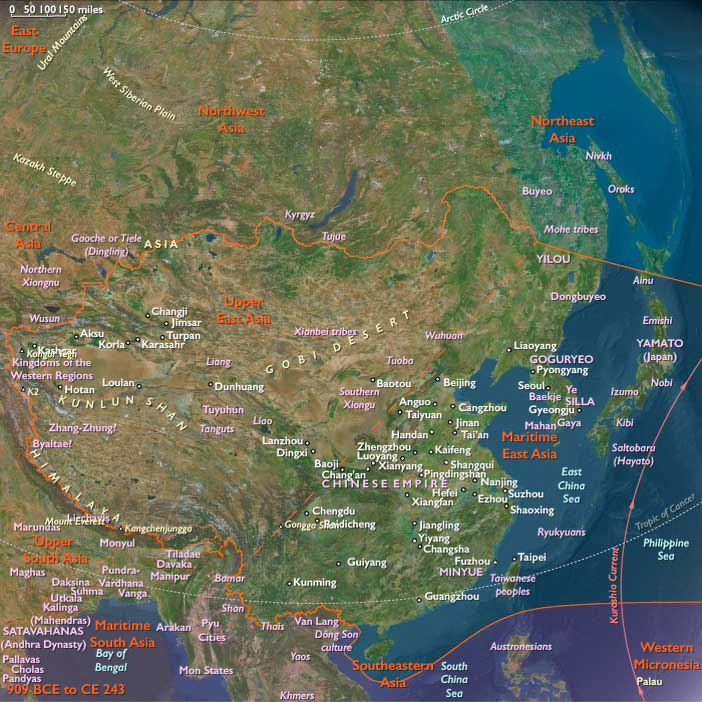
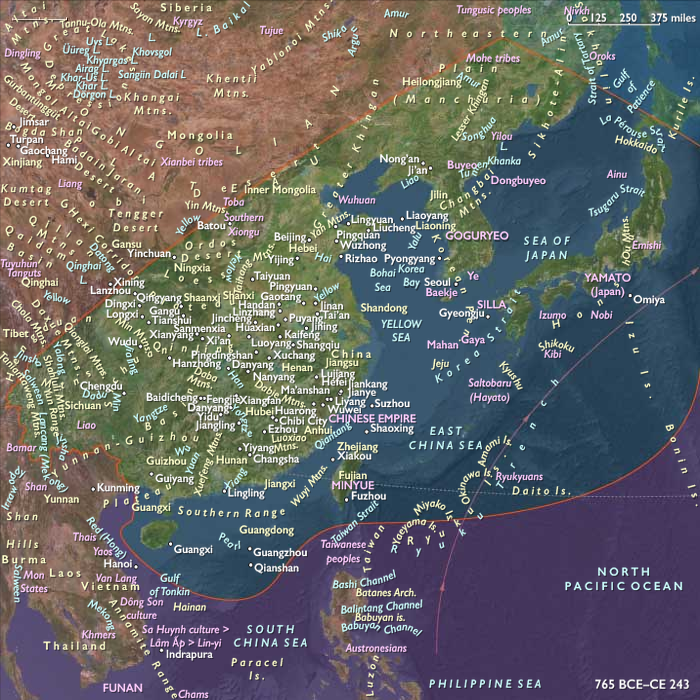
Emperor Gengshi sends his generals Li Bao …
Years: 24 - 24
Emperor Gengshi sends his generals Li Bao and Li Zhong in autumn 24 to try to capture modern Sichuan, held by local warlord Gongsun Shu, but his generals are defeated by Gongsun.
Locations
People
Groups
Topics
Commodoties
Subjects
Regions
Subregions
Related Events
Filter results
Showing 10 events out of 61929 total
After some difficulties, Liu Xiu is able to unify the northern prefectures still loyal to Emperor Gengshi and besiege Handan in 24, killing Wang Lang.
Emperor Gengshi puts Liu Xiu in charge of the region north of the Yellow River and creates him the Prince of Xiao, but Liu Xiu, still aware that he is not truly trusted and secretly angry about his brother's death, secretly plans to depart from Emperor Gengshi's rule.
He begins to strip other Emperor Gengshi-commissioned generals of their powers and troops, and concentrates the troops under his own command.
Also in 24, Emperor Gengshi moves his capital again, back to the Western Han capital of Chang'an.
The people of Chang'an had previously been offended by Emperor Gengshi's officials, who did not appreciate their rising up against Wang Mang but in fact considered them traitors.
Once Emperor Gengshi is back in the capital, he issues a general pardon, which calms the situation for a while.
At this time, Chang'an is still largely intact, except for Weiyang Palace, destroyed by fire.
However, Emperor Gengshi's timidity quickly causes problems.
When the imperial officials gather or an official meeting, Emperor Gengshi, who had never seen such solemn occasions, panics.
Later, when generals submit reports to him, he asks questions such as, "How much did you pillage today?"
This type of behavior further reduces the confidence of the people in him.
Emperor Gengshi entrusts his government to Zhao Meng, whose daughter he takes as an imperial consort.
He himself engages in frequent drinking bouts and as a result is often unable to receive officials or make important decisions.
Zhao greatly abuses his power, and once, when an honest official reveals Zhao's crimes to Emperor Gengshi, Emperor Gengshi has him executed.
The other powerful officials also abuse their power greatly, often commissioning duplicating local officials throughout the empire, causing great confusion and anger.
Chimei troops, stationed at Puyang in winter 24, are highly fatigued and want to go home.
Their leaders feel that if they do so, Chimei forces will scatter and be unable to be re-gathered, and they feel that a clear target needs to be created.
They decide to announce that they are attacking Emperor Gengshi's capital of Chang'an; divided into two armies, they begin to head west.
Liu Xiu, while he has fairly strong troops, chooses to stand by and wait for Chimei to destroy Emperor Gengshi; he uses the Henei region (modern northern Henan, north of the Yellow River) as his base of operations for its strategic location and the richness of its soil.
The two Chimei armies rejoin in Hongnong (in modern Sanmenxia, Henan), defeating every army that Emperor Gengshi sends to stop them.
Strabo describes the world from Gaul and Britain to India and from the Black Sea to Ethiopia, known to him through firsthand observation, in his seventeen-volume Geography.
Intending his work for the use of military leaders and statesmen, he has synthesized the geographical knowledge of the period and included descriptions of important political events and great men.
In a break with convention, Strabo has invented regional geography by substituting divisions based on natural boundaries (such as mountain ranges and drainage systems) for the less permanent and artificially drawn political units.
Books 1-2 of the Geography are introductory; Books 3-10 deal with Europe; 11-16 treat Asia; and 17 covers Africa, chiefly Egypt. (All except a portion of Book 7 have been preserved.)
Its descriptions of lands and peoples often marred by omissions and error, the Geography is not uniformly useful because Strabo both takes Homer too literally and sometimes ignores the descriptions of firsthand observers such as Herodotus.
Like Julius Caesar and Diodorus Siculus before him, Strabo probably based much of his Celtic ethnography on the (now-lost) writings of the Greek philosopher and historian Posidonius.
Geography is the only extant work covering the whole range of peoples and countries known to both Greeks and Romans during the reign of Augustus (27 BCE–CE 14).
Its numerous quotations from technical literature, moreover, provide a remarkable account of the state of Greek geographical science, as well as of the history of the countries it surveys.
Ptolemy of Mauretania has received a good Roman education in Rome and become Romanized.
He is part of the remarkable court of his maternal aunt Antonia Minor, an influential aristocrat who presides over a circle of various princes and princesses that assists in the political preservation of the Roman Empire’s borders and affairs of the client states.
The youngest daughter of Mark Antony and the youngest niece of Emperor Augustus, Antonia Minor is a half-sister of Ptolemy's late mother, also a daughter of Mark Antony.
Antonia Minor's mother was Octavia Minor, Mark Antony's fourth wife and the second sister of Octavian (later Augustus).
Ptolemy lives in Rome until the age of twenty-one, when he returns to the court of his aging father in Mauretania.
When Ptolemy returns to Mauretania, Juba II makes Ptolemy his co-ruler and successor.
Coinage has survived from Juba II’s co-rule with his son.
On coinage, on one side there is a central bust of Juba II with his title in Latin ‘King Juba’.
On the other side there is a central bust of Ptolemy and the inscription stating in Latin ‘King Ptolemy son of Juba’.
Juba II dies in 23 and is placed with Cleopatra Selene II in the Royal Mausoleum of Mauretania; Ptolemy becomes the sole ruler of Mauretania.
Ptolemy, like his father, appears to be a patron of art, learning, literature and sports.
In Athens, Greece, statues are erected to Juba II and Ptolemy in a gymnasium in Athens and a statue is erected in Ptolemy’s honor in reference to his taste in literature.
Ptolemy dedicates statues of himself on the Acropolis.
The Athenians honor Ptolemy and his family with inscriptions dedicated to them, which reveals that the Athenians have respect towards the Roman Client Monarchs and their families, a civic practice common in the first century.
The local Berber tribes, the Numidian Tacfarinas and Garamantes, had in 17 begun a revolt against the Kingdom of Mauretania and Rome.
The war has ravaged North Africa; Berbers, including former slaves from Ptolemy’s household, have joined in the revolt.
As Ptolemy’s military campaigns are unsuccessful in ending the revolt, he summons the Roman Governor of Africa, Publius Cornelius Dolobella and his army to assist him.
The war finally ends in 24.
Although Ptolemy’s army and the Romans are the victors, both sides have suffered considerable losses of infantry and cavalry.
The Roman Senate, impressed by Ptolemy’s loyal conduct, sends a Roman Senator, who greets Ptolemy as king, ally and friend and awards him an ivory scepter, and an embroidered triumphal robe, a traditional recognition and reward by Rome to her allies.

Emperor Gengshi's forces cause the death of the former Western Han emperor-designate, Emperor Ruzi (Liu Ying), in 2.
Two co-conspirators—Fang Wang, the former strategist for the local warlord Wei Xiao, and a man named Gong Lin—and their group of several thousand men, after kidnapping the former Duke of Ding'an, occupy Linjing (in modern Qingyang, Gansu).
Emperor Gengshi sends his prime minister Li Song to attack them, and wipes out this rebel force, killing Liu Ying.
Liu Xiu finally makes a formal break with Emperor Gengshi in summer 25, after his generals and Emperor Gengshi's generals fight over control of the Henei and Luoyang regions.
He declares himself emperor (establishing the regime known later as the Eastern Han Dynasty), and soon his general Deng Yu also captures the modern Shanxi, further reducing Emperor Gengshi's strength.