
Emmaus, due to its strategic position in …
Years: 208 - 219
Emmaus, due to its strategic position in Palestine, has played an important administrative, military and economic role in history.
The first mention of Emmaus occurs in the First Book of Maccabees, chapters 3-4, in the context of Judas the Maccabee’s wars against the Greeks (second century BCE).
Emmaus during the Hasmonean period had become a regional administrative center (toparchy) in the Ayalon Valley.
Josephus Flavius, who mentions Emmaus in his writings several times, speaks about the destruction of Emmaus by the Romans in the year 4 BCE.
Romans and Samaritans in the first half of the second century CE had settled in Emmaus after the defeat of the Bar-Kochba’s revolt.
A Christian scholar and writer born in Jerusalem, Julius Africanus, lives in Emmaus in the early third century CE.
He may have served in 195 under Septimius Severus against the Osrhoenians.
He goes on an embassy to the emperor Severus Alexander to ask for the restoration of Emmaus, which had fallen into ruins.
His mission succeeds, and Emmaus is henceforward known as Nicopolis.
Locations
People
Groups
- Samaritans
- Greeks, Hellenistic
- Syria Palæstina, Roman province of (Judea, Samaria, and Idumea)
- Roman Empire (Rome): Severan dynasty
Subjects
Regions
Subregions
Related Events
Filter results
Showing 10 events out of 60748 total
The widow of Japan’s Emperor Chuai rules as Empress Jingo following her hiusband's death in 209.
The legend of Jingū's invasion of the Korean peninsula is based on the traditional Japanese interpretation of the Kwanggeto Stele found in Manchuria, which proclaimed Goguryeo's dominion over Manchuria and the northern part of Korea.
Closer examination has revealed that this traditional interpretation was based on conjecture, since several critical letters of the text are missing, and in context would correlate more with Goguryeo's immediate southern neighbors, Silla and Baekje.
Baekje had very close relations with Japan, including exchanges between the two courts, and it was a primary conduit of continental culture to Japan.
East Central Europe (208–219 CE): Late Severan Stability and Frontier Prosperity
Between 208 and 219 CE, East Central Europe—encompassing Poland, Czechia, Slovakia, Hungary, and those portions of Germany and Austria lying east of 10°E and north of a line stretching from roughly 48.2°N at 10°E southeastward to the Austro-Slovenian border near 46.7°N, 15.4°E—experienced sustained frontier stability, economic prosperity, and diplomatic continuity. Under the later reign of Emperor Septimius Severus and his successor Caracalla, the region saw significant reinforcement of Roman frontier defenses, prosperous trade relationships, and stable interactions with neighboring Germanic and Sarmatian tribes.
Political and Military Developments
Continuation of Severan Frontier Policies
-
Under Emperor Septimius Severus (193–211 CE), Roman frontier defenses along the Danube remained robust, characterized by extensive fortification networks and increased troop deployments in the provinces of Pannonia Superior, Pannonia Inferior, and Noricum.
-
His successor, Emperor Caracalla (211–217 CE), maintained this strong defensive stance, ensuring ongoing frontier security and political stability throughout the region.
Peaceful Diplomatic Relations
-
Stable diplomatic relations persisted between Roman authorities and major tribal groups—particularly the Marcomanni, Quadi, and Iazyges.
-
Agreements established in previous decades remained largely intact, promoting peaceful coexistence and continued cross-border trade and cooperation.
Internal Consolidation of Tribal Groups
-
Germanic and Sarmatian tribal confederations north and east of the Roman frontier continued internal consolidation, with stable tribal leadership and clearly delineated territories contributing to enduring regional stability.
Economic and Technological Developments
Economic Prosperity and Expanded Trade
-
Economic conditions along the frontier thrived, driven by stable Roman administration and robust trade networks. Frontier towns and tribal communities actively exchanged Roman manufactured goods (ceramics, metalwork, textiles, glassware) for regional resources (amber, iron goods, livestock, agricultural products).
-
Monetary transactions flourished due to the reliable circulation of Roman coinage.
Continued Technological Advancements
-
Military infrastructure improvements and frontier fortifications continued to stimulate local technological innovations. Enhanced roads, bridges, fortresses, and civilian infrastructure projects improved regional productivity and communication.
Cultural and Artistic Developments
Vibrant Cultural Exchange
-
Sustained peaceful conditions fostered vibrant cultural interactions between Roman and tribal communities. Artifacts, including pottery, jewelry, and metalwork, exhibited increasingly sophisticated blends of Roman technical excellence and Germanic artistic traditions.
Artistic Production and Synthesis
-
Local artisans, benefiting from prosperous economic conditions, produced refined artistic objects, demonstrating a continued synthesis of Roman styles and traditional tribal motifs.
Settlement and Urban Development
Reinforcement and Prosperity of Frontier Towns
-
Major Roman frontier settlements, notably Carnuntum, Vindobona, and Aquincum, continued to prosper and expand. These towns strengthened fortifications, enhanced administrative structures, and grew commercially vibrant, serving as central hubs of trade and governance.
Stable Tribal Settlements
-
Germanic and Sarmatian tribal settlements maintained stability, adopting increasingly permanent settlement patterns and fortification practices reflecting peaceful coexistence and stable economic interactions.
Social and Religious Developments
Stable Tribal Leadership and Social Hierarchies
-
Tribal societies maintained stable hierarchical structures dominated by warrior elites and tribal chieftains. Stable conditions allowed for the continued strengthening of social cohesion and clear leadership structures.
Continued Religious Practices and Cultural Identity
-
Traditional tribal religious practices remained robust, emphasizing rituals supporting peace, prosperity, and community solidarity, while still incorporating subtle Roman influences due to ongoing cultural exchanges.
Long-Term Consequences and Historical Significance
The era 208–219 CE under late Severan rulers marked a period of sustained stability, frontier security, and economic prosperity for East Central Europe. Successful frontier management, strengthened diplomatic ties, and vibrant economic and cultural exchanges significantly influenced regional development, setting essential foundations for long-term stability and shaping the region’s historical trajectory into subsequent eras.
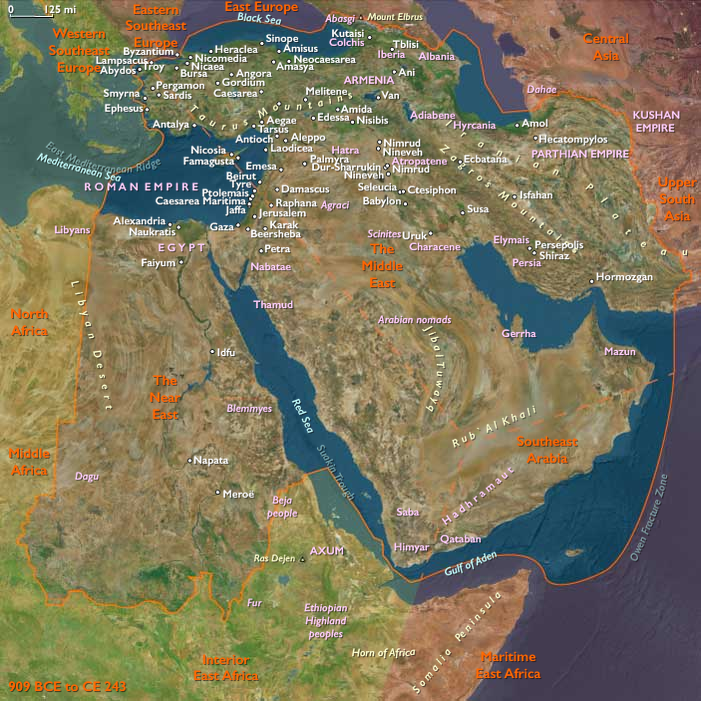
The Middle East: 208–219 CE
Caracalla’s Parthian War and Imperial Overreach
The period from 208 to 219 CE is marked primarily by the aggressive foreign policies of Roman Emperor Caracalla, whose ambitions lead Rome into another major confrontation with the Parthian Empire. This campaign, known historically as the Parthian War of Caracalla (216–217 CE), follows a series of provocative Roman interventions in the client kingdoms on Parthia's frontier starting in 213 CE.
Caracalla initiates hostilities under dubious circumstances, famously using a rejected marriage proposal to the Parthian king’s daughter as a casus belli. In 216, Roman forces under his direct command invade Parthia, carrying out ruthless massacres across northern Parthian territories. Despite initial success, Caracalla fails to consolidate lasting gains, and his army soon withdraws westward toward Asia Minor.
In April 217 CE, Caracalla is assassinated, abruptly halting the campaign. His successor, Macrinus, rapidly concludes peace with Parthia in 218 CE. The resulting treaty, however, proves costly for Rome, as it entails substantial financial reparations paid to the Parthians.
This unsuccessful venture exposes the limitations of Roman military power in the Middle East, further destabilizing imperial authority and foreshadowing continued struggles between Rome and the eastern empires.
The Parthian war of Caracalla, an unsuccessful campaign by the Roman Empire under Caracalla against the Parthian Empire in 216–17, is the climax of a four-year period, starting in 213, when Caracalla pursues a lengthy campaign in central and eastern Europe and the Near East.
After intervening to overthrow rulers in client kingdoms adjoining Parthia, he invades in 216 using an abortive wedding proposal to the Parthian king's daughter as a casus belli.
His forces carry out a campaign of massacres in the northern regions of the Parthian Empire before withdrawing to Asia Minor, where he is assassinated in April 217.
The war is ended the following year with the Romans paying a huge sum of war reparations to the Parthians.
Near East (208–219 CE): Christian Philosophy, Restoration of Emmaus, and Jewish Presence in Jerusalem
The early third century witnesses significant developments in Christian theological thought, as prominent Christian writers and theologians such as Clement of Alexandria (150–211/215) and Origen (c. 185–254) actively blend Christian doctrines with Greek philosophy. This intellectual fusion firmly establishes the Greek-speaking world as the central hub of gentile Christianity, significantly influencing the development of early Church theology and practice.
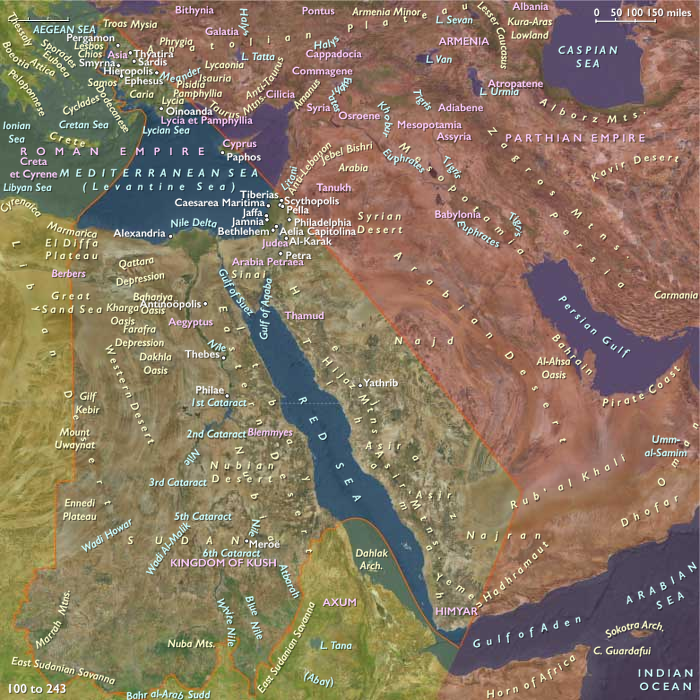
Emmaus, a town of strategic importance in Palestine, undergoes significant renewal in this period. Historically notable since its mention in the First Book of Maccabees (chapters 3–4) during the wars of Judas Maccabeus against the Greeks (second century BCE), Emmaus has served as a critical administrative center (toparchy) in the Ayalon Valley during the Hasmonean period. It had been destroyed by the Romans in 4 BCE, according to the historian Josephus Flavius, and subsequently inhabited by Romans and Samaritans following the Bar Kokhba Revolt.
Julius Africanus, a Christian scholar and writer from Jerusalem, settles in Emmaus (early third century CE). After a military career, possibly serving under Septimius Severus around 195 CE, Africanus successfully petitions Emperor Severus Alexander to restore the city, which had fallen into ruins. Consequently, Emmaus is rebuilt and renamed Nicopolis, marking its revival and continued regional significance.
While the Roman ban on Jewish presence in Jerusalem officially remains in force, evidence emerges during the Severan period suggesting increased Jewish access to the city. Jews reportedly visit Jerusalem more frequently, especially during religious festivals, and possibly establish limited residency in the city despite the formal prohibition—an indication of gradually relaxed enforcement of Roman edicts.
Legacy of the Era
Between 208 and 219 CE, the Near East experiences vibrant religious and cultural transformations. The melding of Christian theology with Greek philosophy reshapes early Christianity, Emmaus (Nicopolis) sees renewal under Julius Africanus, and the Jewish community in Jerusalem begins to reassert its presence, despite ongoing Roman restrictions. These developments reflect a nuanced interplay between imperial policy, religious innovation, and cultural resilience in shaping the region's historical trajectory.
Early Christian theological writers such as Clement of Alexandria (150-211/215) and Origen (about 185 to around 254) attempt to fuse Christian belief with Greek philosophy, establishing the Greek world as the home of gentile Christianity.
The ban on Jews in Jerusalem is officially still in force (and will remain so as late as the fourth century), but there is some evidence that from the Severan period onward Jews visit the city more frequently, especially at certain festival times, and even that there may at this time be some Jews in residence.
Alexander of Aphrodisias, the most distinguished of the later Greek commentators on Aristotle, composes several commentaries on the latter’s works, in which he seeks to escape a syncretistic tendency and to recover the pure doctrines of Aristotle.
His commentaries are still extant on Prior Analytics (Book 1), Topics, Meteorology, Sense and Sensibilia, and Metaphysics (Books 1-5).
The commentary on the Sophistical Refutations is deemed spurious, as is the commentary on the final nine books of the Metaphysics.
The lost commentaries include works on the De Interpretatione, Posterior Analytics, Physics, On the Heavens, On Generation and Corruption, On the Soul, and On Memory.
Simplicius of Cilicia mentions that Alexander provided commentary on the quadrature of the lunes, and the corresponding problem of squaring the circle.
It will be eported in April 2007, itthat imaging analysis had discovered an early commentary on Aristotle's Categories in the Archimedes Palimpsest, and Robert Sharples will suggest Alexander as the most likely author.
There are also several original writings by Alexander still extant.
These include: On the Soul, Problems and Solutions, Ethical Problems, On Fate, and On Mixture and Growth.
Three works attributed to him are considered spurious: Medical Questions, Physical Problems, and On Fevers.
Additional works by Alexander are preserved in Arabic translation, these include: On the Principles of the Universe, On Providence, and Against Galen on Motion.
Alexander's commentaries on Aristotle will by the sixth century be considered so useful that he will be referred to as "the commentator".
His commentaries will be greatly esteemed among the Arabs, who will translate many of them, and he will be heavily quoted by Maimonides.
The Church Council of Paris in 1210 will issue a condemnation, probably targeting the writings of Alexander among others.
Hs doctrine of the soul's mortality will be adopted in the early Renaissance by Pietro Pomponazzi (against the Thomists and the Averroists), and by his successor Cesare Cremonini.
This school will be known as Alexandrists.
Alexander's band is named after him: an optical phenomenon associated with rainbows, it occurs due to the deviation angles of the primary and secondary rainbows.
Both bows exist due to an optical effect called the angle of minimum deviation.
The refractive index of water prevents light from being deviated at smaller angles.
Mediterranean Southwest Europe (208–219 CE): Severan Campaigns and Continued Stability
The era 208–219 CE in Mediterranean Southwest Europe sees continued stability under the Severan dynasty, marked by extensive military campaigns, sustained administrative reforms, and ongoing cultural vitality. The rule of Septimius Severus, succeeded by his sons, further consolidates the dynasty’s influence across the empire.
Septimius Severus’s Final Campaigns
Between 208 and 211 CE, Emperor Septimius Severus embarks on significant military campaigns in Britain to strengthen Rome’s northern frontier. These extensive military actions are costly but demonstrate Severus’s strategic commitment to safeguarding the empire's territorial integrity. His campaigns result in fortified defenses, notably the reinforcement of Hadrian’s Wall.
Succession of Caracalla and Geta
Upon Severus’s death in 211 CE, his sons, Caracalla and Geta, jointly succeed him. Their initial co-rule quickly descends into rivalry and tension, undermining internal stability. This fraught relationship culminates in Geta’s assassination in 211 CE, after which Caracalla assumes sole authority.
Caracalla’s Rule and Legal Reforms
Caracalla’s reign is marked by continued administrative and legal reforms, most famously the issuance of the Constitutio Antoniniana in 212 CE, extending Roman citizenship to nearly all free inhabitants of the empire. This sweeping reform profoundly reshapes Roman identity, reinforcing imperial unity and altering social dynamics across Mediterranean Southwest Europe and beyond.
Economic and Administrative Continuity
Despite internal political tensions, economic stability and effective provincial administration continue under Caracalla’s rule. Infrastructure development remains a priority, with ongoing investment in roads, aqueducts, and urban improvements, facilitating commerce and regional prosperity.
Cultural and Intellectual Activity
Cultural and intellectual activities continue robustly, reflecting Rome’s sustained vitality. Artistic projects, such as elaborately decorated sarcophagi and architectural developments, flourish. Philosophical and religious debates, particularly within Christian communities, maintain their vibrancy, contributing significantly to the intellectual richness of the era.
Religious Expansion and Christian Communities
Christianity continues to expand, characterized by ongoing theological discourse and intellectual engagement. Early Christian communities increasingly integrate philosophical traditions into their teachings, solidifying Christianity’s place within Roman cultural and intellectual landscapes.
Legacy of the Era
The era 208–219 CE underscores the complexities of imperial governance under the Severan dynasty, combining significant administrative achievements and legal reforms with internal familial and political tensions. Caracalla’s citizenship reform notably transforms Roman society, shaping the empire’s long-term trajectory and reinforcing its political and cultural cohesion, even amidst underlying instabilities.
North Africa (208–219 CE)
Roman Stability, Economic Prosperity, and Christian Developments
Roman Provincial Stability and Economic Expansion
From 208 to 219 CE, Roman administration in Africa Proconsularis maintains a consistent focus on stability and economic prosperity through continued investments in infrastructure, agriculture, and urban development. Major urban centers such as Utica, Leptis Magna, and Caesarea (Cherchell) flourish economically, reinforcing their significance within Rome’s Mediterranean trade and administrative networks.
Numidia: Ongoing Prosperity and Cultural Integration
Numidia continues its trajectory of economic growth, benefiting from ongoing Roman investment in agriculture and infrastructure. Numidian communities successfully integrate traditional practices with Roman administrative structures, promoting regional prosperity, social cohesion, and cultural continuity.
Mauretania: Continued Economic Growth and Cultural Vitality
Mauretania sustains robust economic performance and cultural dynamism. Caesarea remains pivotal for commerce, notably in grain, olive oil, and luxury commodities, further supported by continuous Roman infrastructure improvements. This sustained economic activity underscores Mauretania’s strategic importance within Roman North Africa.
Cyrenaica: Economic Stability and Scholarly Influence
Cyrenaica remains economically vibrant and culturally influential. The Greek Pentapolis—Cyrene, Barce (Al Marj), Euhesperides (Benghazi), Teuchira (Tukrah), and Apollonia (Susah)—continues significant trade, particularly in grain, wine, wool, and livestock. Cyrene maintains its role as a Mediterranean center of scholarship, attracting prominent intellectuals and reinforcing regional academic prominence.
Berber Communities: Economic Engagement and Cultural Resilience
Berber communities actively participate in regional commerce through thriving coastal trade centers such as Oea (Tripoli). Inland Berber tribes continue their traditional governance and cultural practices, indirectly benefiting from coastal trade prosperity. This sustained integration promotes regional stability, cultural resilience, and economic prosperity.
Garamantes: Persistent Dominance in Saharan Trade
The Garamantes continue their critical role in managing trans-Saharan trade, employing advanced agricultural techniques and efficiently managing caravan routes. Their dominance facilitates extensive economic exchanges between sub-Saharan Africa and Mediterranean markets, enhancing regional economic stability and cultural integration.
Mauri (Moors) and Saharan Pastoral Nomads
The Mauri (Moors) retain their regional influence through diplomatic activities and dynamic economic participation, contributing significantly to western North Africa’s stability and prosperity.
Saharan pastoral nomads sustain their pivotal roles in trade, cultural exchanges, and information dissemination, effectively connecting diverse ecological and economic regions and reinforcing North Africa’s interconnectedness.
Christian Developments: Tertullian and the Tertullianists
During this era, the influential theologian Tertullian, now in his mid-fifties, breaks from the Montanists and establishes his own faction, known as the Tertullianists. An extremist by nature, Tertullian, having previously experienced a period of licentiousness, now ardently advocates severe asceticism and rigorous discipline, challenging even his own followers. A passionate polemicist, he engages intensely with pagans, Jews, heretics, and orthodox Christians. His influential writings, notably Apologeticum, De carne Christi, and De praescriptione haereticorum, significantly shape Christian theology and discourse through sharp rhetoric and incisive satire.
Cultural Syncretism and Regional Integration
Continued cultural interactions among Berber, Roman, Greek, Garamantian, Musulami, Gaetulian, Mauri, and Saharan pastoral groups enhance regional traditions in arts, crafts, and religious practices. Religious syncretism remains robust, blending indigenous Berber beliefs harmoniously with Roman, Greek, Phoenician, and Saharan spiritual customs, enriching North Africa’s diverse cultural landscape.
Foundation for Continued Stability and Prosperity
By 219 CE, North Africa continues to exhibit strong economic stability, cultural resilience, and regional prosperity. Effective Roman provincial governance, sustained urban growth, vibrant Berber communities, enduring Saharan trade networks, and significant developments in Christian thought collectively affirm North Africa’s continued strategic importance within the broader Mediterranean geopolitical context.
Years: 208 - 219
Locations
People
Groups
- Samaritans
- Greeks, Hellenistic
- Syria Palæstina, Roman province of (Judea, Samaria, and Idumea)
- Roman Empire (Rome): Severan dynasty
Subjects
Regions
Subregions