
The first anti-slavery statement by Dutch and …
Years: 1787 - 1787
May
The first anti-slavery statement by Dutch and German Quakers had been signed in 1688 at Germantown, Pennsylvania.
Following this, English Quakers had begun to express their official disapproval of the slave trade since 1727 and promote reforms.
A number of Quakers in Britain's American colonies had from the 1750s also begun to oppose slavery, calling on English Quakers to take action, and encourage their fellow citizens, including Quaker slave owners, to improve conditions for slaves, educate their slaves in Christianity, reading and writing, and gradually emancipate them.
An informal group of six Quakers had pioneered the British abolitionist movement in 1783 when the London Society of Friends' yearly meeting presented its petition against the slave trade to parliament, signed by over three hundred Quakers.
They had subsequently decided to form a small, committed, non-denominational group so as to gain greater Anglican and Parliamentary support.
The new, non-denominational committee formed in 1787 has nine Quaker members (who, as non-conformists, are debarred from standing for Parliament), and three Anglicans, whose support strengthens the committee's likelihood of influencing Parliament.
Nine of the twelve founding members of the Society for Effecting the Abolition of the Slave Trade are Quakers: John Barton; William Dillwyn; George Harrison; Samuel Hoare Jr; Joseph Hooper; John Lloyd; Joseph Woods Sr; James Phillips; and Richard Phillips.
Five of the Quakers had been among the informal group of six Quakers who had pioneered the movement in 1783 when the first petition against the slave trade was presented to parliament.
The tree Anglicans who co-found the committee are Thomas Clarkson, campaigner and author of an influential essay against the slave trade; Granville Sharp who, as a lawyer, had long been involved in the support and prosecution of cases on behalf of enslaved Africans; and Philip Sansom.
The Society for Effecting the Abolition of the Slave Trade (or the Society for the Abolition of the African Slave Trade) is on May 22, 1787, formed in London.
The mission of the Society is to inform the public of the inhuman and immoral treatment of enslaved Africans committed in the name of slavery, to campaign in favor of a new law to abolish the slave trade and enforce this on the high seas, and to establish areas in West Africa where Africans could live free of the risk of capture and sale into slavery.
It will pursue these proposals vigorously by writing and publishing antislavery books, abolitionist prints, posters and pamphlets, and organizing lecture tours in the towns and cities of England.
Petitions are presented to the House of Commons, antislavery rallies held, and a range of antislavery medallions, crockery and bronze figurines are made, notably with the support of the Unitarian Josiah Wedgwood, whose production of pottery medallions featuring a slave in chains with the simple but effective question: Am I not a man and a brother? is very effective in bringing public attention to abolition.
The Wedgwood medallion is the most famous image of a black person in all of eighteenth-century art.
Thomas Clarkson writes; "ladies wore them in bracelets, and others had them fitted up in an ornamental manner as pins for their hair. At length the taste for wearing them became general, and thus fashion, which usually confines itself to worthless things, was seen for once in the honourable office of promoting the cause of justice, humanity and freedom".
By informing the public, the Committee for the Abolition of the Slave Trade gained many members.
Public interest is generated immediately after the Committee forms in 1787 by Clarkson's tour of the great ports and cities of England.
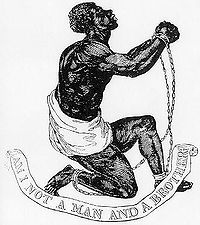
Am I Not A Man And A Brother? Medallion created as part of anti-slavery campaign by Josiah Wedgwood, 1787
Locations
People
Groups
- Friends, Religious Society of (Quakers)
- Britain, Kingdom of Great
- Society for Effecting the Abolition of the Slave Trade
Commodoties
Subjects
Regions
Subregions
Related Events
Showing 10 events out of 24567 total
Years: 1787 - 1787
May
Am I Not A Man And A Brother? Medallion created as part of anti-slavery campaign by Josiah Wedgwood, 1787
Locations
People
Groups
- Friends, Religious Society of (Quakers)
- Britain, Kingdom of Great
- Society for Effecting the Abolition of the Slave Trade
Commodoties
Subjects
Regions
Subregions