
Emir Abdullah of Córdoba dies at the …
Years: 912 - 912
October
Emir Abdullah of Córdoba dies at the age of sixty-seven.
Despite the fact that four of his sons (Aban, Abd al Rahman, Muhammad and Ahmad) are alive at the time of his death, all of them are passed over for succession.
Abdallah instead chooses as his successor his grandson, Abd al-Rahman III (the son of his first son).
This comes as no surprise, since Abdallah had already demonstrated his affection for his grandson in many ways, namely by allowing him to live in his own tower (a privilege he did not grant to any of his sons), and allowing him to sit on the throne on some festive occasions.
Most important, Abdallah had given Abd al-Rahman his ring, the symbol of power, when Abdallah fell ill prior to his death.
Abd al-Rahman succeeds Abdallah the day after his death, October 16, 912.
At the time, Abd al-Rahman is about twenty-one or twenty-two years old.
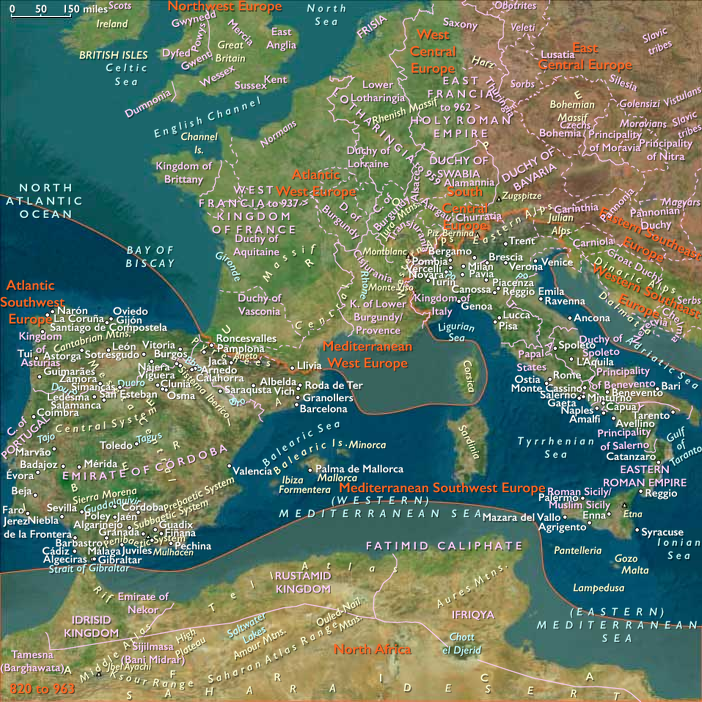
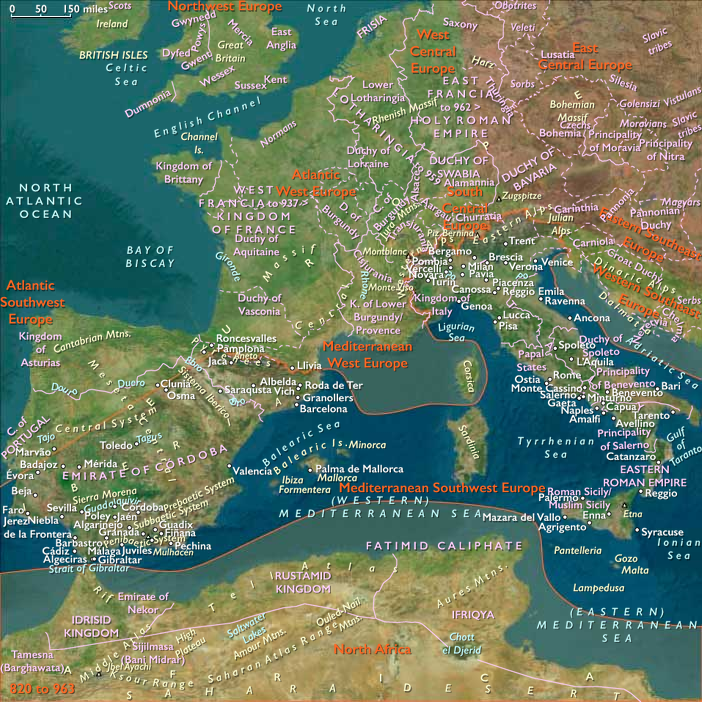
He inherits an emirate on the verge of dissolution, his power extending not far beyond the vicinity of Córdoba.
To the north, the Christian Kingdom of Asturias is continuing its program of Reconquista in the Duero valley.
To the south in Ifriqiya, the Fatimids have created an independent caliphate that threatens to attract the allegiance of the Muslim population, who have suffered under the harsh rule of Abdullah.
Internally, the discontented Muladi families—Muslims of Iberian origin—represent a constant danger for the Córdoban emir.
The most powerful of the latter is Umar ibn Hafsun, who, from his impregnable fortress of Bobastro, controls much of eastern Al-Andalus.
From the very early stages of his reign, Abd ar-Rahman shows a firm resolve to quash the rebels of Al-Andalus, consolidate centralized power, and reestablish internal order within the emirate.
Within ten days of taking the throne, he exhibits the head of a rebel leader in Cordoba.
From this point on, he will lead annual expeditions every spring against the northern and southern tribes to maintain control over them.
To accomplish his aims, he introduces into the court the saqalibah, slaves of East European origin.
The saqalibah represent a third ethnic group that can serve to neutralize the endless strife between his subjects of Muslim Arab heritage, and those of Muslim Berber heritage.
Locations
People
- Abd-ar-Rahman III
- Abdullah ibn Muhammad al-Umawi
- Galindo Aznárez II
- Sancho I of Pamplona
- Umar ibn Hafsun
Groups
- Arab people
- Berber people (also called Amazigh people or Imazighen, "free men", singular Amazigh)
- Slavs, South
- Galicia, Kingdom of
- Christianity, Chalcedonian
- Islam
- Muslims, Sunni
- Saqaliba
- Mozarabs
- Banu Qasi
- Córdoba, Umayyad Emirate of
- Muladi
- Aragón, or Zaca, County of
- Navarre, Kingdom of
- Asturias, Kingdom of
- Ifriqiya, Fatimid Caliphate of
Topics
Commodoties
Subjects
Regions
Subregions
Related Events
Showing 10 events out of 53420 total
Years: 912 - 912
October
Locations
People
- Abd-ar-Rahman III
- Abdullah ibn Muhammad al-Umawi
- Galindo Aznárez II
- Sancho I of Pamplona
- Umar ibn Hafsun
Groups
- Arab people
- Berber people (also called Amazigh people or Imazighen, "free men", singular Amazigh)
- Slavs, South
- Galicia, Kingdom of
- Christianity, Chalcedonian
- Islam
- Muslims, Sunni
- Saqaliba
- Mozarabs
- Banu Qasi
- Córdoba, Umayyad Emirate of
- Muladi
- Aragón, or Zaca, County of
- Navarre, Kingdom of
- Asturias, Kingdom of
- Ifriqiya, Fatimid Caliphate of
Topics
Commodoties
Subjects
Regions
Subregions