Augustus, Elector of Saxony, is thirty-four-years old …
Years: 1560 - 1560
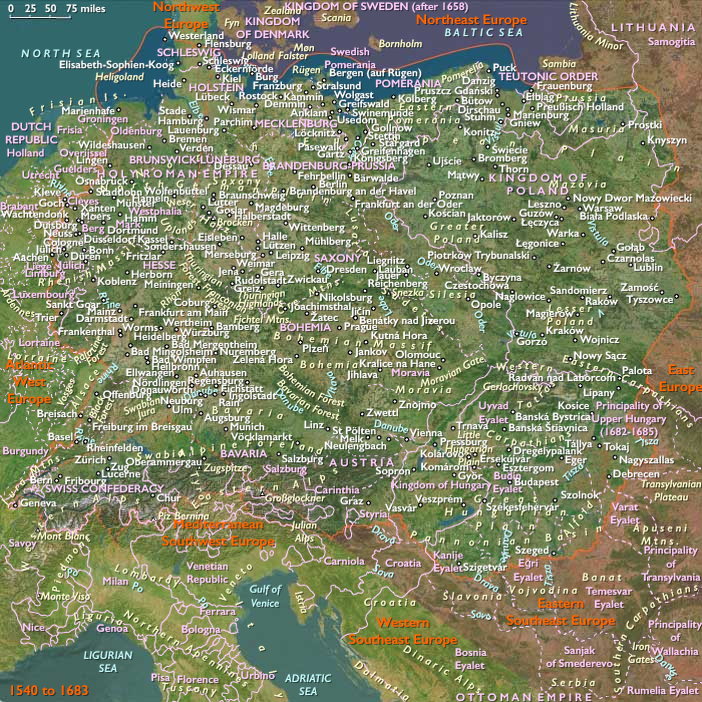
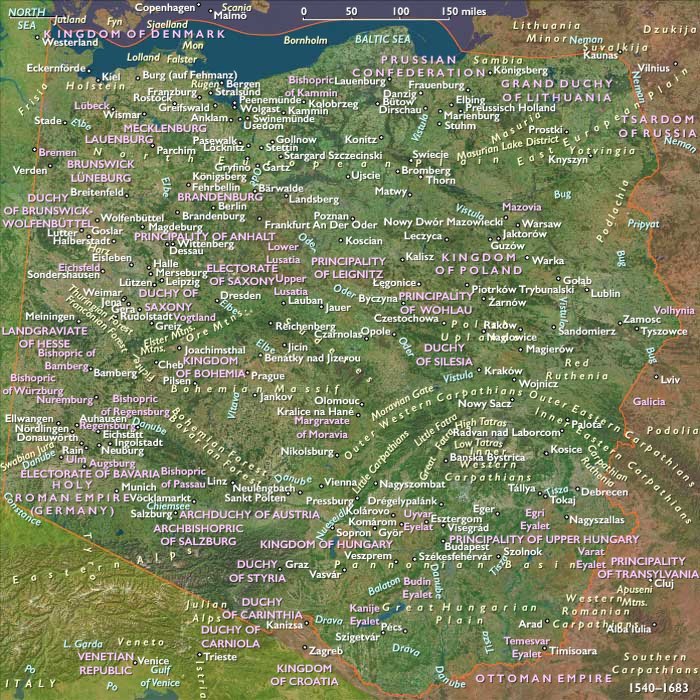
Augustus, Elector of Saxony, is thirty-four-years old in 1560 when he begins to assemble his Kunstkammer, or cabinet of curiosities, in the Dresden Residenzschlossa (it will form the nucleus of the famed Dresden State Art Collection).
Locations
People
Groups
Topics
Subjects
Regions
Subregions
Related Events
Filter results
Showing 10 events out of 35908 total
Oda Nobunaga, born into the Fujiwara clan, a daimyo family of low rank in the eastern Japanese province of Owari, had become the daimyo (territorial lord) of Owari at sixteen.
The son of a government official who had amassed wealth and a respectable force of military retainers, Nobunaga—born as Kichihoshi and later called Saburo—had succeeded to his father's estate in 1549 and soon overpowered his relatives and the principal family of the province.
He is only twenty-six in 1560 when his powerful neighbor to the north, the head of the Imagawa family, attempts to absorb Nobunaga’s domain.
Imagawa Yoshimoto marshals his troops and invades Owari in 1560, but his huge army is soundly defeated and driven from Owari, and Yoshimoto himself is killed in battle.
Sesson Shukei, born in Hitachi and originally named Satake Heizo, is a Japanese monk of the Soto sect of Buddhism and a largely self-taught painter who studies the styles of Shubun and Sesshu and of Chinese painting.
Calling himself Sesson Shukei in tribute to the two Japanese masters, Sessson develops an original, intensely animated style.
The spirited energy and agitated brushwork characteristic of his work is exemplified by a pair of screens titled Dragon and Tiger, painted around 1560 when Sesson is about fifty-four.
His works are classic examples of Japanese ink painting, which has been imported via many artists from China (and has produced many landscapes).
German theologian and educator Philip Melanchthon, who had assumed the leadership of the reform movement after Luther's death in 1546, has bowed too easily to compromise in the interest of peace and has become embroiled in dogmatic controversies with the staunch Lutheran party.
He dies on April 19, 1560, at the age of sixty-three.
The only care that had occupied him until his last moment was the desolate condition of the Church.
The immediate cause of death was a severe cold which he had contracted on a journey to Leipzig in March, 1560, followed by a fever that had consumed his strength, weakened by many sufferings.
His body is laid beside Luther's in the Schlosskirche in Wittenberg.
Akbar's aunt, Maham Anga, one of Bairam’s most serious opponents, is chief nurse and mother of his foster brother, Adham Khan, who is both shrewd and manipulative and hopes to rule by proxy through her son.
The pair urges Akbar in March 1560 to visit them in Delhi, leaving Bairam in the capital, Agra.
While in Delhi, Akbar is deluged by people who insist that he is now ready to take full control of the empire and to dismiss Bairam.
He is persuaded to fund an excursion for Bairam to go on Hajj to Mecca; this is a thinly disguised form of ostracism.
Bairam, shocked at the news from Delhi, is loyal to Akbar, and despite Akbar’s refusal to even meet with the General, refuses the suggestions by some of his commanders to march on Delhi and "rescue" Akbar.
Bairam departs for Mecca, but is soon met by an army sent by Adham Khan, approved by Akbar and sent to "escort" the regent from the Mughal territories.
His patience gone, Bairam leads an attack on the army but is captured and sent to Akbar as a rebel to be sentenced.
Maham Anga urges Akbar to execute Bairam, but Akbar refuses, instead according full honors to the general, giving him robes of honor, and agreeing to fund a proper Hajj excursion.

Husayn Nizam Shah of Ahmadnagar breaks the collective treaty by invading Bijapur in 1560.
Vijayanagar and Golconda respond with an attack that results not only in Ahmadnagar's loss of the fort of Kalyani to Bijapur but also in an invasion of Bidar and the defeat of its ruler by Rama Raya.
Menas banishes the Jesuit bishop André de Oviedo and his companions to a village between Axum and Adwa, located in the modern Tigray Regio, called Maigoga ('noisy water') because of the two rocky streams that run through the community.Te Jesuits optimistically rename the village Fremona, after the missionary Frumentius, who had converted the Axumite kings to Christianity.
The Geneva Bible, one of the most historically significant translations of the Bible into the English language, precedes the King James translation by fifty-one years
The first full edition of this Bible, with a further revised New Testament, appears in 1560.
Geneva, ruled as a republic in which John Calvin and Theodore Beza provide the primary spiritual and theological leadership, had been a refuge for a number of English Protestant scholars who had fled during the reign of Queen Mary.
Among these scholars was William Whittingham, who had come to supervise what became the effort to create the translation now known as the Geneva Bible, in collaboration with Myles Coverdale, Christopher Goodman, Anthony Gilby, Thomas Sampson, and William Cole—several of whom had become prominent figures in the proto-Puritan Nonconformist faction of the Vestments controversy.
Whittingham is directly responsible for the New Testament, which had been completed and published in 1557, while Gilby has overseen the Old Testament.
A new, idiomatic treatment of instrumental sound can be heard in such genres as Luis de Milán’s prelude and fantasia for vihuela and ...
...the organ ricercari (instrumental pieces in motet style) and tocatte of Italian organist and composer Marco Antonio Cavazzoni, who lives from about 1490 to about 1560) and Claudio Merulo.
All of Cavazzoni’s extant music is contained in the print Recerchari, motetti, canzoni [...] libro primo, which had been published in Venice in 1523.
Included are the earliest known ricercars—they are not yet imitative, and are essentially written down improvisations, but there is a considerable amount of thematic development.
The rest of the works in the collection are either arrangements of vocal pieces by Cavazzoni or other composers.
Their style is firmly rooted in the Renaissance vocal chanson tradition.
Titian paints a couple of splendid, light-filled versions of Venus and Adonis in about 1560.
Work on the ornate colored marble facade of the Certosa di Pavia, begun by Giovanni Antonio Amadeo in 1490, had been interrupted in 1519 as work was going forward by the condition of French occupation in Lombardy after the War of the League of Cambrai, when French troops were encamped round the Certosa.
Work on the facade had not resumed until 1554, when a revised design under the direction of Cristoforo Lombardo had been approved for the completion of the facade above the second arcade, where marble intarsia is substituted for the rich sculptural decorations of the lower area.
Completed in 1560, some final details are added by Galeazzo Alessiis.