
Elamite, regarded as a language isolate, is …
Years: 2493BCE - 2350BCE
Elamite, regarded as a language isolate, is unrelated to the neighboring Semitic languages, to the Indo-European languages, or to Sumerian, even though it adopted the Sumerian syllabic script.
Linear Elamite, a writing system from Iran attested in a few monumental inscriptions only, was used for a very brief period during the last quarter of the third millennium BCE.
It is often claimed that Linear Elamite is a syllabic writing system derived from Proto-Elamite, although this cannot be proven.
Several scholars have attempted to decipher Linear Elamite, most notably Walther Hinz and Piero Meriggi.
The Elamite language is first written in pictographs around 2500.
The Elamite Cuneiform script, consisting of about one hundred and thirty symbols, far fewer than most other cuneiform scripts, has been adapted from the Akkadian Cuneiform.
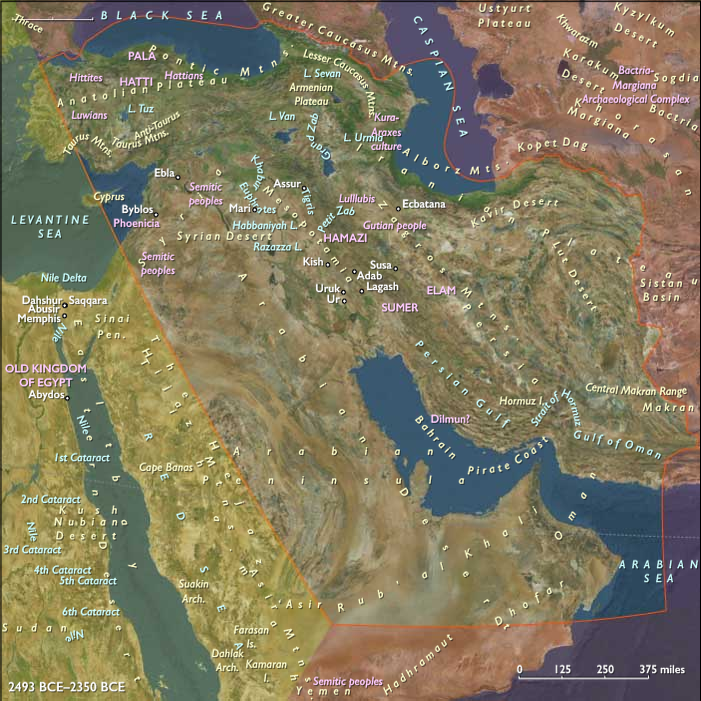
The Awan Dynasty is the first dynasty of Elam of which anything is known today, appearing at the dawn of historical record.
The Elamites are likely major rivals of neighboring Sumer from remotest antiquity; they are said to have been defeated by Enmebaragesi of Kish (who flourished in the twenty-fifth century BCE), who is the earliest archaeologically attested Sumerian king, as well as by a later monarch, Eannatum I of Lagash.
Awan is a city or possibly a region of Elam whose precise location is not certain, but it has been variously conjectured to be north of Susa, in south Luristan, close to Dezful, or Godin Tepe.
At one time, a dynasty from Awan exerted hegemony in Sumer, according to the Sumerian king list, which mentions three Awan kings, who supposedly reigned for a total of three hundred and fifty-six years.
Their names have not survived on the extant copies, apart from the partial name of the third king, "Ku-ul...” who it says ruled for thirty-six years.
This information is not considered reliable, but it does suggest that Awan had political importance in the third millennium BCE.
A royal list found at Susa gives twelve names of the kings in the Awan dynasty.
As there are very few other sources for this period, most of these names are not certain.
Little more of these kings' reigns is known, but Elam seems to have kept up a heavy trade with the Sumerian city-states during this time, importing mainly foods, and exporting cattle, wool, slaves and silver, among other things.
A text of the time refers to a shipment of tin to the governor of the Elamite city of Urua, which was committed to work the material and return it in the form of bronze—perhaps indicating a technological edge enjoyed by the Elamites over the Sumerians.
Locations
People
Groups
Topics
Commodoties
Subjects
- Commerce
- Language
- Symbols
- Writing
- Environment
- Labor and Service
- Conflict
- Faith
- Government
- Technology
- Metallurgy
- Anthropology
- Archaeology
- Linguistics
Regions
Subregions
Related Events
Showing 2 events out of 2 total
Years: 2493BCE - 2350BCE
Locations
People
Groups
Topics
Commodoties
Subjects
- Commerce
- Language
- Symbols
- Writing
- Environment
- Labor and Service
- Conflict
- Faith
- Government
- Technology
- Metallurgy
- Anthropology
- Archaeology
- Linguistics
Regions
Subregions