
Egyptian society along the Nile River begins …
Years: 3645BCE - 3502BCE
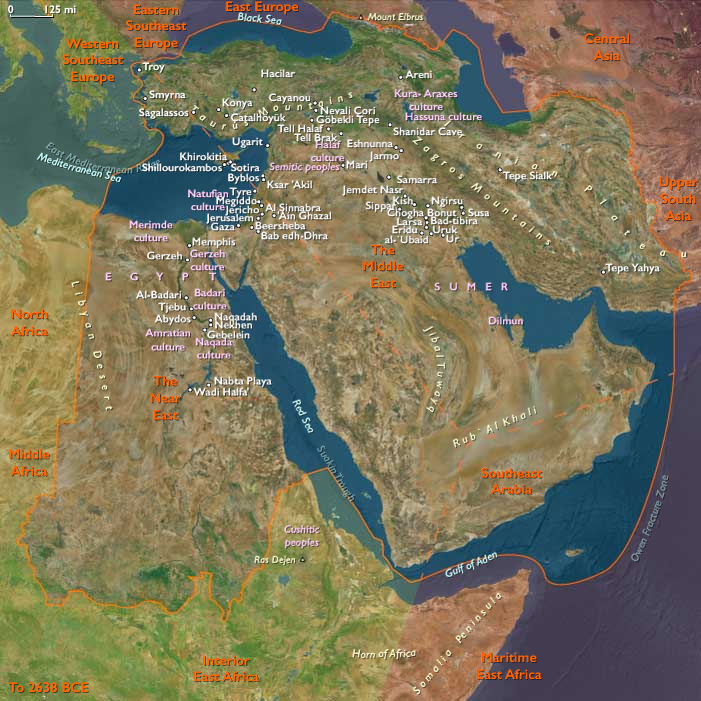
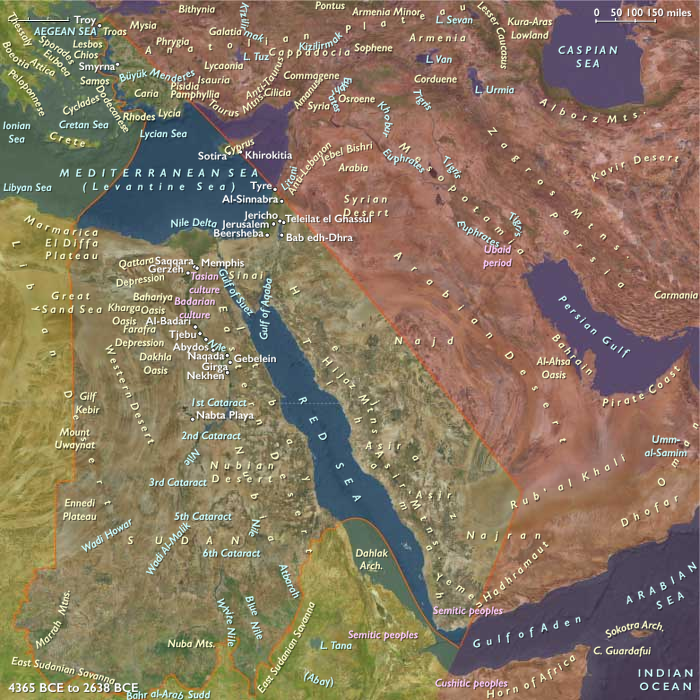
Egyptian society along the Nile River begins in about 3600 BCE to grow and advance rapidly toward civilization; Amratian culture showing technical advances on the Badarian period.
A new and distinctive pottery, related to the pottery of the southern Levant, appears during this time, featuring figures of animals such as hippopotamuses.
Groups
Topics
- Chalcolithic Epoch, or Copper Ages
- Younger Peron Transgression during the Neolithic Subpluvial
- Subboreal Period
Commodoties
Subjects
Regions
Subregions
Related Events
Filter results
Showing 10 events out of 68780 total
Integration of the various societies and cultures in Europe, the Near East, and China increases during this age.
The earliest known Korean pottery dates back to around 8000 BCE or before, and evidence of Mesolithic Pit-Comb Ware culture or Yungimun Pottery is found throughout the peninsula.
An example of a Yungimun-era site is in Jeju-do.
Jeulmun or Comb-pattern Pottery is found after 7000 BCE, and pottery with comb-patterns over the whole vessel is found concentrated at sites in west-central Korea when a number of settlements such as Amsa-dong exist.
Jeulmun pottery bears basic design and form similarities to that of the Russian Maritime Province, Mongolia, and the Amur and Sungari River basins of Manchuria and the Jomon culture in Japan.
Examples of Early Jeulmun settlements include Seopohang, Amsa-dong, and Osan-ri.
Deep-sea fishing, hunting, and small semi-permanent settlements with pit-houses characterize the Early Jeulmun period (from about 6000 BCE to about 3500 BCE).
Radiocarbon evidence from coastal shell midden sites such as Ulsan Sejuk-ri, Dongsam-dong, and Ga-do Island indicates that shellfish were exploited, but many archaeologists maintain that shellmiddens (or shellmound sites) did not appear until the latter Early Jeulmun.
Old Europe is a term coined by archaeologist Marija Gimbutas to describe what she perceived as a relatively homogeneous and widespread pre-Indo-European Neolithic culture in Europe, particularly in Malta and the Balkans.
Archaeologists and ethnographers working within her framework believe that the evidence points to migrations of the peoples who spoke Indo-European languages at the beginning of the Bronze age (the Kurgan hypothesis).
For this reason, Gimbutas and her associates regard the terms Neolithic Europe, Old Europe, and Pre-Indo-European as synonymous.
The Old Europe civilization flourishes in the region of Macedonia, according to archaeological evidence, between 7000 and 3500 BCE.
The Middle East (3646–3502 BCE): Expansion of Urban Centers and Technological Progress
Growth of Urban Settlements
Between 3646 and 3502 BCE, urban centers throughout Mesopotamia and the broader Middle East experienced significant expansion and development. Settlements such as Susa, Uruk, and Tell Brak continued to evolve, demonstrating increasingly complex urban planning and community organization. These cities expanded their influence, becoming central nodes within emerging trade and administrative networks.
Urban Planning and Infrastructure
This period saw significant advancements in urban infrastructure, including the construction of larger monumental buildings, expanded city walls, and more sophisticated public works such as roads and drainage systems. Such infrastructure supported growing urban populations and facilitated more efficient administration, trade, and social interaction.
Administrative and Writing Systems
Building upon earlier developments, the administrative systems within these urban centers became increasingly sophisticated. Cylinder seals, tokens, bullae, and early tablets continued to serve as vital administrative tools, supporting the growth of bureaucracy and record-keeping. The progressive complexity of these writing systems marked a critical step toward the formalization of writing and accounting practices that would underpin future civilizations.
Technological and Economic Advances
Metallurgical technology continued to advance, with the production and distribution of bronze artifacts becoming more widespread. This era witnessed further refinement of metallurgical techniques, improving the quality and utility of metal tools and weapons, and contributing significantly to agricultural efficiency, craftsmanship, and warfare capabilities.
Cultural Interactions and Exchange
Regional trade networks became increasingly interconnected, facilitating the exchange of goods, ideas, and technologies between urban centers. This integration helped spread innovations such as metallurgy, pottery styles, and architectural techniques throughout the region, enhancing cultural cohesion and economic prosperity.
This age represents a vital period of urban growth, technological innovation, and administrative sophistication, significantly shaping the societal complexity and cultural development of the ancient Middle East.
The Near East (3645–3502 BCE): Advances Along the Nile
Rapid Development of Egyptian Society
Around 3600 BCE, Egyptian society along the Nile River experiences a significant acceleration in growth and cultural sophistication, rapidly advancing toward a complex civilization. Building on earlier developments, the Amratian culture (also known as Naqada I) demonstrates remarkable technical progress compared to the preceding Badarian period.
The Amratian period is particularly notable for innovations in pottery. A new and distinctive ceramic style emerges, closely related to contemporary pottery traditions in the southern Levant. These ceramics frequently feature elaborate artistic representations, prominently displaying figures of animals integral to life along the Nile, such as hippopotamuses. The presence of these animal motifs underscores the cultural emphasis on the surrounding environment and the significance of Nile fauna within the growing symbolic repertoire of Egyptian society.
Such technical and artistic advances indicate an increasingly interconnected Near East, with cultural and trade links facilitating the exchange of artistic ideas and technologies between Egypt and its neighbors. These developments lay important groundwork for the subsequent rise of Egyptian civilization, marking a critical stage in the trajectory toward state formation and cultural sophistication.
The megalithic complex of Hagar Qim is located atop a hill on the southern edge of the island of Malta, on a ridge capped in soft globigerina limestone.
All exposed rock on the island was deposited during the Oligocene and Miocene periods.
Globigerina limestone is the second oldest rock on Malta, outcropping over approximately seventy percent of the area of the islands.
The builders used this stone throughout the temple architecture.
A trilithon entrance, outer bench, and orthostats characterize the temple’s façade.
It has a wide forecourt with a retaining wall and a passage runs through the middle of the building, following a modified Maltese megalithic design.
A separate entrance gives access to four independent enclosures that replace the northwesterly apse.
Features of temple architecture reveal a preoccupation with providing accommodation for animal sacrifices, burnt offerings and ritual oracles.
Recesses were used as depositories for sacrificial remains.
Excavation has uncovered numerous statuettes of deities and highly decorated pottery.
No burials exist in the temple or the area surrounding Hagar Qim, nor have any human bones been discovered in Maltese temples.
Bones of numerous sacrificial animals have been found.
It is theorized that the Hagar Qim complex was built in three stages, beginning with the 'Old Temple' northern apses, followed by the 'New Temple', and finally the completion of the entire structure.
The two temples at Ggantija on the Maltese island of Gozo are notable for their gigantic Neolithic structures.
They are the world's oldest freestanding structures, and the world's oldest religious structures, predating the Pyramids of Egypt and Stonehenge.
The temples, each constructed as a series of semicircular apses connected with a hall in the centers, are possibly the sites of an Earth Mother Goddess Fertility Cult, with numerous figurines and statues found on site that archaeologists believe are connected with that cult.
The temples are cloverleaf-shaped; built up with cyclopean facing stones and filled in with rubble.
Each is constructed as a series of semicircular apses connected with a hall in the center.
Archaeologists believe that masonry domes originally covered the apses.
The southern temple, the older and more extensive of the two, dates to approximately 3600 BCE.
Like other megalithic sites in Malta, the temple faces southeast.
It rises to a height of six meters.
At the entrance sits a large stone block with a recess that some archaeologists have hypothesized as a ritual ablution station for purification before entering the complex.
The five apses contain various altars; evidence of animal bones in the site suggests the site was used for animal sacrifice.
Carvings that decorate the site depict goats, sheep, and pigs of both sexes, possibly showing which animals were used by the sacrificial cult.
The structures are all the more impressive for having been constructed at a time when no metal tools were available to the natives of the Maltese islands, and when the wheel had not yet been introduced.
Small, spherical stones have been discovered; it is believed that these were used as ball bearings to transport the enormous stone blocks required for the temples' construction.
Mnajdra, a megalithic temple complex found on the southern coast of the Mediterranean island of Malta, is made of coralline limestone, which is much harder than the soft globigerina limestone of Hagar Qim, approximately five hundred meters away.
The main structural systems used in the temples are corbelling with smaller stones, and post-and-lintel construction using large slabs of limestone.
The cloverleaf plan of Mnajdra appears more regular than that of Hagar Qim, and seems reminiscent of the earlier complex at Ggantija.
The prehistoric structure consists of three conjoined but not connected temples: the upper, middle and lower.
The upper temple is the oldest structure in the Mnajdra complex and dates to the Ggantija phase (3600-3200 BCE).
It is a three-apsed building, the doorway of which is formed by a hole cut into a large piece of limestone set upright, a type of construction typical of other megalithic doorways in Malta.
This temple appears originally to have had a vaulted ceiling, but only the base of the ceiling now remain on top of the walls.
The pillar-stones were decorated with pitmarks drilled in horizontal rows on the inner surface.
The temple contains "furniture" such as stone benches and tables that set it apart from other European megalith constructions.
The earliest appearance of the wagon dates to the middle of the fourth millennium BCE in Mesopotamia, (though some argue that the steppes of Central Asia, also home to early users, is the more likely birthplace of the wagon).
The earliest well-dated depiction of a wheeled vehicle (here a wagon—four wheels, two axles) is on the Bronocice pot, a circa 3500–3350 BCE clay pot excavated in a Funnelbeaker culture settlement in southern Poland.
Years: 3645BCE - 3502BCE
Groups
Topics
- Chalcolithic Epoch, or Copper Ages
- Younger Peron Transgression during the Neolithic Subpluvial
- Subboreal Period
