Egbert of Wessex has also gained recognition …
Years: 839 - 839
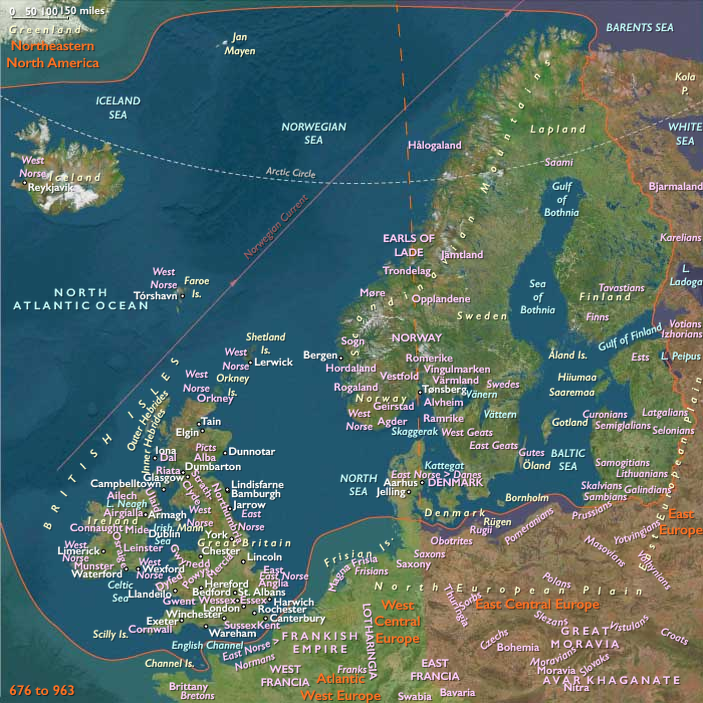
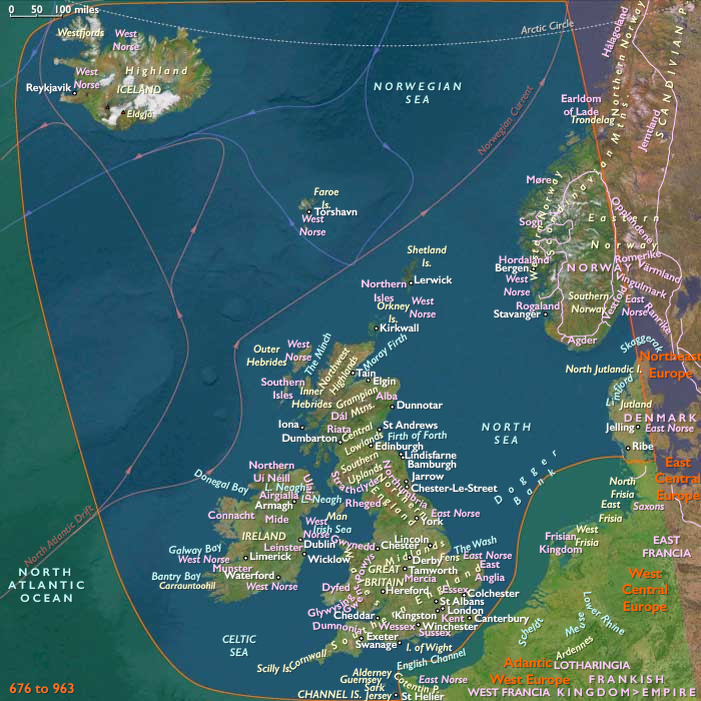
Egbert of Wessex has also gained recognition as sovereign in Kent, Surrey, Sussex, and Essex, by the time of his death in 839; Æthelwulf succeeds him.
Locations
People
Groups
Topics
Subjects
Regions
Subregions
Related Events
Filter results
Showing 10 events out of 54272 total
Ancona had been one of the cities of the Pentapolis of the Roman Exarchate of Ravenna in the seventh and eighth centuries, and had come under Carolingian control after Charlemagne’s conquest of northern Italy.
Saracen raiders from the south sack and burn the city in 840.
The Partition of 839: Lothair I's Middle Frankish Kingdom
In 839, Emperor Louis the Pious reorganizes the Carolingian succession, granting Lothair I sovereignty over the Middle Frankish Kingdom, a vast territory stretching from the North Sea to Italy. This new partition further escalates tensions among Louis' surviving sons, especially Louis the German and Charles the Bald.
Lothair’s Middle Frankish Kingdom (839)
The lands assigned to Lothair I include:
- Most of the present Low Countries (modern Belgium, the Netherlands, and Luxembourg).
- Alsace-Lorraine (modern northeastern France and western Germany).
- Switzerland (a crucial region linking the empire’s northern and southern territories).
- Northern Italy, securing control over key cities such as Milan and Pavia.
Louis II Designated as King of Italy
- Louis II, Lothair’s eldest son, is formally designated as King of Italy under his father’s sovereignty.
- This decision ensures that the imperial control over Rome and the Papal States remains within Lothair’s lineage, maintaining a connection between the Carolingian dynasty and the imperial title.
Consequences of the 839 Partition
- Louis the German and Charles the Bald are angered by the decision, as it relegates them to the peripheries of the empire while Lothair controls its central lands.
- The new arrangement overturns previous partitions, further fueling civil war after Louis the Pious’ death in 840.
- The division fails to create a lasting empire, as the Treaty of Verdun (843) permanently fragments the Carolingian realm into three independent kingdoms.
Though Lothair's inheritance makes him the most powerful Carolingian ruler, his control over the Middle Frankish Kingdom proves fragile, and his descendants struggle to maintain dominance over this politically unstable region.
The Pyu, who speak a Tibeto-Burman language, are believed to have been an ethnic group distinct from the Bamar (Burmans), although they may have intermarried with Sino-Tibetan migrants who later became part of the Bamar ethnicity.
The Pyu city-states of the region of present Mynamar, or Burma, have never unified into a Pyu kingdom, but the more powerful cities have often dominated and called for tribute from the lesser cities.
The most powerful city by far had been Sri Ksetra, which archaeological evidence indicates was the largest city that has ever been built in Burma.
The exact date of its founding is not known, though likely to be prior to a dynastic change in the year 94 mentioned in Pyu chronicles.
The Pyu in the seventh century had shifted their capital northward towards Halingyi in the dry zone, leaving Sri Ksetra as a secondary center to oversee trade in the south.
Sri Ksetra had apparently been abandoned around 656 in favor of a more northern capital, though the exact site is not known.
Some historians believe it was Halingyi, and may be related to the ancient city of Tagaung.
Wherever the new capital was located, it is sacked by the Bai kingdom of Nanzhao in in about 840, ending the Pyu's period of dominance.
Emperor Wenzong had originally created his son Li Yong crown prince, but after Li Yong died in 838, he had been unsure whom to make his successor.
Emperor Wenzong's favorite concubine Consort Yang had recommended Li Rong, but when Emperor Wenzong consulted the chancellors, Li Jue had opposed this proposal.
Emperor Wenzong had thus, in 839, created Emperor Jingzong's youngest son Li Chengmei the Prince of Chen crown prince.
When Emperor Wenzong becomes seriously ill early in 840, he has his trusted eunuchs Liu Hongyi and Xue Jileng summon the chancellors Yang Sifu and Li Jue to the palace, intending to entrust Li Chengmei to them.
However, the powerful eunuchs Qiu Shiliang and Yu Hongzhi, who had not been not consulted in the decision, oppose Li Chengmei, and despite Li Jue's objection, forge an edict in Emperor Wenzong's name deposing Li Chengmei by claiming that Li Chengmei is too young, and creating Li Chan crown prince instead.
Subsequently, Qiu and Yu have soldiers escort Li Chan from his mansion to the palace and, after Emperor Wenzong then dies, persuade Li Chan to order Consort Yang, Li Chengmei, and Li Rong all to commit suicide.
After a short mourning period, Li Chan takes the throne as Emperor Wuzong.
The collapse of Tang's erstwhile vassal and ally the Uyghur Khaganate—which had supported the Tang Dynasty in various campaigns through the decades—is one of the first things with which Emperor Wuzong has to deal.
The Uyghur Khaganate had weakened due to internal power struggles to the point that when the Xiajiasi (Kirghiz) khan Are attacks them in 840, the Uyghur khan Yaoluoge Hesa is killed.
The Uyghur tribespeople scatter, fleeing in various directions.
One major group, under the leadership of the prince Wamosi and the nobles Chixin, Pugu, and Najiachuo, heads for the Tang border city of Tiande (in modern Hohhot, Inner Mongolia) and seeks to submit to the Tang.
The leader of another major group, the noble Yaoluoge Wuxi, claims the khan title for himself (as Wujie Khan); Wujie Khan subsequently seizes Emperor Wuzong's aunt, Princess Taihe, who had married a previous khan (Chongde Khan) and holds her hostage.
Various Uyghur remnants pillage the Tang border regions, causing much disturbance for the Tang people.
At Li Deyu's suggestion, Emperor Wuzong supplies food to the Uyghur remnants to try to calm them, while accepting Wamosi's submission.
When Wujie Khan subsequently demands that Tang turn Wamosi over to him as a traitor, Emperor Wuzong refuses.
The power of the Uyghur Khaganate had declined after the death of Tun Bagha Tarkhan death in 789, and the empire had begun to fragment.
The Tibetans had taken the area of Beshbalik, and the Karluks had captured Fu-tu valley.
The khagan bearing the title Qutlugh Bilge had died in 795, ending the Yaghlakar dynasty.
A general named had Qutlugh declared himself the new khagan, under the title Tängridä ülüg bulmïsh alp kutlugh ulugh bilgä kaghan ("Greatly born in moon heaven, victorious, glorious, great and wise Kaghan"), founding a new dynasty, the Ediz.
The Khaganate, with solid leadership once more, had averted collapse.
Qutlugh became renowned for his leadership and management of the empire but, while he consolidated the empire, he failed to restore its previous power.
The empire on his death in 808 had once again begun to fragment.
Qutlugh was succeeded by his son, who had gone on to improve trade in inner Asia.
The name of the last great khagan of the Empire is unknown, though he bore the title Kün tengride ülüg bulmïsh alp küchlüg bilge ("Greatly born in sun heaven, victorious, strong and wise").
His achievements included improved trade up with the region of Sogdiana, and on the battlefield in 821 he repulsed a force of invading Tibetans.
This khagan, who died in 824, had been succeeded by a brother, Qasar, whose murder in 832 had inaugurated a period of anarchy.
The legitimate khagan had been forced in 839 to commit suicide, and a usurping minister named Kürebir had seized the throne with the help of twenty thousand horsemen of Shato from Ordos.
A famine and an epidemic in the same year, coupled with a particularly severe winter that killed much of the livestock, had devastated the Uyghur economy.
One of nine Uyghur ministers, Kulug Bagha, rival of Kurebir, flees in the following spring, in 840, to the Kyrgyz tribe and invites them to invade from the north.
The Kyrgyz, with a force of around eighty thousand horsemen, sack the Uyghur capital at Ordu-Baliq, razing it to the ground, and capture the Uyghur Khagan, Kürebir (Hesa), who they promptly behead.
They go on to destroy other cities throughout the Uyghur Khaganate, burning them to the ground.

It owes its name, meaning "seven rivers" (literally "seven waters") in Kazakh and Persian, to the rivers which flow from the south-east into Lake Balkhash.
The rise to power will brings about a spread south of the Yenesei Kyrgyz people to reach the Tian Shan and Xinjiang, bringing them into contact with the existing peoples of western China, especially Tibet.
A Lombard prince held prisoner in Taranto is in 840 freed by his partisans, brought to Benevento, and made duke.
At the same time, the Saracens take control of Taranto, exploiting the weak Lombard control to make Taranto an Arab stronghold and privileged harbor.
In the same year, an Arab fleet leaves Taranto, defeating in the Gulf of Taranto a Venetian fleet of sixty ships that had responded to a summons by the emperor Theophilos, and enters the Adriatic sea, sacking the coastal cities.
The Final Partition of the Carolingian Empire and the Outbreak of Civil War (839–840)
Throughout his long reign, Louis the Pious seeks to divide his empire fairly among his sons, adhering to Frankish traditions of partible inheritance as outlined in Salic Law. However, his decision to grant land to his youngest son, Charles the Bald, born from his second marriage to Judith of Bavaria, sparks decades of civil war among his older sons.
The Final Partition of 839: The Division at Worms
Following his vindicating victory over his last rebellious son, Louis the German, in 839, Emperor Louis the Pious divides his empire for the last time at Worms on May 30, 839:
- Lothair I → Retains Italy and the imperial title, along with all the other lands of the east, consolidating his claim as primary ruler of the empire.
- Charles the Bald → Receives all the lands of the west, ensuring a powerful Frankish kingdom that will later evolve into France.
- Louis the German → Left with only Bavaria, significantly reducing his authority.
- Pepin II of Aquitaine (son of the late Pepin I) → Excluded from the inheritance, fueling his discontent.
This arrangement favors Charles and Lothair, sidelining Louis the German and Pepin II, setting the stage for another civil war upon Louis the Pious’ death in 840.
The Death of Louis the Pious and the Civil War (840–843)
On June 20, 840, Louis the Pious dies, and almost immediately, Lothair I attempts to assert full imperial control, violating the agreements of Worms (839).
- On July 24, 840, in Strasbourg, Lothair declares his imperium over all Frankish lands, claiming overlordship over his brothers.
- He allies with his disinherited nephew, Pepin II of Aquitaine, and together they invade the Loire Valley, launching a campaign against Charles the Bald.
The Fracturing of the Empire: Divided Loyalties
The Carolingian nobility is divided in allegiance, particularly in Burgundy, where counts split between Charles and Lothair:
Lothair’s Supporters
- Ermenaud III of Auxerre
- Arnoul of Sens
- Audri of Autun
- Girard II, Count of Paris (Lothair’s brother-in-law)
Charles’ Supporters
- Guerin of Provence
- Aubert of Avallon
The War’s Outcome: The Treaty of Verdun (843)
The war continues until Charles the Bald and Louis the German defeat Lothair at the Battle of Fontenay (841) and solidify their alliance with the Oaths of Strasbourg (842). This culminates in the Treaty of Verdun (843), which permanently divides the Carolingian Empire into three distinct kingdoms:
- West Francia → Charles the Bald (precursor to France).
- Middle Francia → Lothair I, including the imperial title, but his kingdom will later fracture.
- East Francia → Louis the German (precursor to Germany).
Legacy of the 839 Partition and Civil War
- The dream of a unified Carolingian Empire collapses, marking the beginning of medieval Europe’s political map.
- The Frankish kingdoms begin evolving into separate entities, leading to the future emergence of France and Germany.
- Lothair’s imperial ambitions fail, and his Middle Frankish Kingdom proves unstable, setting the stage for further fragmentation.
Thus, the final partition of Louis the Pious in 839 directly leads to the division of Charlemagne’s empire, shaping the medieval European world for centuries to come.