Edward is meanwhile crowned on June 8, …
Years: 900 - 900
June
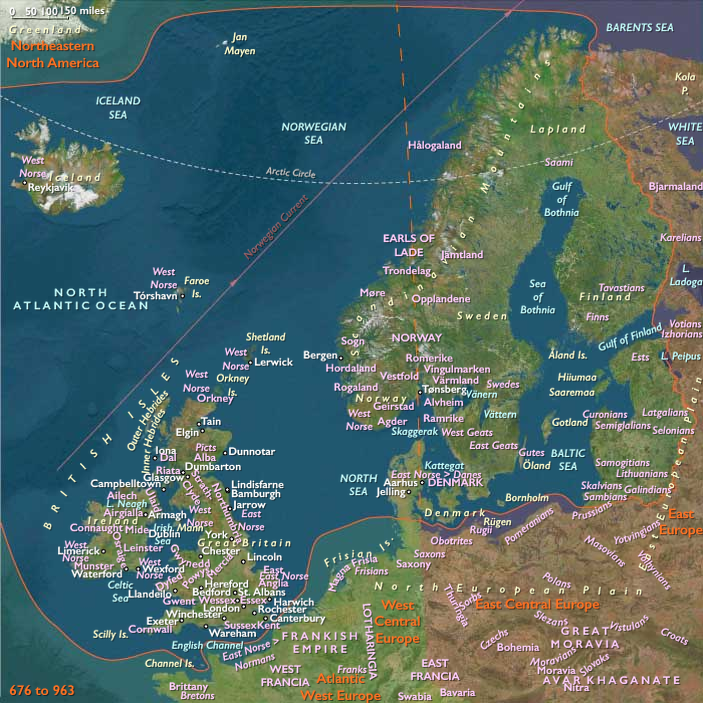
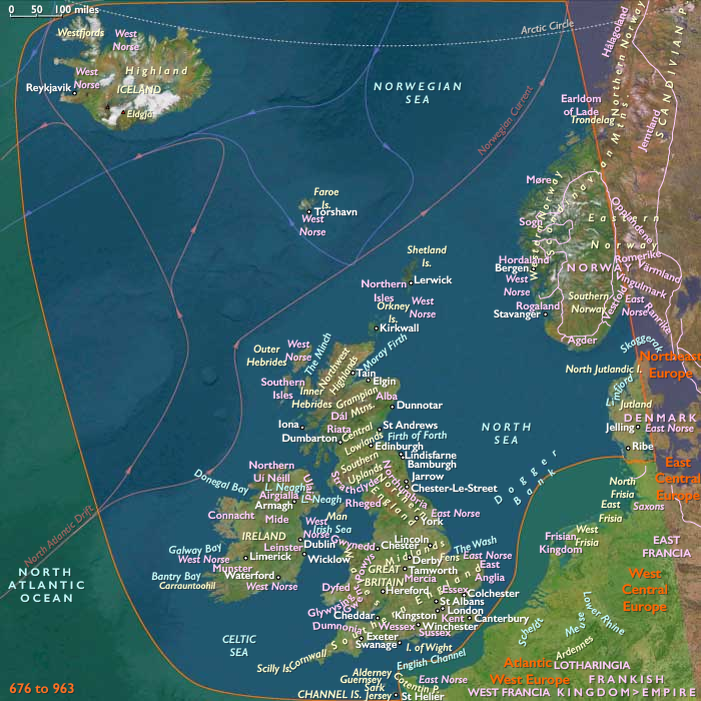
Edward is meanwhile crowned on June 8, 900, possibly at Kingston on Thames.
Locations
People
Groups
Topics
Commodoties
Subjects
Regions
Subregions
Related Events
Filter results
Showing 10 events out of 53568 total
Gyeon Hwon conquers the southwest regions and in 900 declares himself king of Hubaekje ("later Baekje"), a country meant to revive Baekje's glory.
He establishes his capital at Wansanju, today's Jeonju, and continues to expand the kingdom.
The chancellor Cui Yin, who harbors an ardent hatred for the eunuchs and who is allied with Zhu Quanzhong, is meanwhile also rising in power at the Tang court.
By 900, Emperor Zhaozong, who has come to trust Cui and who will later describe him as "faithful but trickier" (than Han Wo, the official to whom the emperor was addressing his comment) is planning with Cui to slaughter the eunuchs.
When Cui's fellow chancellor Wang Tuan urges against such action, believing the plans to be too drastic, Cui accuses Wang of being in league with the powerful eunuchs Zhu Daobi and Jing Wuxiu, who serve as the directors of palace communications.
Upon Cui's accusations, Emperor Zhaozong orders Wang, Zhu Daobi, and Jing to commit suicide, and it is said that from this point Cui became the leading figure at court, the eunuchs regarding him with anger and fear.
The eunuchs also have become fearful of Emperor Zhaozong himself, who, after returning from Hua Prefecture, is described to be depressed, alcoholic, and unpredictable in his temperament.
The four top-ranked eunuchs—Liu Jishu and Wang Zhongxian, the commanders of the Shence Armies, and Wang Yanfan and Xue Qiwo, the new directors of palace communications—begin plotting to remove him.
After an incident in winter 900 in which Emperor Zhaozong, in a drunken rage, kills several attending eunuchs and ladies in waiting, Liu Jishu leads Shence Army troops into the palace and forces Emperor Zhaozong to yield the throne to his son Li Yu the Crown Prince.
Emperor Zhaozong and his wife (Li Yu's mother) Empress He ware honored as retired emperor (Taishang Huang) and retired empress (Taishang Huanghou) but put under house arrest.
Li Yu, whose name the eunuchs change to Li Zhen, is proclaimed emperor, but the eunuchs control the court.
They want to kill Cui, but are fearful that Cui's ally Zhu Quanzhong might react violently, so they only relieve Cui from his secondary posts as the director of finances and the director of salt and iron monopolies.

The Uyghur people, who have occupied Xinjiang since their expulsion from the Mongol steppes in 840 by the Yenisey Kyrgyz, in around 900 abandon their indigenous religion—a combination of shamanistic and Buddhist traditions—for Sunni Islam.
The Magyars under Árpád and Kurszán gain full control of the Carpathian Basin by about 900.
Abdallah, son of the Aghlabid emir Ibrahim II, represses a revolt of his Muslim subjects and then initiates a campaign against the last imperial strongholds in Sicily.
The Establishment of the County of Hainaut (c. 900)
Around 900 CE, the County of Hainaut is formally established in Lotharingia, the former Middle Kingdom of the Carolingian Empire. The county’s creation is tied to Duke Reginar I of Lorraine, a powerful noble and grandson of Emperor Lothair I, who assumes the title of Count of Hainaut.
Reginar I and the Creation of Hainaut
- Reginar I (also called Reginar Longneck) had already been a dominant figure in Lotharingian politics, holding the titles of Margrave of Lotharingia and Duke of Lorraine.
- Around 900, he consolidates his rule over the region of Hainaut, taking the title Count of Hainaut, formalizing its status as a distinct feudal entity within Lotharingia.
- The county is located between the Scheldt and Meuse rivers, a strategic border region with strong military and economic importance.
Hainaut’s Role in Feudal Europe
- As Lotharingia becomes increasingly contested between East Francia and West Francia, the Counts of Hainaut gain increasing autonomy.
- Hainaut serves as a buffer zone, making it a militarily significant stronghold in the power struggles between West Francia, East Francia, and later the Holy Roman Empire.
- The county will become an important feudal domain, playing a key role in the later political landscape of medieval France and the Low Countries.
Legacy of the County of Hainaut
- Hainaut will remain a powerful regional lordship, later becoming part of the Duchy of Burgundy and the Habsburg Netherlands.
- The foundation of the county around 900 CE marks the continuing fragmentation of the Carolingian Empireand the emergence of local feudal rulers as the dominant political figures in post-Carolingian Europe.
- Reginar I’s dynasty—the House of Reginar—will remain influential in the Low Countries for generations.
The establishment of the County of Hainaut under Reginar I reflects the transition from centralized Carolingian rule to decentralized feudal governance, setting the stage for the political structure of medieval Europe.
Muhammad has been given the former palace of the Tahirids as his residence in Baghdad.
In January 900, however, the vizier Ubayd Allah ibn Sulayman ibn Wahb learns that Muhammad is planning to escape, and he is arrested.
Nothing further is known of him thereafter.
The Mezzogiorno in the time of Gregory IV of Naples is under constant Saracen assaults.
Around 900, Gregory destroys the castrum Lucullanum, a Neapolitan fortress just outside the city, to prevent the Muslims from taking it as a base.
Otherwise, he reinforces the city walls and stores supplies to ensure survival in the event of a long siege.
Atenulf I of Capua, the son of Landenulf, gastald of Teano, has through his influence and conquests succeeded in vindicating his Lombard family's pretensions to princely status, à la those of Benevento and Salerno.
Capua had from 879 been contested between several candidates, but, by 887, Atenulf had removed his brothers and cousins from contention and become sole prince with the assistance of the hypatus Athanasius of Naples.
In the next year (888), he was at war with Athanasius over "Liburnia."
They fought an indecisive battle at S. Carzio on the Clanio.
Atenulf had next turned his attention to Benevento, which had recently been under the control of Constantinople, then Spoleto.
Conquering it from the once-deposed Prince Radelchis II in 899, he is acclaimed prince in Santa Sofia in Benevento in January 900.
He is opposed by the one-time regent of Benevento, the Bishop Peter, whom he exiles to Salerno.
Having united most of the Lombard Mezzogiorno, he directs his aggression towards the Saracens of the Garigliano.
Louis is crowned in Forchheim on February 4, 900.
This is the earliest German royal coronation about which records are known to exist.
Louis is of a weak personal constitution, often sick, and with his young age, the reins of government are entirely in the hands of others, the nobles and bishops.
Indeed, the coronation is probably a result of the fact that there is little Louis can gain at the expense of the nobles.
Louis will also inherits Lotharingia with the death of his elder illegitimate half-brother, Zwentibold, in 900.