
Edmund's reputation as a warrior is such …
Years: 1016 - 1016
November
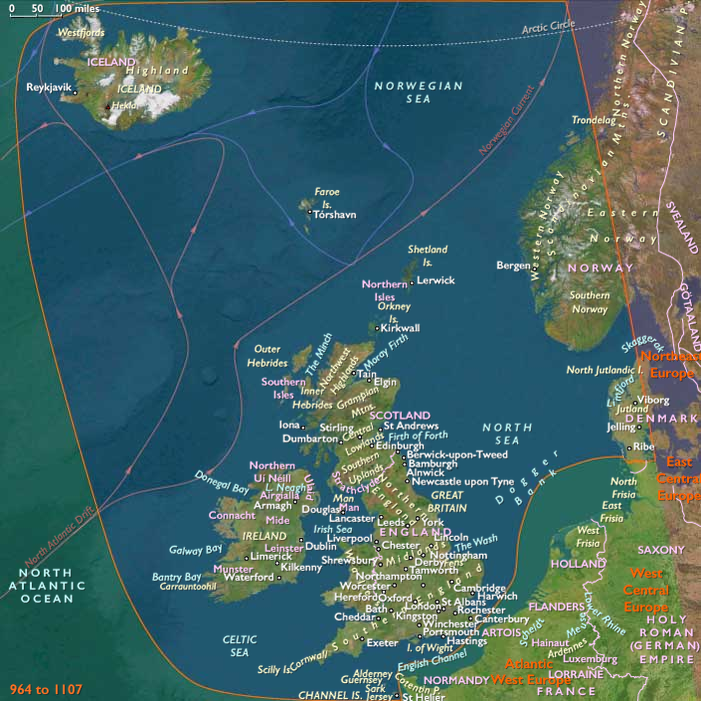
Edmund's reputation as a warrior is such that Cnut nevertheless agreed to divide England, Edmund taking Wessex and Cnut the whole of the country beyond the Thames.
However, Edmund dies on November and Cnut becomes king of the whole country.
Locations
People
Groups
- Anglo-Saxons
- Denmark, Kingdom of
- Vikings
- Danes (Scandinavians)
- Normandy, Duchy of
- England, (Anglo-Saxon) Kingdom of
- England, (Danish) Kingdom of
Topics
Commodoties
Subjects
Regions
Subregions
Related Events
Filter results
Showing 10 events out of 51753 total
Fan Kuan's masterpiece and best known painting is his Travelers among Mountains and Streams, a large hanging scroll.
A seminal work of the Northern Song school, it establishes an ideal in monumental landscape painting to which later artists will return time and again for inspiration.
Fan Kuan based the painting on the Taoist principle of reclusion, the composition emphasizes the monumentality of nature.
A packhorse train can barely be seen emerging from a wood at the base of a huge precipice.
Despite the fact that the painting represents an ideal example of the achievements of the Northern Song landscape styles, the painting still represents several archaic conventions dating back to the Tang Dynasty.
The composition remains dominated by a central massif.
The foliage are composed of mechanically repeated and narrow texture strokes.
The exact date and circumstances of Tmutarakan's takeover by the Kievan Rus are uncertain, but the Hypatian Codex mentions Tmutarakan as one of the towns that Vladimir the Great gave to his sons, which implies that Russian control over the city was established in the late tenth century and certainly before Vladimir's death in 1015.
Bronze and silver imitations of Constantinople’s coinage are struck by the new rulers during this period.
Vladimir's son Mstislav of Chernigov is the prince of Tmutarakan at the start of the eleventh century.
Mstislav of Chernigov was about five years old when his father baptized himself and his family.
On this event, Mstislav received the Christian name of Constantine, alluding to the founding emperor of the imperial city, and was dispatched to rule Tmutarakan on the Black Sea.
His relations with the Empire are cordial for the most part.
In 1016, he subdues the last Crimean strongholds of the Khazar, led by Georgius Tzul.
This campaign, conducted in conjunction with imperial forces, helps the Greeks to reassert their control of the Crimea.
Georgius Tzul appears only in the account of the Byzantine court historians Kedrenos and John Skylitzes, who place him at Kerch and calls him "khagan" (the title of the Khazar emperors).
Kedrenos states that he was captured by the expeditionary force but does not relate his ultimate fate.
Inscriptions and other references exist referring to a Tzul or Tsal clan in Crimea during this period; presumably he was a member although the relationship of that family to the original ruling dynasty of Khazaria is unknown.
Almost nothing else about him, including the extent of his holdings, is known.
Despite the fact that earlier writers maintained that the Khazar khagan was required to adhere to Judaism, Georgius is a Christian name.
Whether Georgius Tzul was himself a Christian, a Jew or Shamanist with an unusual Greek name, or whether the name is merely a Byzantine attempt to transliterate a Turkic or Hebrew name, is unknown.
It is worth noting that Constantinople’s campaigns occurred roughly during this period against the Georgians and Bulgarians, suggesting a concerted effort to reestablish imperial dominance in the Black Sea region.
Ali ibn Hammud al-Nasir, the Hammudi governor of Ceuta, occupies the Iberian port of Algeciras, then moves to …
…Málaga, conquering that city also, then in 1016 marches with his North African army to …
…the capital, Córdoba, to which Sulayman’s policy of concessions to Berbers, Arab and "slave" troops and has effectively reduced the caliphate's authority.
In the meantime, the Zirids of Granada have formed an independent dynasty.
Claiming to act on behalf of the dethroned Hisham II, Ali conquers the city on July 1.
Sulayman is imprisoned and, shortly after news of the death of Hisham II arrives, beheaded.
Ali is elected caliph, adopting the title (laqab) of al-Nasir li-din Allah ("Defender of the Religion of God").
Bari had continued to be governed by Constantinople, with only occasional interruption, until the arrival of the Normans.
Throughout this period, and indeed throughout the Middle Ages, Bari has served as one of the major slave depots of the Mediterranean, providing a central location for the trade in Slavic slaves.
The slaves are mostly captured by Venice from Dalmatia, the Holy Roman Empire from what is now Prussia and Poland, and the Greeks from elsewhere in the Balkans, and are generally destined for other parts of the Empire and (most frequently) the Muslim states surrounding the Mediterranean: the Abbasid Caliphate, the Umayyad Caliphate of Córdoba, the Emirate of Sicily, and the Fatimid Caliphate (which relies on Slavs purchased at the Bari market for its legions of Sakalaba Mamluks).
Al-Muizz ascends the throne as a minor following the death of his father Badis ibn Mansur, with his aunt acting as regent.
In 1016, the year of his father’s death, there is a bloody revolt in Ifriqiya in which the Fatimid residence Al-Mansuriya is completely destroyed and twenty thousand Shiites are massacred.
The unrest forces a ceasefire in the conflict with the Hammadids of Algeria.
ijon Becomes the Capital of the Dukes of Burgundy (1016)
Originally settled as a Roman military camp, Dijon, situated at the confluence of the Suzon and Ouche rivers, emerged as a significant center of power in medieval France. In 1016, it was formally established as the capital of the Duchy of Burgundy, marking a turning point in its political and economic development.
Dijon's Early History
- The site was first occupied by the Romans, serving as a strategic settlement along vital trade and military routes.
- Following the fall of the Western Roman Empire, Dijon remained an important local stronghold, later incorporated into the growing Burgundian territories.
The Rise of Dijon as the Burgundian Capital
- In 1016, the Dukes of Burgundy, vassals of the Capetian kings of France, chose Dijon as their administrative center, replacing previous centers of power.
- The city’s central location within the duchy made it an ideal choice for governance, commerce, and military logistics.
- Bishop Lambert of Langres, who held jurisdiction over Dijon, was instrumental in securing its importance as an ecclesiastical and political hub.
Impact and Legacy
- As the Burgundian capital, Dijon became a center of ducal authority, where the dukes established administrative institutions and fortifications.
- Over time, the city grew into a major economic and cultural center, particularly under the Valois Dukes of Burgundy (14th–15th centuries), when it flourished as a hub of art, learning, and commerce.
- Dijon’s designation as the ducal capital in 1016 set the stage for its long-term prominence in French history, eventually becoming a symbol of Burgundian identity and prestige.
The elevation of Dijon in 1016 marked the beginning of its transformation into a leading medieval and Renaissance city, shaping the trajectory of the Duchy of Burgundy as a powerful entity in medieval Europe.
Odo II of Blois: The Battle of Pontlevoy and the Struggle Against Fulk III of Anjou (1016)
Odo II of Blois, son of Odo I and Bertha of Burgundy, was the first to unite Blois and Champagne, consolidating a powerful feudal domain. However, his ambitions brought him into continuous conflict with neighboring lords and his Capetian overlords, as he sought to expand his influence through war and strategic marriages. One of the most significant setbacks of his career came at the Battle of Pontlevoy (1016), where he suffered a devastating defeat at the hands of Fulk III of Anjou and Herbert I of Maine.
Early Conflicts with Normandy and King Robert II (1005–1007)
- Odo’s first marriage to Matilda of Normandy (daughter of Duke Richard I) ended abruptly in 1005, leaving him without an heir from the union.
- Richard II of Normandy, Matilda’s brother, demanded the return of her dowry, which included half the county of Dreux.
- Odo refused, leading to war with Normandy, which lasted until King Robert II of France intervened in 1007.
- The arbitration awarded Odo the castle of Dreux, while Richard retained the surrounding lands, preventing a full-scale Norman-Blois war.
- Odo remarried quickly, taking Ermengarde of Auvergne, securing an alliance in southern France.
Rivalry with Fulk III of Anjou and the Battle of Pontlevoy (1016)
Odo’s expansionist ambitions clashed directly with those of Fulk III "Nerra" of Anjou, another aggressive feudal lord whose conquests threatened Odo’s territorial claims. Their rivalry culminated in a decisive battle at Pontlevoy on July 6, 1016.
Prelude to the Battle
- Odo, planning to attack the fortress of Montrichard, marched his forces into Angevin territory.
- Fulk III, recognizing the threat, allied with Herbert I of Maine, ensuring that Odo’s advance would be blocked from multiple directions.
- The Angevin-Maine forces split, with Fulk and one part of the army positioned to intercept Odo directly, while Herbert maneuvered separately.
The Battle of Pontlevoy (July 6, 1016)
- Odo’s larger force initially gained the upper hand, overwhelming Fulk’s troops.
- Fulk III was thrown from his horse, nearly captured or killed, as Odo’s cavalry pressed their advantage.
- Seeing the imminent collapse of the Angevin army, a messenger reached Herbert I of Maine, urging him to attack immediately.
- Herbert struck Odo’s left flank, throwing the Blois army into total confusion.
- Odo’s cavalry fled the battlefield, abandoning their infantry, who were slaughtered by Fulk and Herbert’s forces.
- The battle resulted in a crushing defeat for Odo, who would be unable to challenge Fulk for nearly a decade.
Aftermath and Consequences
- Odo’s defeat halted his ambitions against Anjou, forcing him into a period of military inactivity.
- Herbert I of Maine’s reputation soared, marking him as a rising power in western France.
- The battle strained relations between Fulk III and Herbert, as Herbert’s intervention had ultimately saved Fulk, highlighting a power imbalance between the two allies.
Legacy
The Battle of Pontlevoy solidified Fulk III’s dominance in Anjou and Maine, while Odo’s defeat weakened his ability to expand his territories further. However, Odo would later return to challenge his enemies, continuing his lifelong feudal struggles. The Capetian monarchy, meanwhile, benefited from these feudal rivalries, as they prevented any single vassal from becoming too powerful.
Years: 1016 - 1016
November
Locations
People
Groups
- Anglo-Saxons
- Denmark, Kingdom of
- Vikings
- Danes (Scandinavians)
- Normandy, Duchy of
- England, (Anglo-Saxon) Kingdom of
- England, (Danish) Kingdom of
