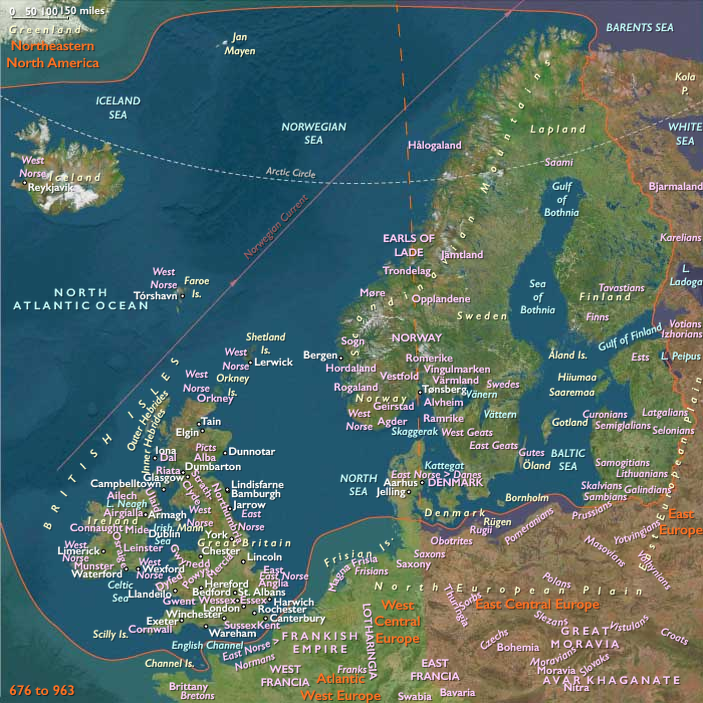
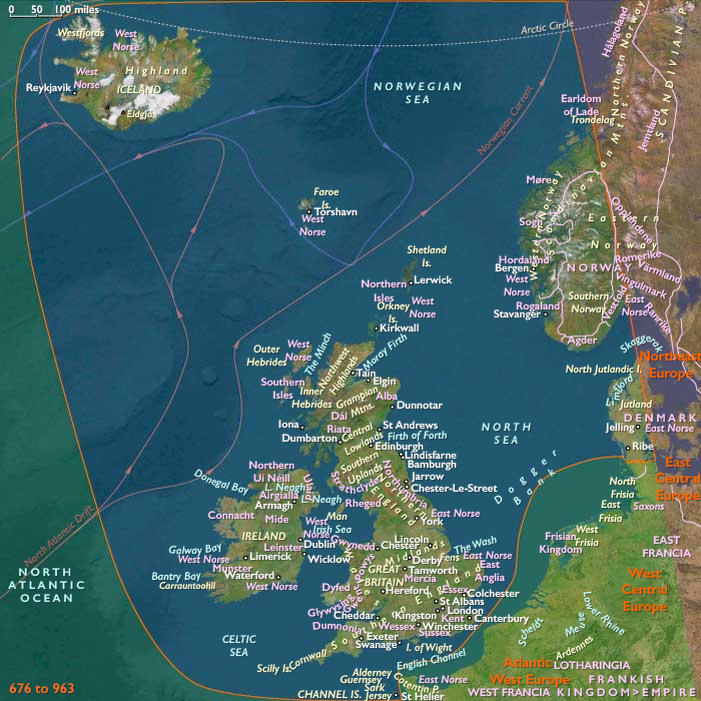
Edmund is successful in reconquering Northumbria in …
Years: 944 - 944
Edmund is successful in reconquering Northumbria in 944.
His ally Amlaíb of York loses his throne in the same year and leaves for Dublin in Ireland.
Locations
People
Groups
- Christianity, Chalcedonian
- Vikings
- Norse
- Ireland, medieval
- Dublin, Kingdom of
- York, Scandinavian (Norse)
- England, (Anglo-Saxon) Kingdom of
Topics
Commodoties
Subjects
Regions
Subregions
Related Events
Filter results
Showing 7 events out of 7 total
The Middle East (1948–1959): Independence, Conflict, and Cold War Alignments
The era from 1948 to 1959 dramatically reshapes the political landscape of the Middle East, marked by the establishment of new states, the eruption of intense conflicts, and the region’s growing strategic importance amid Cold War rivalries. This period sees the founding of Israel, a surge in Arab nationalism, and major shifts in geopolitical alliances, all of which have profound long-term consequences.
Establishment of Israel and the Arab-Israeli Conflict
In 1947, the United Nations proposes partitioning British-mandated Palestine into separate Jewish and Arab states, igniting fierce Arab opposition. On May 14, 1948, the State of Israel declares independence, immediately triggering the 1948 Arab-Israeli War, as neighboring Arab states—including Egypt, Syria, Jordan, Iraq, and Lebanon—launch attacks aiming to prevent Israel's establishment.
Despite initial setbacks, Israel emerges victorious, expanding its territory beyond the original UN partition boundaries. Jordan takes control of the West Bank and East Jerusalem, while Egypt occupies the Gaza Strip. The conflict results in the mass displacement of over 700,000 Palestinian Arabs, marking the beginning of the Palestinian refugee crisis.
Armistice agreements in 1949 do not lead to peace; instead, a fragile ceasefire prevails. Tensions persist, shaping Arab-Israeli relations for decades.
Egypt and the Rise of Nasser
The early 1950s see a nationalist revolution in Egypt. In July 1952, a military coup led by Colonel Gamal Abdel Nasser overthrows King Farouk, abolishing Egypt’s monarchy and establishing a republic in 1953. Nasser rapidly rises as Egypt's foremost leader, championing Arab nationalism, anti-imperialism, and economic reform.
In 1956, Nasser nationalizes the Suez Canal, previously controlled by British and French interests, to finance the construction of the Aswan High Dam. Britain, France, and Israel respond with the Suez Crisis (1956), launching a coordinated invasion to retake control. International pressure, particularly from the United States and Soviet Union, forces the invading powers to withdraw, dramatically elevating Nasser’s prestige as a symbol of Arab resistance against colonialism and Western interference.
Syria and Lebanon: Political Instability and Emerging Nationalism
In Syria, the early independence period is turbulent, with frequent military coups and shifting governments. Syrian politics become increasingly radicalized, influenced by Arab nationalism, socialism, and a growing alignment with the Soviet Union. In 1958, Syria briefly unites with Egypt to form the United Arab Republic (UAR) under Nasser’s leadership, reflecting widespread Arab nationalist aspirations. However, the union proves short-lived due to internal disagreements, eventually dissolving in 1961.
In contrast, Lebanon experiences relative stability in the early 1950s but faces rising internal tensions by the decade’s end. The influx of Palestinian refugees after 1948 alters Lebanon’s delicate sectarian balance, increasing internal strain. President Camille Chamoun’s pro-Western stance in the late 1950s triggers unrest, culminating in the 1958 Lebanese crisis. U.S. Marines intervene militarily to support Chamoun, stabilizing the situation temporarily but highlighting Lebanon’s vulnerability to regional and sectarian pressures.
Iraq: Monarchy, Revolution, and the Emergence of the Republic
Iraq initially remains a conservative monarchy closely aligned with Britain. However, growing dissatisfaction with economic inequalities, British influence, and the monarchy’s pro-Western policies lead to mounting nationalist agitation.
In July 1958, a military coup led by General Abd al-Karim Qasim overthrows the Hashemite monarchy, brutally killing King Faisal II and his family. Iraq becomes a republic under Qasim, who institutes land reform, expands social welfare, and distances Iraq from Western alliances. Although initially popular, Qasim faces fierce internal struggles between Arab nationalist factions (including Ba'athists) and communists, foreshadowing further turmoil.
Iran: Mossadegh, Oil Nationalization, and the 1953 Coup
Iran in the early 1950s is dominated by nationalist leader Prime Minister Mohammad Mossadegh, who in 1951 nationalizes the British-owned Anglo-Iranian Oil Company, sparking a severe international crisis. Britain and the United States, concerned by Mossadegh’s increasingly independent policies and potential Soviet influence, orchestrate a covert operation (Operation Ajax) in 1953, removing Mossadegh and reinstating Shah Mohammad Reza Pahlavi’s autocratic rule.
The Shah consolidates his power, aligning firmly with Western interests, especially the United States. Though initially stabilizing Iran’s economy and securing Western support, this event sows deep resentment, fueling anti-Western sentiment and laying groundwork for future revolutionary movements.
Turkey and NATO Membership
Amid increasing Cold War tensions, Turkey moves decisively toward the West, joining the North Atlantic Treaty Organization (NATO) in 1952. This strategic alignment provides Turkey with military security and substantial U.S. economic aid. NATO membership firmly places Turkey as a critical Western ally bordering the Soviet Union, influencing regional dynamics significantly during the Cold War.
Saudi Arabia and the Gulf States: Rising Oil Revenues
The Arabian Peninsula experiences profound economic transformations during this era due to oil discoveries and exports. Saudi Arabia, under King Saud (1953–1964), rapidly expands infrastructure and development projects financed by burgeoning oil revenues. Saudi Arabia's geopolitical importance rises dramatically, becoming a key Western ally and an influential voice in Arab politics.
Smaller Gulf states such as Kuwait, Qatar, and Bahrain also benefit from increased oil revenues, transforming from impoverished sheikhdoms into wealthy states. These countries continue under British protection, maintaining traditional tribal governance structures but modernizing their economies rapidly.
Jordan: Consolidation under King Hussein
Jordan, having annexed the West Bank after the 1948 war, faces a significant Palestinian population and rising nationalist sentiment. King Hussein, ascending the throne in 1952, stabilizes his rule by balancing British and American support with domestic political reforms, carefully navigating regional tensions. Despite persistent challenges, Jordan emerges as a relatively stable monarchy in a volatile region.
Legacy of the Era (1948–1959)
The years between 1948 and 1959 leave an enduring legacy on Middle Eastern geopolitics. The establishment of Israel and subsequent Arab-Israeli conflict define regional hostilities for decades. The rise of assertive Arab nationalism, particularly under Nasser, reshapes political ideologies throughout the Arab world, challenging Western dominance. Iran’s pivotal 1953 coup plants seeds of future revolutionary upheaval, while oil wealth transforms the Arabian Peninsula into a global economic center. Amid Cold War dynamics, Turkey’s NATO membership and strategic alignments further polarize regional politics, embedding global tensions within local conflicts. The complex interplay of nationalism, colonial legacies, and superpower rivalry profoundly reshapes the Middle East, influencing regional and global politics for generations.
Saudi Arabia contributes only one battalion in the Arab-Israeli War of 1948.
Ibn Saud had joined the Arab League, but the king has not played a leading part in it since the religious and conservative element in Saudi Arabia opposes cooperation with other Arab states, even when Saudis share common views, as in opposition to Zionism.
The Middle East (1960–1971): Regional Transformations and the Rise of Oil Politics
The era from 1960 to 1971 is pivotal for the Middle East, characterized by intense geopolitical struggles, rapid economic transformations driven by oil wealth, shifting regional alliances, and critical developments in Arab nationalism, culminating in profound long-term consequences for the region and beyond.
The Formation of OPEC and the Era of Oil Politics
In 1960, five oil-exporting nations—Iran, Iraq, Kuwait, Saudi Arabia, and Venezuela—form the Organization of Petroleum Exporting Countries (OPEC). This event marks a crucial turning point, as Middle Eastern nations begin asserting control over their natural resources and challenging Western dominance of oil markets. Initially, OPEC’s influence is modest, but the foundation laid during this era sets the stage for future global economic power shifts.
Oil wealth rapidly transforms the Arabian Peninsula. Saudi Arabia, Kuwait, Qatar, and the United Arab Emirates undergo significant modernization, investing in infrastructure, education, and healthcare. These states emerge as crucial economic hubs with growing international leverage.
Egypt under Nasser and Arab Nationalism
Egyptian President Gamal Abdel Nasser remains the region's leading figure in the early 1960s, advocating pan-Arab nationalism, socialism, and anti-imperialism. His influence peaks with the establishment of the United Arab Republic (UAR), initially a union of Egypt and Syria (1958–1961). However, the union collapses in 1961 due to Syrian dissatisfaction with Egyptian dominance.
Nasser's regional prestige endures despite setbacks. He supports revolutionary movements throughout the Arab world, notably in Yemen, where Egyptian troops intervene in a prolonged and costly civil war (1962–1967). This drains Egypt's resources and contributes to future vulnerabilities.
The Arab-Israeli Conflict and the Six-Day War (1967)
Tensions between Israel and its Arab neighbors escalate dramatically throughout the 1960s. A critical flashpoint occurs in June 1967 with the Six-Day War, when Israel launches preemptive strikes against Egypt, Jordan, and Syria, following months of escalating rhetoric and troop mobilizations.
The outcome is a resounding Israeli victory, dramatically altering the region’s geopolitical map. Israel captures the Sinai Peninsula and Gaza Strip from Egypt, the West Bank and East Jerusalem from Jordan, and the strategic Golan Heights from Syria. This devastating defeat deeply wounds Arab nationalism, humiliating Nasser and shaking Arab confidence.
In the war's aftermath, hundreds of thousands of additional Palestinian refugees are displaced. The occupied territories become focal points of bitter disputes, setting the stage for future conflicts and prolonged occupation.
Palestinian Nationalism and the Rise of the PLO
Following the 1967 war, Palestinian identity and resistance to Israeli occupation intensify. The Palestine Liberation Organization (PLO), founded in 1964 as a political body representing Palestinians, rapidly evolves into a prominent militant organization under Yasser Arafat’s leadership by 1969. Palestinian guerrilla operations against Israel increase significantly, particularly from bases in Jordan and Lebanon, drawing these countries deeper into regional conflict.
In Jordan, tensions between Palestinian guerrillas and King Hussein’s government culminate in the Black September crisis of 1970. Jordanian forces violently suppress Palestinian factions, resulting in thousands of deaths and driving the PLO leadership to relocate to Lebanon, further destabilizing that nation.
Syria and Iraq: Radical Regimes and Ba’athist Rule
In Syria, instability following the collapse of the UAR leads to several coups, culminating in the seizure of power by the Arab Socialist Ba’ath Party in 1963. By 1970, Defense Minister Hafez al-Assad consolidates his power through a military coup, establishing an authoritarian regime marked by socialist economic policies, repression of dissent, and strategic alignment with the Soviet Union.
In Iraq, instability persists throughout the 1960s. A Ba’athist-led coup in 1968 brings Ahmed Hassan al-Bakr and his deputy, Saddam Hussein, to power. The new Iraqi government pursues extensive modernization and social reform but also establishes a fiercely authoritarian system, marked by brutal suppression of opposition and increased militarization.
Iran and the Shah’s Modernization
In Iran, Mohammad Reza Shah Pahlavi launches ambitious economic and social reforms, known as the White Revolution (1963), aimed at rapid modernization, land redistribution, and industrialization. While the reforms stimulate economic growth and infrastructure development, they alienate religious leaders and large segments of Iranian society who view them as overly secular, authoritarian, and westernizing. Opposition to the Shah grows, planting seeds for future unrest.
Lebanon: Fragile Balance and Rising Tensions
Lebanon, traditionally viewed as a stable commercial center, becomes increasingly volatile as Palestinian refugees and PLO factions settle within its borders. By the late 1960s, Lebanese politics grow dangerously polarized, as Christians and Muslims diverge sharply over the Palestinian presence. Although full-scale conflict does not erupt until later, the foundations of Lebanon's subsequent civil strife are firmly laid during this period.
Turkey and Cyprus: Regional Conflict
Turkey, a strategic NATO member, experiences economic growth and stability under military-backed governments in the 1960s, but tensions with neighboring Greece escalate dramatically over Cyprus. Inter-communal violence on the island intensifies between Greek Cypriots and Turkish Cypriots, leading to increased regional instability and setting the stage for future Turkish intervention in Cyprus (1974).
Gulf States and British Withdrawal
Britain, weakened economically and politically by World War II and subsequent global commitments, announces its intention to withdraw military and political oversight from the Persian Gulf by 1971. This sparks anxiety among small Gulf sheikhdoms previously protected by British treaties. In response, the states of Abu Dhabi, Dubai, Sharjah, Ajman, Umm al-Quwain, and Fujairah establish the United Arab Emirates (UAE) in December 1971. Qatar and Bahrain opt for independence, becoming fully sovereign states in 1971. These new nations rapidly use burgeoning oil revenues to modernize and diversify their economies.
Oman’s Internal Conflict and Modernization
Oman experiences severe internal tensions during this period. Sultan Said bin Taimur’s repressive rule and resistance to modernization lead to significant unrest, notably the prolonged Dhofar Rebellion (1965–1975). In 1970, Sultan Said is overthrown by his British-backed son, Qaboos bin Said, who immediately embarks on a modernization program, ending Oman’s isolation and seeking regional cooperation and stability.
Legacy of the Era (1960–1971)
The period from 1960 to 1971 profoundly reshapes the Middle East. The Six-Day War significantly alters regional geopolitics, embedding long-lasting Arab-Israeli conflicts and the Palestinian issue deeply within regional and global politics. OPEC’s formation and increased oil wealth dramatically enhance the global influence of Middle Eastern states. Meanwhile, the emergence of authoritarian regimes in Syria and Iraq, the Shah’s modernization in Iran, and internal turmoil in Lebanon and Oman highlight the region's complexity and instability. These developments set the stage for intensified future conflicts, regional power shifts, and enduring strategic rivalries, profoundly influencing Middle Eastern politics into the twenty-first century.

Construction magnate Sheik Muhammad bin Laden reportedly helps to forge an alliance between King Sa'd and his half-brother, Crown Prince Faisal, who serves as Foreign Minister.
When Saud is deposed by religious leaders, senior members of the ruling family, and the Council of Ministers, bin Laden is reportedly among the few people who succeeded in convincing King Sa'ud to abdicate, thus allowing his brother to assume the Saudi throne, as King Faisal, in November 1964.
A grateful Faisal issues a royal decree that every contractor must work through bin Laden, who becomes Saudi Arabia's leading construction magnate.
On his death in a plane crash near San Antonio, Texas, in 1968, Sheik Muhammed leaves behind not only an industrial and financial estate, but also a progeny made up of fifty-two sons and daughters, the fruit of ten marriages.
The lastborn entered the world in 1967.
Osama, eleven or twelve at the time of his father's death, may have inherited any where from $20 million to $80 million to as much as $300 million -- estimates vary.
Saudi Arabia helps found the Organization of Petroleum Exporting Countries (OPEC) in September of 1960 to coordinate the petroleum policies of its members and to provide the member states with technical and economic aid.
This organization, born of exasperation, is formed in response to the oil companies having, in 1959, twice cut crude oil prices in Venezuela and the Middle East without consulting their host governments.
Faisal, more competent than his brother, has developed the ministries of government and established for the first time an efficient bureaucracy.
In December 1960, however, he is obliged to resign as prime minister and Saud himself assumes the office.
Saudi relations with Egypt have often been strained following the rise to power of Egypt's Pan-Arab nationalist president, Gamal Abdel Nasser.
Egyptian propaganda has made frequent attacks on the Saudi system of royal government.
Egyptian troops lend immediate support to the Yemen Arab Republican Army in Yemen's civil war starting in 1962, which make tensions between Saudi Arabia and Egypt become more acute.
The Saudis, together with Iran and Jordan, help the Yemeni royalist forces against the Egyptian-backed Yemen republic.
The deposed Sa'ud dies at sixty-seven in Athens on February 23, 1969.
Years: 944 - 944
Locations
People
Groups
- Christianity, Chalcedonian
- Vikings
- Norse
- Ireland, medieval
- Dublin, Kingdom of
- York, Scandinavian (Norse)
- England, (Anglo-Saxon) Kingdom of