
China's economic tensions, military defeats at Western …
Years: 1847 - 1847
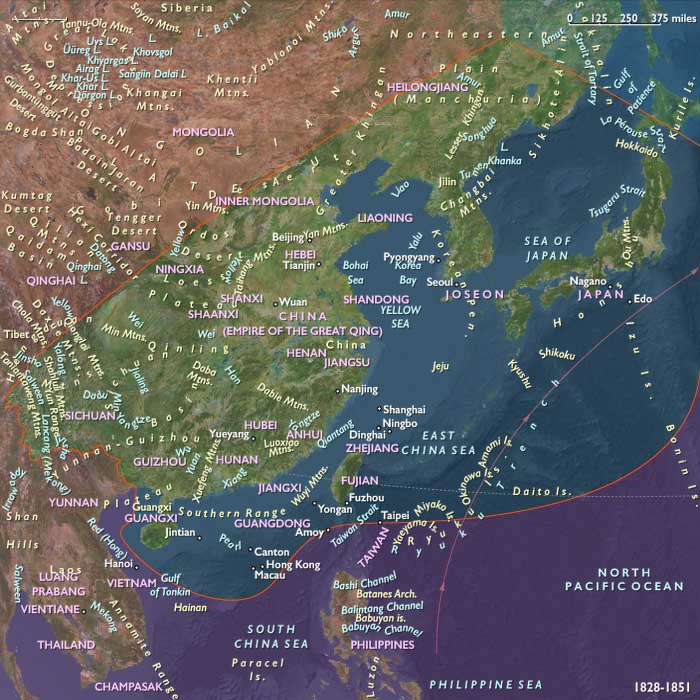
China's economic tensions, military defeats at Western hands, and anti-Manchu sentiments all combine to produce widespread unrest, especially in the south.
South China had been the last area to yield to the Qing conquerors and the first to be exposed to Western influence.
The southern Chinese province of Guangdong, the homeland of the Taiping people, is beset with accelerating social unrest.
After the first Opium War, government prestige declines, and officials lose their capacity to reconcile communal feuding.
The greatest among such conflicts is that between the native settlers and the so-called guest settlers: the clannish, industrious Hakka, a Han subgroup who had migrated in the late twelfth century from North China, to Kwangsi and western Guangdong, mainly from eastern Guangdong.
Hong Xiuquan, founding ruler of the Heavenly Kingdom, the youngest son of four children in a poor but proud Hakka family, had shown early signs of great intelligence, and his entire village sponsored him in his studies, hoping that he would eventually pass the Confucian civil service examination, enter the government bureaucracy, and bring wealth and honor to his family and friends.
Hung, an epileptic, had failed the civil service examination several times however, and, influenced by Christian teachings, had a series of visions and believed himself to be the son of God, the younger brother of Jesus Christ, sent to reform China.
His schoolmate Feng Yunshan, an able organizer, utilizes Hong's ideas to organize a new religious group, the Pai Shang-ti Hui ("God Worshipers"), which he forms among the impoverished miners, charcoal workers and peasants of central Kwangsi, most of whom belong to the Hakka.
In 1847, Hung joins Feng and the God Worshippers, and is immediately accepted as the new leader of the group.
Conditions in the countryside are deplorable, and sentiment runs high against the foreign Manchu rulers of China.
As a result, Hung and Feng begin to plot rebellion.
Hong's movement—perhaps under the impact of Protestant missions—is quite austere, and it opposes magic, idols, and belief in spirits.
He considers the New Testament to be authoritative for his new sect, and its rapid growth-aided by connections with other revolutionary movements-soon results in a genuine danger to the Manchu emperor.
Locations
People
Groups
- Chinese Empire, Qing (Manchu) Dynasty
- Britain (United Kingdom of Great Britain and Ireland)
- Taiping (Heavenly Kingdom)
Topics
Subjects
Regions

Subregions
Years: 1847 - 1847
Locations
People
Groups
- Chinese Empire, Qing (Manchu) Dynasty
- Britain (United Kingdom of Great Britain and Ireland)
- Taiping (Heavenly Kingdom)
Topics
Subjects
Regions
Subregions