
Eastern West Indies (1684–1827 CE): Sugar Frontiers, …
Years: 1684 - 1827
Eastern West Indies (1684–1827 CE): Sugar Frontiers, Revolt, and Revolutionary Shockwaves
Geographic & Environmental Context
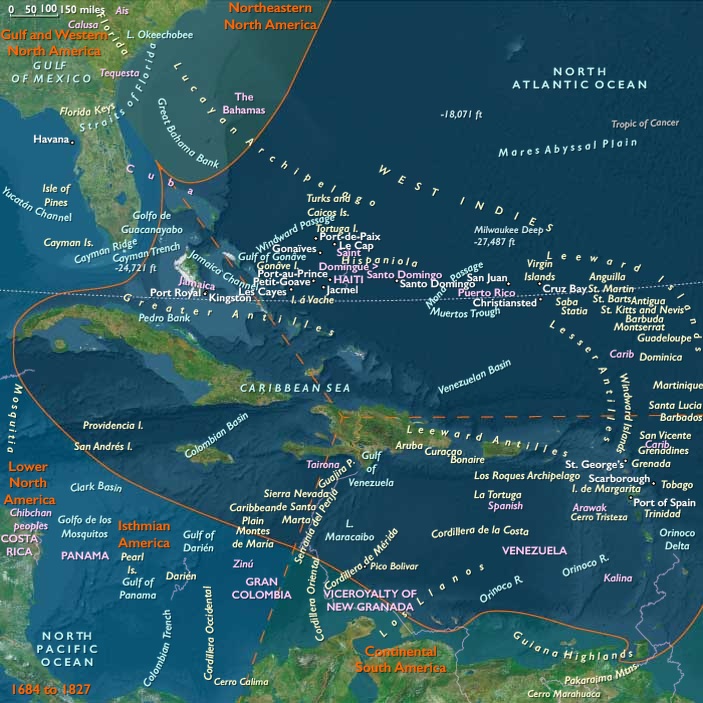
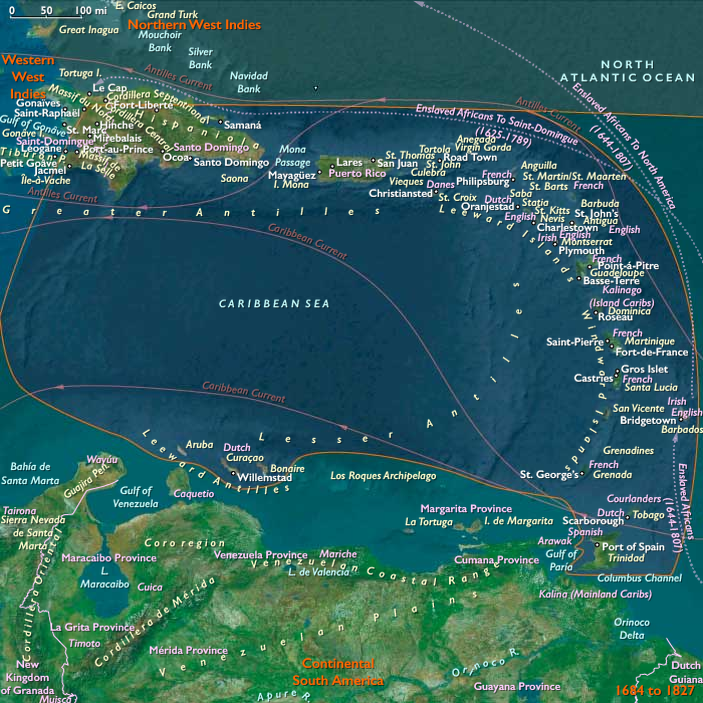
The subregion of Eastern West Indies includes Trinidad, Saint Lucia, Barbados, most of Haiti, most of the Dominican Republic, Puerto Rico, and the Virgin Islands. Anchors include the Orinoco–Trinidad seaway, the Cordillera Central (Hispaniola), the karst valleys of Puerto Rico, and the volcanic arc from Saint Lucia through the Virgin Islands. Deep channels and steady trades funneled fleets, while fertile valleys and limestone plains supported plantation cores.
Climate & Environmental Shifts
The late Little Ice Age persisted, with devastating hurricanes—especially the Great Hurricane of 1780—and multi-year droughts alternating with flood seasons on Hispaniola and Puerto Rico. Volcanic soils on windward islands buffered rainfall shocks; leeward cays suffered salinization and erosion after major storms.
Subsistence & Settlement
-
Hispaniola: The Treaty of Ryswick (1697) formalized a split between French Saint-Domingue (west) and Spanish Santo Domingo (east). Saint-Domingue became the hemisphere’s premier sugar/coffee colony, powered by massive imports of enslaved Africans; the Spanish east emphasized cattle, small farms, and provisioning ports.
-
Puerto Rico: Spain expanded towns, forts, and mixed agriculture (sugar, coffee, tobacco), relying on enslaved labor alongside free smallholders.
-
Barbados: A mature British sugar colony dominated by estates; enslaved Africans formed the vast majority.
-
Saint Lucia: A contested French/British battleground; sugar estates expanded under shifting flags.
-
Trinidad: Spanish until 1797, then British; late but rapid plantation growth under the Cedula of Population (1783) attracted French planters and enslaved labor.
-
Virgin Islands: Danish St. Thomas and St. John (and St. Croix after 1733) developed plantation complexes; neighboring British islands mixed small estates with maritime trades.
Technology & Material Culture
Wind- and later steam-powered mills, boiling houses, and curing ranges defined sugar landscapes. Fortified harbors (San Juan, Santo Domingo) mounted new artillery. African knowledge shaped cane field practices, provision plots, and foodways; maroon strongholds adapted mountain house forms. On Saint-Domingue, coffee terraces and aqueducts climbed steep slopes.
Movement & Interaction Corridors
-
Atlantic slave trade funneled captives to Saint-Domingue, Barbados, Trinidad, and the Danish/British Virgin Islands.
-
Convoy routes threaded the Windward Passage and Mona Passage, while inter-island smuggling tied Spanish east Hispaniola to French markets.
-
Runaway corridors led into Hispaniola’s ranges and Puerto Rico’s cordilleras, feeding marronnage and maroon communities.
Cultural & Symbolic Expressions
Catholic and Protestant establishments framed public ritual, yet Afro-Caribbean lifeways dominated plantation quarters: vodou (Saint-Domingue), cabildos and cofradías (Hispaniola, Puerto Rico), drumming and ring-shout traditions across British and Danish islands. Maroon treaties in Jamaica (contextual neighbors) resonated with mountain communities in Saint-Domingue and eastern Hispaniola. Revolutionary slogans and catechisms later fused with African ritual speech.
Environmental Adaptation & Resilience
Provision grounds (cassava, plantains, yams) stabilized diets; inter-island provisioning cushioned hurricane losses. Coffee diversified steep lands; cattle in eastern Hispaniola buffered drought. Coastal towns rebuilt with thicker masonry, wind-smart roofs, and raised cisterns after great storms.
Transition
By 1827 CE, the subregion had been remade by revolution. The Haitian Revolution (1791–1804) shattered Saint-Domingue and birthed Haiti, catalyzing regional slave resistance and planter flight (some to Trinidad and Puerto Rico). Santo Domingo oscillated between Spanish rule and local movements, heading toward the Haitian unification (1822–1844) just beyond this span. British islands tightened plantation order yet faced rising emancipation debates. The Eastern West Indies stood at a pivot between the age of sugar/slavery and an era of abolition and post-plantation change.
People
- Alexandre Pétion
- Bartholomew Roberts
- Dutty Boukman
- Gabriel de Clieu
- Henri Christophe
- Jean-Pierre Boyer
- Toussaint Louverture
Groups
- Martinique, (French colony)
- Anguilla (British colony)
- Saint Domingue, French Colony of
- Santo Domingo (Spanish Colony)
- Danish West Indies
- Martinique, (French colony)
- Santo Domingo (French Colony)
- Britain (United Kingdom of Great Britain and Ireland)
- Barbados (British colony)
- Martinique, (French colony)
- Haiti, Republic of
- Haiti, Kingdom of northern
- Santo Domingo, Captaincy General of
- France, constitutional monarchy of
- Martinique, (French colony)
- Trinidad, British colony
- Netherlands, Kingdom of The United
- Santo Domingo (Haitian-occupied)
Topics
- Colonization of the Americas, Spanish
- 1733 slave insurrection on St. John
- Anguilla, Battle of
- Haitian Revolution
- Haitian Invasion of Santo Domingo
- Bussa's Rebellion
Subjects
Regions
Subregions
Years: 1684 - 1827
People
- Alexandre Pétion
- Bartholomew Roberts
- Dutty Boukman
- Gabriel de Clieu
- Henri Christophe
- Jean-Pierre Boyer
- Toussaint Louverture
Groups
- Martinique, (French colony)
- Anguilla (British colony)
- Saint Domingue, French Colony of
- Santo Domingo (Spanish Colony)
- Danish West Indies
- Martinique, (French colony)
- Santo Domingo (French Colony)
- Britain (United Kingdom of Great Britain and Ireland)
- Barbados (British colony)
- Martinique, (French colony)
- Haiti, Republic of
- Haiti, Kingdom of northern
- Santo Domingo, Captaincy General of
- France, constitutional monarchy of
- Martinique, (French colony)
- Trinidad, British colony
- Netherlands, Kingdom of The United
- Santo Domingo (Haitian-occupied)
Topics
- Colonization of the Americas, Spanish
- 1733 slave insurrection on St. John
- Anguilla, Battle of
- Haitian Revolution
- Haitian Invasion of Santo Domingo
- Bussa's Rebellion
Subjects
Regions
Subregions