
Eastern West Indies (1792–1803 CE): Revolution, Warfare, …
Years: 1792 - 1803
Eastern West Indies (1792–1803 CE): Revolution, Warfare, and Haitian Independence
Revolution and Devastation in Saint-Domingue
From 1792 to 1803, Saint-Domingue became the epicenter of revolutionary upheaval, profoundly altering the Eastern West Indies. Triggered by ideals of liberty inspired by France's own revolution, the Haitian Revolution evolved into one of history's bloodiest slave rebellions. The conflict dismantled the plantation system, resulting in mass flight of surviving Europeans, and caused severe demographic devastation—more than half of Haiti's population and two-thirds of its male inhabitants perished during fifteen years of warfare.
International Conflict and Territorial Struggle
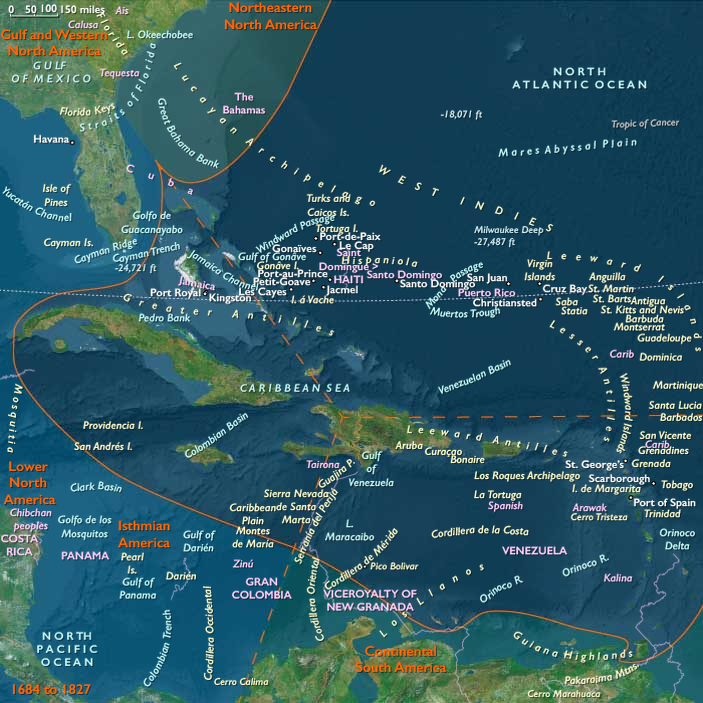
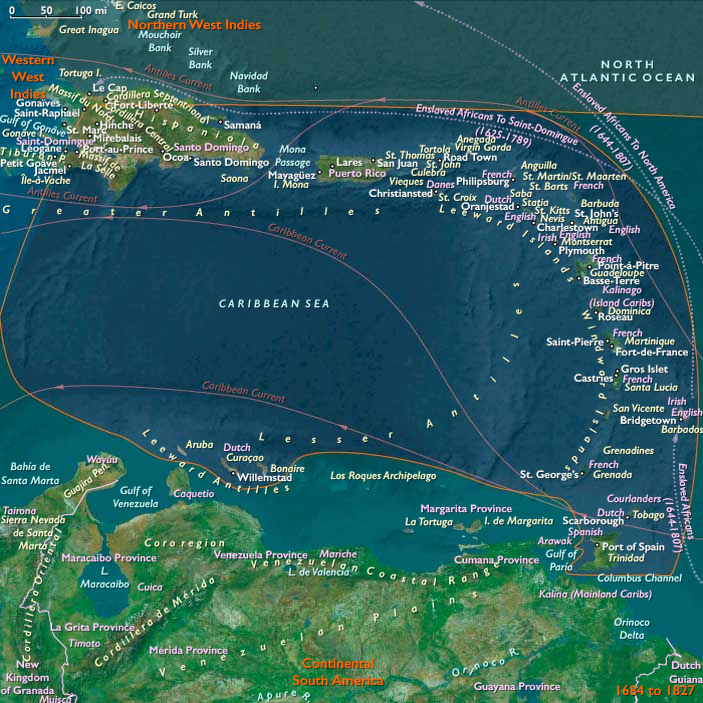
Amidst the revolution, Spain and Britain initially saw an opportunity to divide Saint-Domingue between them. British forces seized territories like Jeremie and Mole Saint-Nicolas, capturing Port-au-Prince in June 1794, while Spain pushed into northern regions. However, their advances were halted primarily by tropical diseases, which decimated their forces. Britain ultimately withdrew in April 1798 after losing more than 25,000 troops.
Spain, struggling in Europe, ceded the eastern part of Hispaniola to France in mid-1795, reflecting its declining global power. French forces occupied the Spanish colony of Santo Domingo in February 1802, reestablishing slavery there, but soon faced insurmountable resistance.
Leadership and Conflict under Toussaint Louverture
Emerging as the key revolutionary figure, Toussaint Louverture became lieutenant governor in 1796 after rescuing French commander General Etienne-Maynard Laveaux from mulatto insurgents. Toussaint subsequently gained complete military authority, expelling French officials and defeating mulatto forces in the War of the Castes (1799–1800). After capturing Santo Domingo in 1800, Toussaint controlled the entire island.
Toussaint aimed to maintain economic stability, reinstating forced labor (fermage) for plantations and outlawing voodoo in favor of Roman Catholicism. He instituted controversial social regulations, including bans on divorce, despite personal contradictions. His authority culminated in his appointment as governor-general for life in 1801.
French Attempts at Re-conquest
Toussaint’s power alarmed slave-holding nations and threatened Napoleon Bonaparte’s imperial ambitions. Consequently, in January 1802, Napoleon dispatched a 20,000-strong multinational force under General Charles Victor Emmanuel Leclerc, who landed in Saint-Domingue. Initially resisting fiercely, Toussaint was betrayed by lieutenants Jean-Jacques Dessalines and Henry Christophe, leading to his surrender on May 6, 1802. Despite assurances of safety, Toussaint was imprisoned in France, where he died on April 7, 1803.
Independence and the End of French Rule
Leclerc's army suffered catastrophic losses to tropical diseases, notably yellow fever, killing around 52,000 French soldiers. Following Leclerc’s death from illness in November 1802, his successor, General Donatien Rochambeau, continued the brutal struggle. Rochambeau advocated extreme measures, including mass extermination, yet eventually succumbed to defeat at the hands of Dessalines and Haitian revolutionary forces.
After the pivotal French defeat at Vertieres, Rochambeau fled to Jamaica, surrendering to the British in November 1803. French colonial rule ended, and the independent Republic of Haiti was declared by Dessalines in January 1804.
Conclusion
The era from 1792 to 1803 in the Eastern West Indies was defined by revolutionary fervor, brutal conflict, and significant geopolitical shifts. The Haitian Revolution eradicated three centuries of foreign domination, profoundly reshaping Caribbean history and inspiring global anti-colonial movements.
People
- Charles Leclerc
- Donatien-Marie-Joseph de Vimeur, vicomte de Rochambeau
- Henri Christophe
- Jean-Jacques Dessalines
- Napoleon
- Toussaint Louverture
- Étienne Laveaux
Groups
- Polytheism (“paganism”)
- Christians, Roman Catholic
- France, (Bourbon) Kingdom of
- Saint Domingue, French Colony of
- Santo Domingo (Spanish Colony)
- Spain, Bourbon Kingdom of
- Jamaica (British Colony)
- Britain (United Kingdom of Great Britain and Ireland)
Topics
- Colonization of the Americas, Spanish
- Colonization of the Americas, French
- Haitian Revolution
- Castes, War of the
- Haitian French War of 1801-03
- Haitian Independence, Second War of
Subjects
Regions
Subregions
Years: 1792 - 1803
People
- Charles Leclerc
- Donatien-Marie-Joseph de Vimeur, vicomte de Rochambeau
- Henri Christophe
- Jean-Jacques Dessalines
- Napoleon
- Toussaint Louverture
- Étienne Laveaux
Groups
- Polytheism (“paganism”)
- Christians, Roman Catholic
- France, (Bourbon) Kingdom of
- Saint Domingue, French Colony of
- Santo Domingo (Spanish Colony)
- Spain, Bourbon Kingdom of
- Jamaica (British Colony)
- Britain (United Kingdom of Great Britain and Ireland)
Topics
- Colonization of the Americas, Spanish
- Colonization of the Americas, French
- Haitian Revolution
- Castes, War of the
- Haitian French War of 1801-03
- Haitian Independence, Second War of
Subjects
Regions
Subregions