
Eastern West Indies (1636–1647 CE): Sugar Revolutions …
Years: 1636 - 1647
Eastern West Indies (1636–1647 CE): Sugar Revolutions and Colonial Rivalries
Introduction of the Sugar Plantation Economy
The mid-seventeenth century marked a critical turning point for the Eastern West Indies as the sugar plantation economy, reliant on enslaved labor, was introduced by the Dutch following their expulsion from Brazil in 1640. This economic transformation could not have come at a more crucial time for English and French colonists, whose precarious agricultural economies—previously dependent largely on tobacco—were increasingly threatened by competition from the mainland colonies.
Caribbean tobacco struggled to compete with superior products from the mid-Atlantic colonies, prompting severe economic strain and population decline as settlers migrated to more profitable regions. However, the introduction of the sugar plantation system revitalized the colonial economies, ushering in the period known historically as the "Caribbean Sugar Revolutions." These interrelated agricultural, demographic, social, and economic changes dramatically reshaped the Caribbean, significantly elevating its global economic and political importance.
Expansion of European Plantations and Slave Labor
The adoption of the sugar plantation model by the English and French was directly influenced by the Portuguese experiences in Brazil, while the Dutch provided the crucial infrastructure for the rapidly growing sugar industry through their well-established networks. The Dutch West India Company supplied the necessary enslaved West African laborers, accelerating the region’s demographic transformation. Tens of thousands of Africans were forcibly brought into the Eastern West Indies, profoundly reshaping its social and cultural landscape.
French Colonial Expansion
Under the auspices of the French West India Company, chartered by Cardinal Richelieu in 1635, the French successfully expanded their Caribbean presence. They established strongholds on Martinique and Guadeloupe, from which they would later spread to St. Barthelemy, St. Martin, Grenada, St. Lucia, and the western part of Hispaniola, which Spain formally ceded to France by the Treaty of Ryswick in 1697.
The Arrival of Yellow Fever
This era also witnessed the devastating introduction of yellow fever, first definitively recorded in the New World on the island of Barbados in 1647. The virus, originating from Africa, was likely brought to the Caribbean through the Columbian Exchange, along with its mosquito vector, Aedes aegypti, by enslaved Africans. Unlike the African populations who had developed some immunity, European colonists suffered high mortality rates, significantly impacting colonial societies and economies.
Conclusion
The era from 1636 to 1647 marked profound changes in the Eastern West Indies, setting enduring patterns of agricultural production, labor exploitation, and demographic transformation. The establishment of sugar plantations laid a new economic foundation, making the Caribbean a strategically crucial region for competing European empires and marking the beginning of its long-term dependence on enslaved African labor.
People
Groups
- Kalinago (Amerind tribe)
- Saint Barthélemy
- England, (Tudor) Kingdom of
- Spanish Empire
- Saint Lucia
- Nevis
- Santo Domingo, Captaincy General of
- Sint Eustatius
- Montserrat
- Santo Domingo, Real Audiencia de
- Spain, Habsburg Kingdom of
- Spaniards (Latins)
- New Spain, Viceroyalty of
- Anglicans (Episcopal Church of England)
- Calvinists
- Huguenots (the “Reformed”)
- Peru, Viceroyalty of
- Brazil, Colonial
- Trinidad, Spanish colony
- Netherlands, United Provinces of the (Dutch Republic)
- France, (Bourbon) Kingdom of
- Dutch East India Company (Vereenigde Oostindische Compagnie or VOC in Dutch, literally "United East Indies Company")
- Saint Kitts (English Colony)
- Barbados (English colony)
- Nevis (English Colony)
- Dutch Brazil (New Holland)
- Saint Martin, colonial
- Antigua (English colony)
- Montserrat (English Colony)
- Guadeloupe, (French Compagnie des Îles de l'Amérique)
- Martinique, (French colony)
Topics
- Colonization of the Americas, Portuguese
- Colonization of the Americas, Spanish
- Encomienda system
- Thirty Years' War
Commodoties
Subjects
Regions
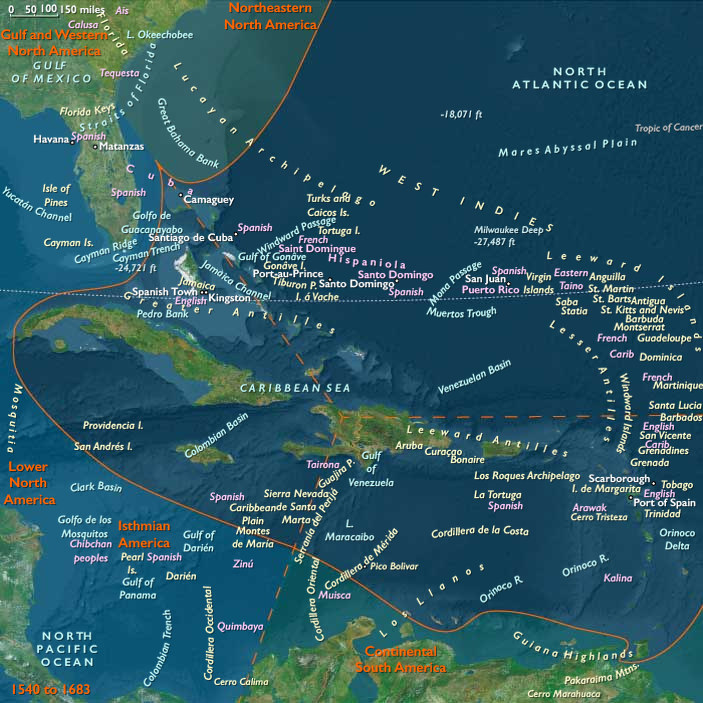
Subregions
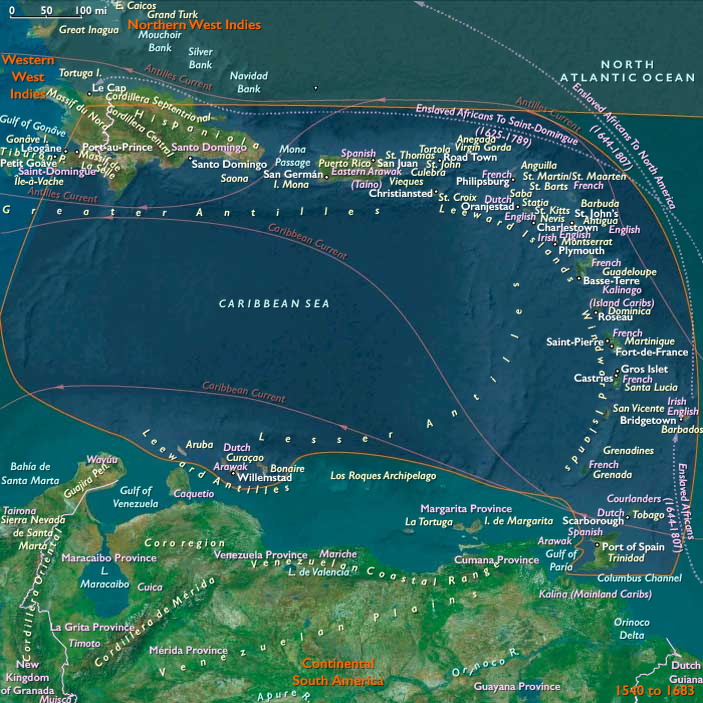
Years: 1636 - 1647
People
Groups
- Kalinago (Amerind tribe)
- Saint Barthélemy
- England, (Tudor) Kingdom of
- Spanish Empire
- Saint Lucia
- Nevis
- Santo Domingo, Captaincy General of
- Sint Eustatius
- Montserrat
- Santo Domingo, Real Audiencia de
- Spain, Habsburg Kingdom of
- Spaniards (Latins)
- New Spain, Viceroyalty of
- Anglicans (Episcopal Church of England)
- Calvinists
- Huguenots (the “Reformed”)
- Peru, Viceroyalty of
- Brazil, Colonial
- Trinidad, Spanish colony
- Netherlands, United Provinces of the (Dutch Republic)
- France, (Bourbon) Kingdom of
- Dutch East India Company (Vereenigde Oostindische Compagnie or VOC in Dutch, literally "United East Indies Company")
- Saint Kitts (English Colony)
- Barbados (English colony)
- Nevis (English Colony)
- Dutch Brazil (New Holland)
- Saint Martin, colonial
- Antigua (English colony)
- Montserrat (English Colony)
- Guadeloupe, (French Compagnie des Îles de l'Amérique)
- Martinique, (French colony)
Topics
- Colonization of the Americas, Portuguese
- Colonization of the Americas, Spanish
- Encomienda system
- Thirty Years' War
Commodoties
Subjects
Regions
Subregions