
Eastern West Indies (1576–1587 CE): Piracy, Plantation …
Years: 1576 - 1587
Eastern West Indies (1576–1587 CE): Piracy, Plantation Expansion, and Colonial Society
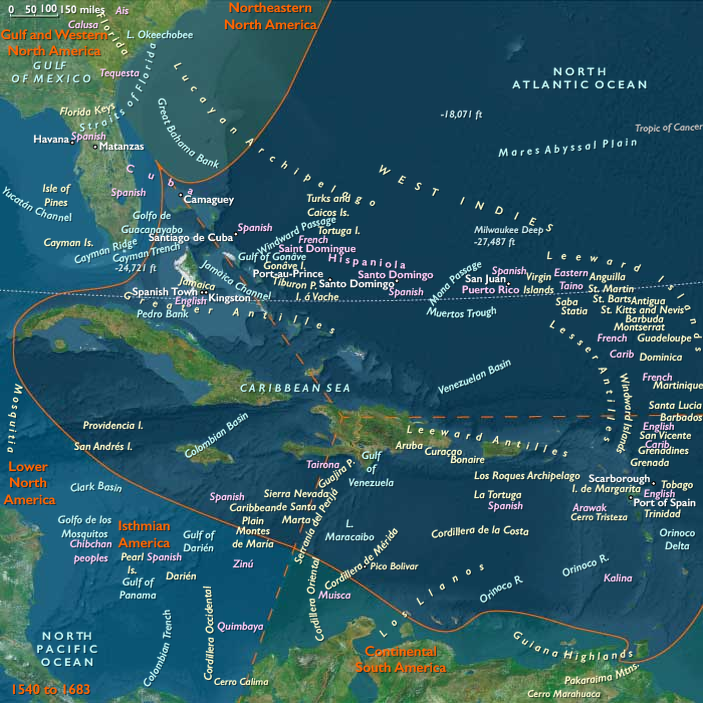
The period from 1576 to 1587 in the Eastern West Indies was characterized by heightened piracy, expansion of plantation economies, and deepening social stratification. Spanish colonial authorities grappled with increasing external threats, while internally, reliance on enslaved labor reshaped the demographic and economic landscape.
Intensified Maritime Threats
During this era, piracy emerged as an escalating threat to Spanish dominance in the Caribbean, prompting significant military and defensive responses. Notorious privateers, primarily from England, France, and the Netherlands, sought to challenge Spanish hegemony and intercept shipments of silver, sugar, and other valuable commodities. In response, Spain bolstered fortifications, especially in key strategic points such as Santo Domingo and San Juan. The fortresses of El Morro in Puerto Rico and the fortified port of Santo Domingo were reinforced, reflecting heightened Spanish vigilance.
Expansion of Plantation Agriculture and Slave Economy
The economic backbone of the Eastern West Indies continued to rest firmly on plantation agriculture, particularly sugar production. Sugar plantations expanded rapidly across Hispaniola and Puerto Rico, solidifying the islands' role as critical economic assets. To support this growth, Spanish colonists dramatically increased their importation of enslaved Africans, whose forced labor became indispensable to the burgeoning plantation economy. This deepening dependence on slavery had profound demographic consequences, dramatically altering the region's cultural and social makeup.
Deepening Social Stratification
The wealth generated by the plantations continued to benefit primarily a small colonial elite, deepening existing social divisions. Colonial society became increasingly stratified, with clear distinctions emerging among Spanish settlers, indigenous populations, free persons of mixed ancestry, and enslaved Africans. The rigid caste system implemented by Spanish authorities sought to maintain social control, leading to heightened racial and class tensions that defined daily life across the colonies.
Cultural Consolidation and Missionary Efforts
The Roman Catholic Church strengthened its position as a central institution in colonial governance and social life, continuing its evangelization efforts among indigenous peoples and enslaved populations. Missionaries expanded their reach, fostering cultural assimilation while reinforcing the Spanish social hierarchy through religious doctrine and practice. This period saw the establishment of additional religious missions, which served both spiritual and practical purposes, providing education and reinforcing colonial rule.
Geopolitical Context
Geopolitically, the Eastern West Indies maintained a strategic role in Spanish imperial ambitions, acting as a critical crossroads for Atlantic trade and imperial competition. Spain's control over these islands became increasingly contested by rival European powers, setting the stage for future conflicts and persistent maritime tensions.
In summary, the era from 1576 to 1587 represented a period of significant challenges and transformations for the Eastern West Indies, defined by intensified maritime conflict, rapid plantation expansion driven by slave labor, and deeper societal stratification underpinned by religious and cultural integration.
Groups
- Arawak peoples (Amerind tribe)
- Kalinago (Amerind tribe)
- Taíno
- Santo Domingo, Captaincy General of
- Santo Domingo, Real Audiencia de
- Spain, Habsburg Kingdom of
- Spaniards (Latins)
Topics
Commodoties
Subjects
Regions
Subregions

Years: 1576 - 1587
Groups
- Arawak peoples (Amerind tribe)
- Kalinago (Amerind tribe)
- Taíno
- Santo Domingo, Captaincy General of
- Santo Domingo, Real Audiencia de
- Spain, Habsburg Kingdom of
- Spaniards (Latins)
Topics
Commodoties
Subjects
Regions
Subregions