
Eastern West Indies (1396–1539 CE): Taíno Chiefdoms …
Years: 1396 - 1539
Eastern West Indies (1396–1539 CE): Taíno Chiefdoms and the Spanish Conquest
Geographic & Environmental Context
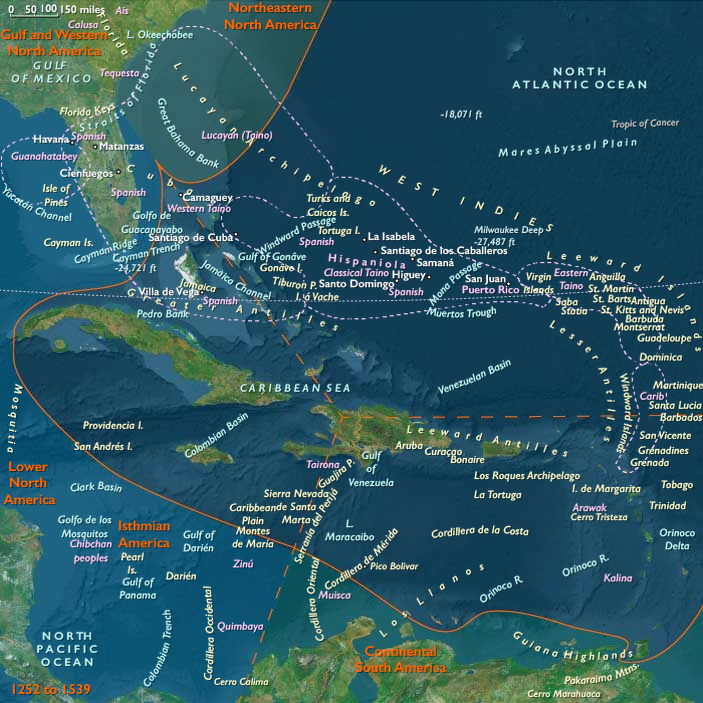
The subregion of Eastern West Indies includes Trinidad, Saint Lucia, Barbados, most of Haiti, most of the Dominican Republic, Puerto Rico, and the Virgin Islands. Anchors included the Orinoco delta feeding into Trinidad, the Cordillera Central of Hispaniola, the karst valleys of Puerto Rico, and the arc of volcanic islands from Saint Lucia to the Lesser Antilles. The region featured fertile valleys, tropical forests, coral reefs, and hurricane-prone coasts.
Climate & Environmental Shifts
The Little Ice Age brought cooler decades and intensified hurricanes. Seasonal rainfall supported abundant crops, though drought occasionally struck the leeward islands. Fertile volcanic soils on Hispaniola, Puerto Rico, and Saint Lucia sustained dense agriculture.
Subsistence & Settlement
-
Hispaniola and Puerto Rico: Dominated by Taíno chiefdoms (cacicazgos). Populations farmed cassava, maize, beans, and sweet potato in conucos, supplemented by fishing, manatee hunting, and bird snaring. Villages clustered around plazas and ball courts.
-
Trinidad and Lesser Antilles: Populated by Kalinago (Caribs), who practiced shifting cultivation, fishing, and raiding, maintaining mobility across island chains.
-
Barbados: Supported small farming and fishing communities, less densely settled than volcanic islands.
-
Virgin Islands: Strategically located waypoints with mixed Taíno and Kalinago presence.
Technology & Material Culture
Taíno crafts included dugout canoes, stone celts, shell ornaments, and cotton hammocks. Wooden zemí idols embodied ancestral spirits. Pottery decorated domestic life. Kalinago weaponry featured bows, arrows, and poisoned tips. After 1493, Spanish technologies—iron, firearms, horses—entered the region.
Movement & Interaction Corridors
-
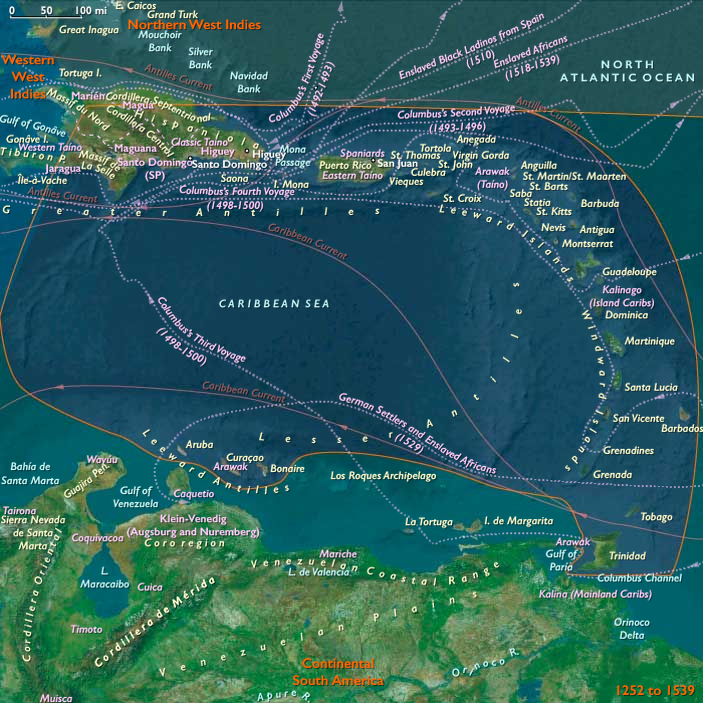
Taíno canoes moved between Hispaniola, Puerto Rico, and the Virgin Islands.
-
Kalinago warriors raided by canoe across Saint Lucia, Dominica, and neighboring islands.
-
Spanish expeditions under Christopher Columbus reached the Eastern West Indies on his second voyage (1493), landing at Dominica, Guadeloupe, Puerto Rico, and Hispaniola.
-
Spanish conquest followed: Hispaniola was colonized from 1493; Puerto Rico in 1508; the Lesser Antilles remained contested.
Cultural & Symbolic Expressions
Taíno religion centered on zemí idols, rituals of cohoba, and communal dances (areítos). Kalinago spirituality emphasized ancestor veneration and warrior rituals. Spanish Catholicism imposed churches and missions on conquered lands. Ball courts (batey) and plazas served as sacred spaces, soon overlaid by colonial towns.
Environmental Adaptation & Resilience
Taíno relied on conuco mound fields to sustain fertility in fragile soils. Fishing, foraging, and hunting diversified diets. Kalinago adapted to mobility and seaborne raiding, enabling resilience against Spanish advances longer than Taíno chiefdoms. Epidemics, slavery, and warfare devastated populations after 1493, though pockets of resistance persisted.
Transition
By 1539 CE, the Eastern West Indies had been dramatically transformed. Hispaniola and Puerto Rico were firmly under Spanish control, their Indigenous populations decimated by conquest and disease. Trinidad, Saint Lucia, and the smaller Antilles remained in Kalinago hands, resisting conquest. The subregion, once a mosaic of Taíno and Kalinago chiefdoms, had become a frontier of Spanish colonization and Indigenous resistance.
People
Groups
- Arawak peoples (Amerind tribe)
- Kalinago (Amerind tribe)
- Taíno
- Caquetio people
- Christians, Roman Catholic
- Santo Domingo, Captaincy General of
- Santo Domingo, Real Audiencia de
- Spaniards (Latins)
- Spain, Habsburg Kingdom of
Topics
Commodoties
Subjects
Regions
Subregions
Years: 1396 - 1539
People
Groups
- Arawak peoples (Amerind tribe)
- Kalinago (Amerind tribe)
- Taíno
- Caquetio people
- Christians, Roman Catholic
- Santo Domingo, Captaincy General of
- Santo Domingo, Real Audiencia de
- Spaniards (Latins)
- Spain, Habsburg Kingdom of
Topics
Commodoties
Subjects
Regions
Subregions