
Eastern West Indies (1528–1539 CE): Shifts in …
Years: 1528 - 1539
Eastern West Indies (1528–1539 CE): Shifts in Colonial Power and Society
Decline and Decentralization in Santo Domingo
By the late 1520s, the Spanish colony of Santo Domingo on Hispaniola had entered a period of significant decline and decentralization. The depletion of gold deposits, which had initially attracted settlers, combined with the catastrophic collapse of the indigenous Taíno population due to disease, exploitation, warfare, and social disintegration, caused severe labor shortages. The encomienda system—a structure resembling medieval feudalism wherein Spanish colonists exacted labor and tribute from native populations—faltered, intensifying reliance on imported enslaved Africans.
Increasingly isolated from Spain and overshadowed by wealthier colonial regions like Mexico and Peru, the administrative effectiveness of Santo Domingo diminished. The city itself remained an official seat of power, housing the Real Audiencia, the colony’s supreme court and administrative council, but its actual governance capabilities rapidly eroded, with local authority increasingly diffused among regional landowners.
Plantation Economy and the Growth of African Slavery
The early 1530s witnessed a dramatic expansion of the Caribbean’s nascent plantation economy, particularly focused on sugar cane cultivation. Originating from the Canary Islands and first established commercially on Hispaniola in 1516, sugar plantations now became the economic backbone of the region.
The depletion of indigenous labor led to an intensified importation of enslaved Africans, whose forced labor under brutal conditions rapidly expanded sugar production. Santo Domingo and its hinterland thus emerged as a leading hub of the Atlantic slave trade, setting a tragic model soon emulated throughout the Caribbean and the wider Americas.
Emergence of Maroon Communities
As slavery intensified, resistance grew. The phenomenon of escaped enslaved Africans forming independent communities—known as maroons or cimarrónes—expanded significantly during this period. By the 1530s, large numbers of enslaved persons regularly escaped into Hispaniola's mountainous interior, establishing communities characterized by defiance and self-sufficiency. These maroon settlements posed an ongoing challenge to colonial authority, embodying early resistance to the brutality of the plantation system.
Economic Marginalization and Changing Social Dynamics
Economic stratification deepened sharply during this era. A small but powerful elite of wealthy sugar mill owners consolidated their influence over colonial governance by gaining representation in the Real Audiencia, further distancing the island’s administration from royal oversight. In contrast, poorer colonists increasingly depended on subsistence activities, notably hunting the herds of wild cattle now proliferating across the island. Their economic marginalization presaged the later rise of a distinct social class known as boucaniers or buccaneers, initially hunters of cattle and later infamous as pirates in the Caribbean.
Cultural Erasure and Indigenous Collapse
By 1539, the Taíno, the once-dominant indigenous people of Hispaniola and Puerto Rico, had nearly vanished as a distinct group. Factors including disease, forced labor, warfare, cultural disruption, intermarriage, and displacement combined to devastating effect. Efforts to protect the natives legally, such as the Laws of Burgos (1512–1513), proved ineffective, unenforced, or systematically ignored.
In the Lesser Antilles, the fierce Kalinago (Carib) continued to resist European penetration fiercely, maintaining autonomy and delaying European colonization attempts well into later centuries.
Geopolitical Reorientation and Neglect of the Lesser Antilles
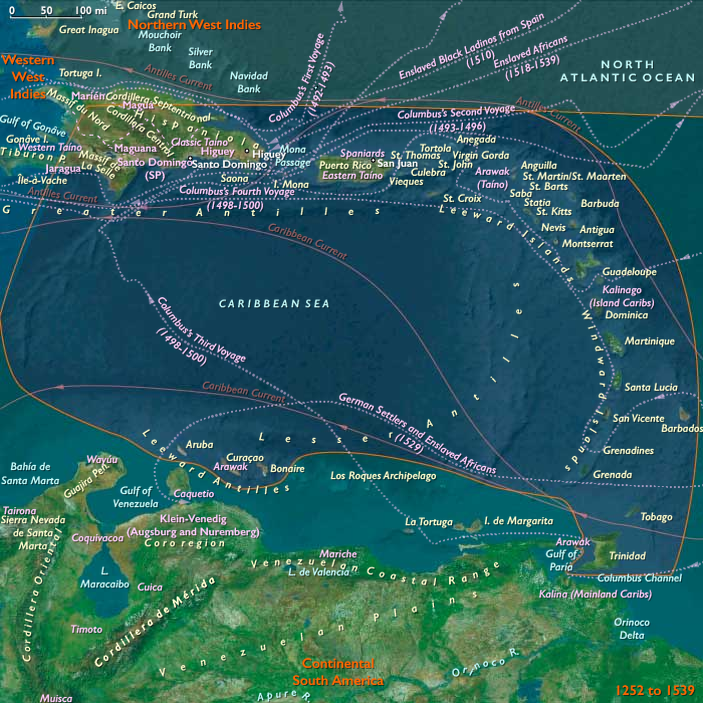
As Spanish attention turned westward toward the richer mainland regions of Mexico and Peru, the islands of the Lesser Antilles—notably Aruba, Curaçao, and Bonaire—continued to be marginalized. After earlier Spanish depopulation measures, notably the forced removal of indigenous Caquetío populations, the islands now primarily served minor economic functions, such as the extraction of brazilwood and dyewood. Their sparse populations, often remnants or returning indigenous people, were left largely to themselves, neglected by Spanish colonial oversight.
Key Developments (1528–1539 CE)
-
Expansion of Sugar Economy: Rapid growth in sugar plantations in Hispaniola, demanding an increased influx of enslaved Africans.
-
Maroon Communities Flourish: Significant increase in escaped enslaved Africans establishing self-sufficient settlements in Hispaniola’s mountainous regions.
-
Marginalization of Lesser Antilles: Continued neglect by the Spanish, with minimal economic exploitation and scant oversight.
-
End of Indigenous Dominance: Near-total collapse of the Taíno population, completing the demographic shift toward African and European dominance.
-
Decentralization of Authority: Ongoing diffusion of administrative power among local elites, reducing the influence of Spain and the centralized authorities in Santo Domingo.
Long-Term Consequences and Historical Significance
The era 1528 to 1539 marked a crucial transitional phase in the Eastern West Indies. The islands experienced significant shifts in population, economy, and governance. The consolidation of plantation-based economies dependent on African slavery set a precedent with lasting historical impacts, reshaping the region’s demographic and cultural fabric. Simultaneously, the persistence of maroon communities and indigenous resistance in the Lesser Antilles underscored the complexities and contested nature of colonial rule, foreshadowing future conflicts and cultural resilience in the Caribbean.
Groups
- Arawak peoples (Amerind tribe)
- Kalinago (Amerind tribe)
- Taíno
- Santo Domingo, Captaincy General of
- Santo Domingo, Real Audiencia de
- Spain, Habsburg Kingdom of
- Spaniards (Latins)
Topics
Commodoties
Subjects
Regions
Subregions
Related Events
Showing 10 events out of 38215 total
Years: 1528 - 1539
Groups
- Arawak peoples (Amerind tribe)
- Kalinago (Amerind tribe)
- Taíno
- Santo Domingo, Captaincy General of
- Santo Domingo, Real Audiencia de
- Spain, Habsburg Kingdom of
- Spaniards (Latins)
Topics
Commodoties
Subjects
Regions
Subregions