
Eastern West Indies (1516–1527 CE): Consolidation, Exploitation, …
Years: 1516 - 1527
Eastern West Indies (1516–1527 CE): Consolidation, Exploitation, and Cultural Shifts
Spanish Consolidation and Administration
Between 1516 and 1527, Spanish authority in the Eastern West Indies—encompassing present-day Haiti, the Dominican Republic, Puerto Rico, and territories extending toward Florida and Central America—solidified through structured governance and increased exploitation of indigenous and African populations. The Royal Audiencia of Santo Domingo, formally established in 1524, became the administrative hub, effectively integrating the region into Spain’s expansive empire and exerting greater royal oversight on colonial governance. This audiencia, originally a tribunal of three judges, expanded significantly in power, incorporating administrative, legislative, and consultative functions that spanned the Caribbean and adjacent continental territories.
Demographic Transformations and Forced Labor
The native Taíno populations continued to experience devastating declines due to European-introduced diseases such as smallpox, measles, malaria, and dysentery, exacerbated by the harsh encomienda system. These forced labor practices significantly contributed to the rapid depopulation of indigenous communities, who faced not only disease but also physical abuse, starvation, cultural disruption, and warfare with Spanish colonists.
By 1520, the systematic importation of enslaved Africans was well established, dramatically reshaping the Caribbean’s demographic composition and cultural landscape. This forced migration introduced enduring African cultural influences, blending with indigenous traditions and emerging European colonial culture. The first major slave revolt in the Americas occurred in Santo Domingo in 1522, reflecting early resistance against oppressive colonial conditions. Many insurgents escaped, forming independent maroon communities in Hispaniola’s mountainous interior.
Economic Intensification: Sugar Cultivation and Gold Extraction
Sugar cultivation significantly intensified, encouraged by Spanish colonial policies and monastic financial incentives. The first sugar mill in the New World, established on Hispaniola in 1516, marked a pivotal shift toward plantation agriculture. By 1525, sugar production had expanded robustly, laying the economic foundation for the Caribbean’s plantation system. Wealthy sugar mill owners quickly formed a new colonial elite, influencing political decisions and even securing the right to elect members of the Real Audiencia.
Simultaneously, gold extraction continued sporadically, maintaining the allure of quick wealth and sustaining Spanish investment and indigenous exploitation, despite diminishing returns from exhausted mines.
Resistance and Cultural Survival
Indigenous resistance persisted throughout this period. The Kalinago (Caribs) of the Lesser Antilles notably continued to resist Spanish encroachment fiercely, maintaining substantial autonomy and significantly delaying European domination in the region. Their resistance helped preserve indigenous cultural identity and political autonomy, making the Lesser Antilles a contested frontier that would persist into later centuries.
Key Developments (1516–1527 CE)
-
1516: Establishment of the first sugar mill on Hispaniola, initiating extensive plantation agriculture.
-
1520: Systematic importation of enslaved Africans entrenched, transforming demographic and cultural dynamics.
-
1522: First major slave revolt in the Americas occurs in Santo Domingo, prompting the formation of maroon communities.
-
1524: Establishment of the expanded Royal Audiencia of Santo Domingo, strengthening royal administrative control.
-
Circa 1525: Significant expansion of sugar cultivation under Spanish colonial policy.
-
Ongoing indigenous resistance, especially by the Kalinago, safeguarding much of the Lesser Antilles against European incursions.
Long-Term Implications
This period shaped enduring patterns of social, economic, and cultural relationships across the Eastern West Indies. The demographic shifts caused by disease and forced African migration, combined with the establishment of a plantation-based economy, laid lasting foundations for Caribbean colonial society. Persistent indigenous resistance, particularly from the Kalinago, underscored ongoing tensions with colonial authorities, preserving critical elements of indigenous identity and autonomy for centuries to come.
Groups
- Arawak peoples (Amerind tribe)
- Kalinago (Amerind tribe)
- Taíno
- Santo Domingo, Captaincy General of
- Santo Domingo, Real Audiencia de
- Spain, Habsburg Kingdom of
- Spaniards (Latins)
Topics
Commodoties
Subjects
Regions
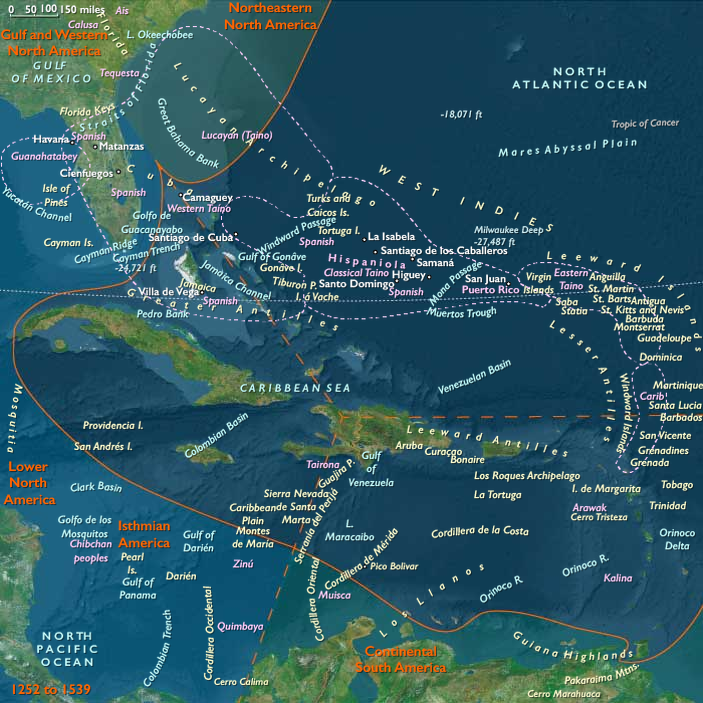
Subregions
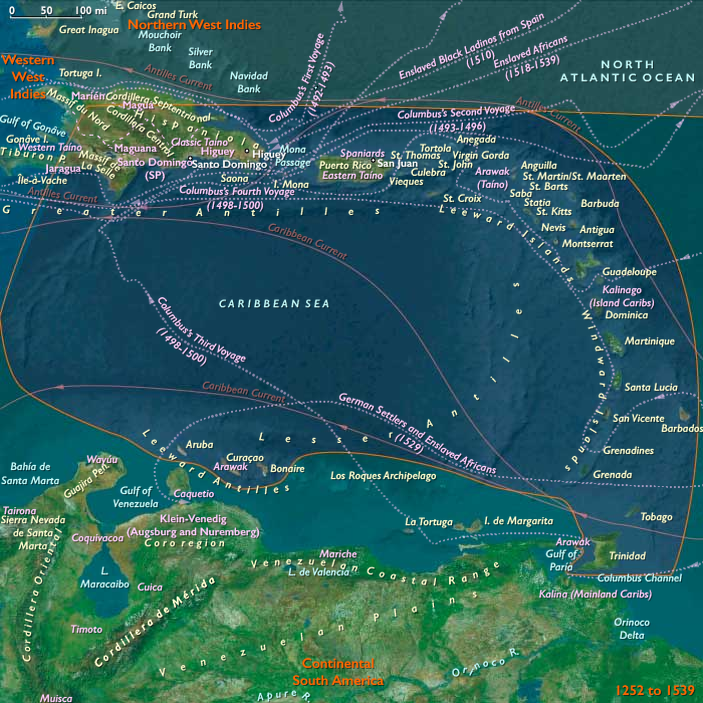
Related Events
Showing 10 events out of 39076 total
Years: 1516 - 1527
Groups
- Arawak peoples (Amerind tribe)
- Kalinago (Amerind tribe)
- Taíno
- Santo Domingo, Captaincy General of
- Santo Domingo, Real Audiencia de
- Spain, Habsburg Kingdom of
- Spaniards (Latins)
Topics
Commodoties
Subjects
Regions
Subregions