Eastern Wei sends an advance guard of …
Years: 537 - 537
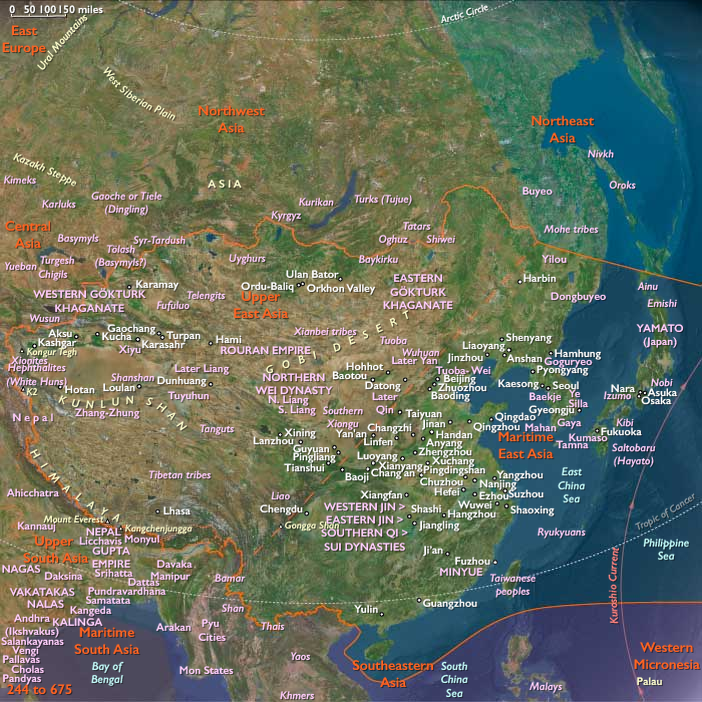
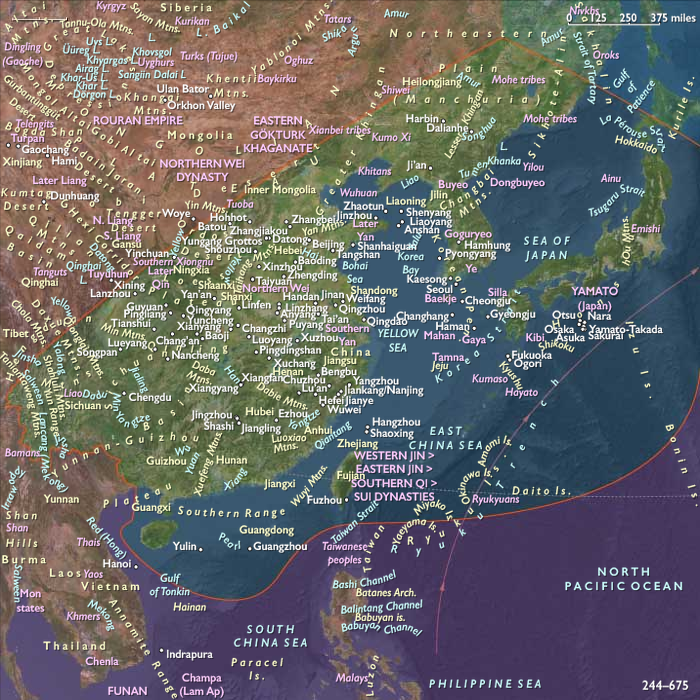
Eastern Wei sends an advance guard of three army columns through the Tong Pass to attack Western Wei.
The Western army under Yuwen Tai defeats one of the columns while the others retreat.
Yuwen follows up, but runs into the main Eastern army (two hundred thousand men).
The Westerners are pushed back through the pass and the Eastern army emerges from the mountains.
Unexpectedly, they are charged in the flank by ten thousand Western cavalry: six thousand Easterners are killed and seventy thousand captured.
Locations
People
Groups
Topics
Commodoties
Subjects
Regions
Subregions
Related Events
Filter results
Showing 7 events out of 7 total
Mediterranean Southwest Europe (1864–1875 CE): Turbulent Transitions and National Consolidations
The era from 1864 to 1875 CE across Mediterranean Southwest Europe—including the Italian Peninsula, southern and eastern Spain, southern Portugal, Andorra, the Balearic Islands, Sicily, Sardinia, and Malta—is characterized by significant political realignments, national consolidations, cultural developments, and socio-political upheaval.
Completion of Italian Unification and the "Roman Question"
Italian unification nears completion during this period, prominently marked by the final annexation of Rome in 1870. When France withdraws its protective garrisons from Rome amidst the Franco-Prussian War, Piedmont-led Italian forces occupy the city after minimal resistance by papal troops. Pope Pius IX retreats to the Vatican, becoming a self-proclaimed "prisoner in the Vatican." Although the newly established Italian government guarantees papal sovereignty within Vatican walls, the pope refuses to acknowledge Italy’s authority over Rome. The "Roman Question"—the unresolved dispute over temporal power and church-state relations—persists as a significant political issue until 1929.
Following Rome’s annexation, Victor Emmanuel II moves Italy’s capital permanently from Florence to Rome in 1871, symbolically concluding the Risorgimento. The former papal residence, the Quirinal Palace, becomes the official royal palace for Italy’s monarchy.
Spain: The Revolution of 1868 and the Bourbon Restoration
Spain endures dramatic political shifts beginning with the Revolution of 1868, leading to the abdication of Queen Isabella II. Instability follows as various forms of governance rapidly succeed each other:
-
A brief period of Liberal Monarchy (1870–1873) under Amadeo I of Savoy, who faces isolation and abdicates after his short, ineffective reign.
-
The tumultuous First Spanish Republic (1873–1874) attempts federal decentralization but collapses quickly amid regional rebellions and internal chaos.
-
A military intervention facilitates the Restoration of the Bourbon monarchy in 1875 under Alfonso XII, who, trained at Britain’s Sandhurst Military Academy, promises stability, proclaiming himself a "Spaniard, Catholic, and Liberal."
The political instability highlights divisions between Moderate liberals advocating constitutional monarchy and Progressives favoring broader democratic reforms, laying the foundation for enduring tensions within Spanish politics.
Andorra's Reforms and Economic Progress
In 1866, Andorra undergoes significant political reform led by the influential syndic Guillem d'Areny-Plandolit. The aristocratic oligarchy is replaced by the Council General, which modernizes governance with broader electoral representation. This New Reform (Nova Reforma) ratified by Andorra’s Co-Princes strengthens national identity and economic modernization, ushering in infrastructure projects, hotels, telegraph lines, and nascent tourism, setting the stage for future prosperity.
Malta: British Colonial Stability
Under British rule since 1814, Malta experiences ongoing infrastructural developments, reinforcing its strategic role in Mediterranean geopolitics. Although colonial tensions occasionally arise, Malta’s economy continues to stabilize and flourish, primarily driven by its maritime and naval significance to British imperial interests.
Cultural Continuity and Romanticism
Culturally, Romantic influences remain strong, particularly in Italy, where Giuseppe Verdi’s operas continue to embody nationalistic fervor and cultural pride. Romantic ideals permeate artistic expression across the region, emphasizing emotional intensity, historical themes, and national identities, thereby enriching Mediterranean Southwest Europe's cultural landscape.
Conclusion: Political Realignments and National Identity
The era from 1864 to 1875 CE signifies critical transitions in Mediterranean Southwest Europe, marked by Italy’s final steps towards unification, Spain’s turbulent experimentation with governance, Andorra’s political reforms, and Malta’s strategic stabilization. These developments reshape the region’s political landscape and national identities, setting the stage for subsequent historical dynamics

The Search for a New Monarch and the Short Reign of Amadeo I (1870–1873)
Following the exile of Isabella II, Spanish Prime Minister Juan Prim embarked on a European search for a suitable monarch to lead Spain. His efforts to secure a Hohenzollern candidate briefly ignited an international crisis—the Franco-Prussian War (1870–1871)—before he ultimately settled on Amadeo of Savoy, the son of King Victor Emmanuel II of Italy.
A Doomed Monarchy: Amadeo I’s Struggle for Stability
-
Assassination of Prim and Political Isolation
- Shortly after Amadeo's arrival in Spain, Prim was assassinated, leaving the inexperienced king without a mentor and vulnerable to political intrigue.
- Spanish factional leaders, deeply mistrustful of a foreign monarch, refused to cooperate or offer guidance, further isolating Amadeo.
-
A Constitution That Weakened the Monarchy
- The constitution inherited by Amadeo granted him insufficient authority to supervise the formation of a stable government.
- Political divisions and shifting alliances made governance virtually impossible, as Spain remained in a state of chronic instability.
-
Abdication and the Fall of the Monarchy
- Abandoned even by the army, Amadeo abdicated in 1873, leaving a powerless parliament to declare Spain a federal republic.
The brief and tumultuous reign of Amadeo I (1870–1873) underscored Spain’s deep political fractures, as neither a constitutional monarchy nor a parliamentary system could provide lasting stability. His abdication paved the way for the short-lived First Spanish Republic (1873–1874), a government that would soon succumb to military intervention and monarchical restoration.
Atlantic Southwest Europe (1864–1875): Liberal Revolutions, Industrial Expansion, and Regional Turmoil
Between 1864 and 1875, Atlantic Southwest Europe—including northern and central Portugal, Galicia, Asturias, Cantabria, northern León and Castile, northern Navarre, northern Rioja, and the Basque Country—experienced renewed political upheaval, significant economic transformation, and growing regional tensions. This period was shaped by revolutionary changes in Spain culminating in the short-lived First Spanish Republic, continuing industrial expansion, increased labor activism, and intensified regional cultural movements, reflecting the era's broader European liberal trends.
Political and Military Developments
Spain: Revolution, Republic, and Restoration
-
In 1868, the Glorious Revolution overthrew Queen Isabella II, ushering in a period of intense political experimentation and instability.
-
Following the brief reign of Amadeo I (1870–1873), Spain established its First Republic in 1873, characterized by political turmoil and decentralized federalist aspirations, influencing regional politics significantly.
-
Persistent instability, Carlist insurrections in the Basque Country and Navarre (Third Carlist War, 1872–1876), and republican factionalism led to the Republic’s collapse in 1874, leading to the Bourbon Restoration under Alfonso XII (1874–1885).
Portugal: Stability Amidst Regionalism
-
Portugal maintained relative political stability under the ongoing Regeneration period led by Prime Minister Fontes Pereira de Melo. Moderate liberal governments continued infrastructural modernization and economic reforms.
-
Northern Portuguese regions, notably Porto, Braga, and Coimbra, experienced limited political unrest compared to Spain, benefiting from sustained economic and infrastructural improvements.
Economic Developments: Industrialization and Trade Expansion
Industrial Growth in Northern Spain
-
Economic expansion continued robustly, particularly in the Basque Country. Bilbao became Spain’s primary industrial center for iron mining and steel production, significantly modernizing its industries and infrastructure.
-
Cantabria, particularly Santander, flourished through maritime trade and commerce, increasingly connecting with British and European markets.
Portuguese Economic Diversification and Maritime Growth
-
Northern Portugal, especially Porto, Braga, and Guimarães, diversified economically through expanded textile manufacturing, wine exports (Port wine), and emerging industries like glass and ceramics production.
-
Railways expanded further, integrating Porto and Lisbon closely with international trading networks, strengthening Portugal’s economic stability and growth.
Social and Urban Developments
Urbanization and Social Inequalities
-
Industrial and commercial growth accelerated urbanization dramatically in Bilbao, Porto, Santander, and Vigo. This rapid expansion intensified socioeconomic disparities, creating pronounced working-class neighborhoods characterized by poverty and overcrowding.
-
Labor movements became increasingly visible, with workers in Bilbao’s steel industries, Vigo’s maritime trade, and Porto’s textile factories advocating labor rights, fair wages, and improved working conditions, resulting in numerous strikes and protests.
Rural Poverty and Emigration
-
Persistent rural stagnation, especially in Galicia, Asturias, and northern Castile-León, continued driving substantial emigration to the Americas, notably Brazil, Argentina, Mexico, and Cuba, reshaping demographic structures and regional economies significantly.
Cultural and Religious Developments
Regional Cultural Revivals and Autonomy Movements
-
Regional cultural identities strengthened substantially. Galician cultural movements flourished through literature, language revival, and folklore, promoting a distinctive Galician identity.
-
Basque nationalism and cultural revival intensified, particularly influenced by political instability and Carlist wars. Cultural organizations actively promoted Basque language preservation (Euskara), literature, and folklore, laying foundations for later political nationalism.
-
Northern Portuguese cultural institutions continued promoting Romantic nationalism, emphasizing historical heritage, Portuguese identity, and literary traditions prominently in cities like Porto and Coimbra.
Persistent Influence of Catholicism
-
Catholicism maintained a central social and cultural role across northern Spain and Portugal, providing stability amidst political turmoil. The Church remained influential in educational and social institutions, particularly in rural regions, sustaining traditional values and community cohesion.
Legacy and Significance
The years 1864–1875 were pivotal for Atlantic Southwest Europe, characterized by political upheaval, rapid industrial expansion, intensified labor movements, and burgeoning regional identities. Spain's revolutionary turmoil and the brief republican experiment profoundly impacted regional politics, while Portugal maintained relative stability, experiencing continued modernization and economic diversification. Increased urbanization, labor activism, and significant cultural revival movements in Galicia, the Basque Country, and northern Portugal underscored deepening regional identities, significantly shaping the region's subsequent political, economic, and cultural trajectories.
Juan Prim had finally obtained the election of Amadeus of Savoy, the son of King Victor Emmanuel of Italy, on November 16, after Prince Leopold stepped down.
On December 27, 1870, just prior to Amadeus' arrival in Spain, Prim is fatally wounded by assassins, and dies three days later.
Barcelona, traditionally a center of anti-Catholic feeling, has witnessed the formation of powerful syndicalist and anarchist groups.
The struggle between the right and left in Spain, which is far more a conflict between clericals and anticlericals than elsewhere in Latin Europe, had become especially intense after 1870.
Juan Prim's death has deprived Amadeo of a staunch supporter.
Bereft of Prim's help and feebly served by a series of short-lived ministries, Amadeo faces continuous turmoil.
He attempts to rule as a constitutional monarch but, opposed both by Republicans and by Carlists, he can form no stable government from the “September coalition” of former conservative Liberal Unionists, the ex-Progressives, and the moderate Democrats—now called Radicals.
Once Amadeo calls the Radicals to power, the conservatives desert the dynasty.
Support for Alfonso, the grandson of Don Carlos, increases, along with republican agitation, and the Second Carlist War beaks out in 1872.
Amadeo abdicates gracefully, as soon as circumstances permit, on February 11, 1873, after an attack by the Radicals on the army.
Amadeo returns to Italy and the Cortes proclaim Spain a republic.