
Southeast Europe (964 – 1107 CE): Byzantine …
Years: 964 - 1107
Southeast Europe (964 – 1107 CE): Byzantine Resurgence, Bulgarian Integration, and Adriatic–Danubian Corridors
Geographic and Environmental Context
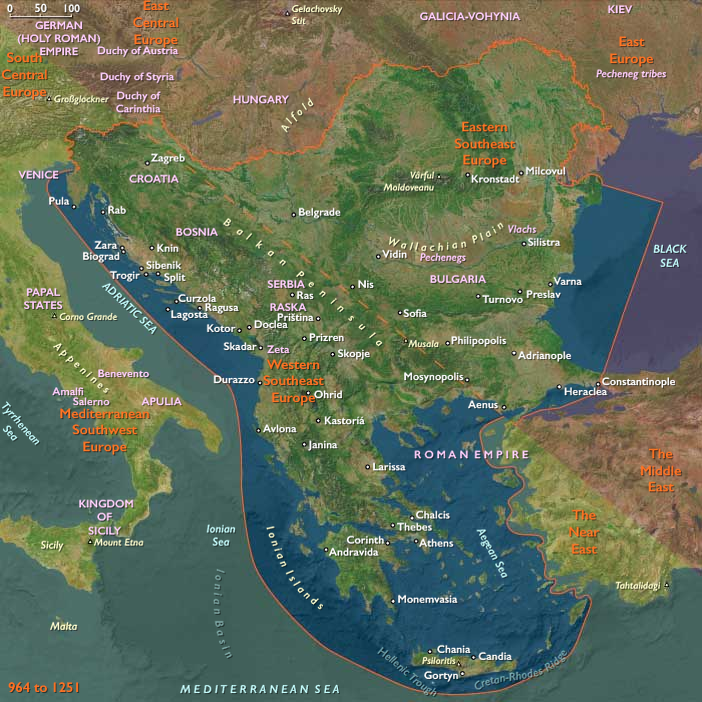
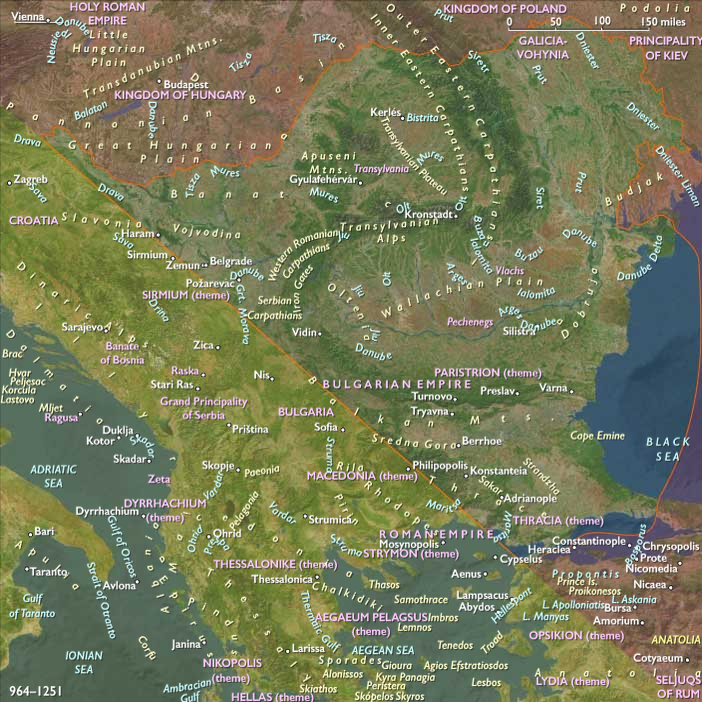
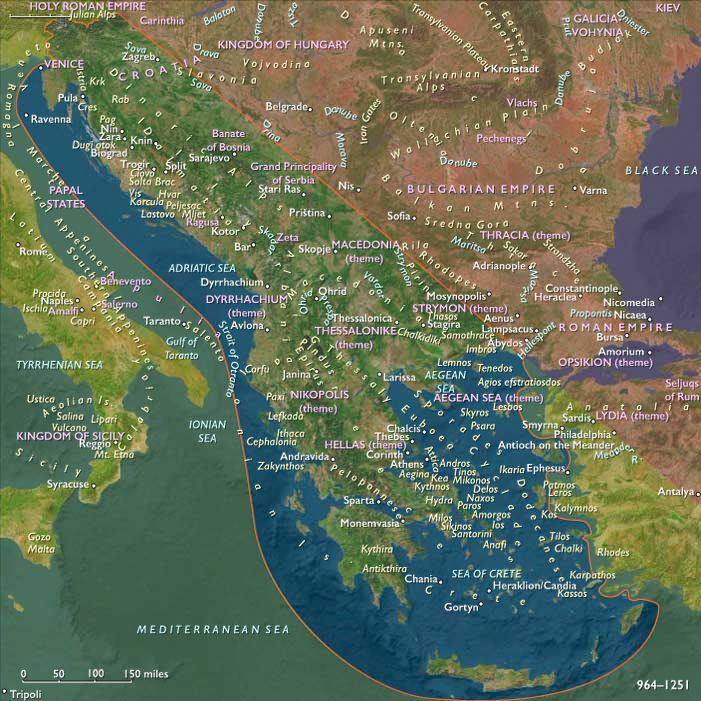
Southeast Europe in this age stretched from Thrace and the Lower Danube through Macedonia and the Morava–Vardar axis to the Adriatic littoral and Dalmatian islands, encompassing nearly all Bulgaria (except the southwest), Romania and Moldova, northeastern Serbia, northeastern Croatia, extreme northeastern Bosnia, and Greece outside Thrace (Attica, Boeotia, Peloponnese, Epirus).
Core lowlands—Wallachian Plain, Lower Danube, Dobruja, Thracian basins—fed populous centers; Balkan passes (Shipka, Varbitsa), the Carpathian Gates, and the Via Militaris tied Belgrade–Niš–Sofia–Adrianople–Constantinople. To the west, the Via Egnatia linked Dyrrhachium (Durrës) with Thessaloniki, while Adriatic island ports (Zadar, Split, Trogir, Kotor, Ragusa) connected to Italy and the Aegean. Black Sea harbors (Varna, Constanţa) and Danube crossings remained strategic for trade and war.
Climate and Environmental Shifts
The Medieval Warm Period (c. 950–1250) lengthened growing seasons in Thrace and the Danube plain, boosting wheat, barley, and vine production. Flood pulses on the Danube and Maritsa set transport calendars. On the steppe margin, drought swings intensified pressures from Pecheneg and later Cuman nomads, shaping frontier policy and campaigning rhythms.
Societies and Political Developments
Bulgarian Decline and Absorption (10th–early 11th c.)
After Peter I (r. 927–969), Bulgaria faced internal strain and external shocks. Sviatoslav of Rus’ (968–971) seized Preslav, prompting John I Tzimiskes to intervene, defeat Sviatoslav, and annex eastern Bulgaria (971). Resistance shifted west under the Cometopuli; Samuel (r. 997–1014) forged a powerful Ohrid-centered empire. Basil II “Bulgar-Slayer” (r. 976–1025) dismantled it via relentless campaigns (notably Kleidion, 1014); by 1018, Bulgaria was fully integrated into the Byzantine system.
Byzantine Resurgence and Administration
The Macedonian dynasty consolidated the Balkans after 1018, reorganizing conquered lands into themes and reestablishing imperial garrisons and bishoprics from Thrace to the Danube marches. In Greece (outside Thrace)—Attica, Boeotia, the Peloponnese, and Epirus—imperial fiscal and judicial structures stabilized agrarian estates and port cities; rising aristocracies (proto-Komnenian milieu) gained regional weight.
Steppe Pressures and Frontier Politics
The Pechenegs dominated the Lower Danube steppe through the late 10th–11th centuries, raiding imperial and former Bulgarian lands; the empire alternated tribute, alliances, and force—culminating in decisive defeat of the Pechenegs with Cuman support (e.g., Levounion, 1091). Thereafter the Cumans (Polovtsians) became the chief nomadic threat along the Danube and into Wallachia and Moldova.
Western Alignments: Croatia, Serbia, Dalmatia
Croatia preserved kingship but, after dynastic ebb, entered a personal union with Hungary (1102), while its coastal communes bargained with Venice. Serbian principalities (Raška, Zeta) oscillated between imperial suzerainty and local assertion; Vukan’s line advanced late in the period. Dalmatian communes—Zadar, Split, Trogir, Kotor, Ragusa—codified statutes, expanded harbors, and played Byzantium, Hungary, and Venice against one another to preserve autonomy and commerce. Inland, Transylvania developed under Hungarian expansion after 1000, shaping northern Danubian balances.
Economy and Trade
Agrarian Core and Fiscal Integration
In Thrace and the Danube valley, grain, vines, and stock-raising thrived. After 1018, Byzantine praktika registered Bulgar peasantry into imperial tax law, channeling surplus to Adrianople, Thessaloniki, and Constantinople.
Corridors and Markets
-
Danube artery: moved wax, honey, furs, grain, slaves between Rus’/Hungary and Constantinople.
-
Via Militaris: imperial armies and caravans supplied inland garrisons and markets.
-
Via Egnatia: fed Dyrrhachium and Thessaloniki, bridging Adriatic and Aegean.
-
Black Sea ports: Varna, Constanţa connected Balkan produce to Byzantine and Rus’ circuits.
-
Adriatic: Venetian convoys knit Dalmatia to Apulia and Ancona, re-exporting Balkan metals (Bosnian/Serbian silver, iron) and salt (e.g., Pag).
Coinage: Byzantine nomismata and copper issues circulated widely; communal credit and notarial practices matured on the Adriatic.
Subsistence and Technology
Fortification & Arms
Byzantium rebuilt Preslav, fortified Sofia, Skopje, Adrianople, and strengthened Danube palisades. Imperial forces relied on cataphract cavalry and thematic infantry; Bulgarian levies served within imperial formations. Pecheneg/Cuman warfare emphasized horse archery and deep raids.
Rural/Maritime Infrastructures
Stone citadels multiplied in coastal and upland nodes; shipyards produced galleys and cogs for Adriatic convoys; inland estates improved presses, mills, and viticultural terraces.
Movement and Interaction Corridors
-
Danube crossings—Ruse, Silistra, Vidin—were pivotal gates for steppe incursions and imperial counter-marches.
-
Carpathian passes opened Magyar/Hungarian access into Transylvania and the lower Danube.
-
Morava–Vardar and Drina–Sava channels linked inland Balkans to Aegean and Central Europe.
-
Adriatic sea-lanes connected Dalmatia to Venice and Italian markets; Black Sea shipping tied ports to Rus’ and the capital.
Belief and Symbolism
Orthodoxy and Slavic Literacy
Orthodox Christianity, consolidated in Bulgaria under Boris and Simeon, was integrated into the Byzantine patriarchal orbit after 1018. Basil II confirmed the Ohrid Archbishopric’s autonomy, preserving Slavic liturgy and Cyrillic script; scriptoria at Ohrid and Preslav continued hagiography and law-text production.
Bogomilism
A dualist critique of hierarchy spread in 10th–11th centuries, embedding dissent within Balkan society and later influencing heretical currents westward.
Relic Cults and Icons
In Greek and Macedonian lands, icons, relics, and monastic networks reinforced imperial legitimacy and localized sanctity; along the Adriatic, Latin rites coexisted with Orthodox practice, especially in the communes.
Adaptation and Resilience
-
Administrative absorption: Byzantine themes stabilized taxation, justice, and military service in newly integrated Bulgaria.
-
Nomad diplomacy: tribute, alliance, and selective recruitment of Pecheneg/Cuman auxiliaries turned steppe pressures into tools of imperial statecraft.
-
Communal governance: Dalmatian statutes and consulates lowered merchant risk and secured harbor revenues despite great-power rivalries.
-
Cultural continuity: the Ohrid settlement safeguarded Slavic ecclesiastical autonomy and literacy under imperial rule.
Long-Term Significance
By 1107 CE, Southeast Europe had been reshaped into a Byzantine-led but polycentric landscape:
-
Bulgaria—politically integrated into the empire—retained Slavic identity and ecclesiastical autonomy at Ohrid, ensuring cultural survival.
-
Byzantium held Thrace and the Danube frontier, yet constant steppe raids taxed imperial resources even amid the Komnenian recovery.
-
Pecheneg collapse and Cuman ascendancy redefined the northern threat; Hungary advanced in Transylvania, shifting power north of the Danube.
-
Croatia–Hungary alignment (1102), Serbian consolidation, and Dalmatian communal strength set the stage for 12th-century realignments—Venetian maritime assertion, Komnenian strategies, and the eventual rise of the Second Bulgarian Empire.
This age fixed the region’s Orthodox Christian character, embedded Cyrillic literacy, and hardened the Byzantine–steppe frontier while keeping the Adriatic–Danubian–Aegean corridors open—foundations that would structure Balkan politics and commerce for the next century.
Eastern Southeast Europe (with civilization) ©2024-25 Electric Prism, Inc. All rights reserved.
People
- Basil II
- Boleslaw I Chrobry
- Constantine VIII
- John I Tzimiskes
- Peter I of Bulgaria
- Samuel of Bulgaria
- Sviatoslav I of Kiev
Groups
- Thrace, Theme of
- Slavs, South
- Christianity, Chalcedonian
- Muslims, Sunni
- Macedonia, East Roman Theme of
- Pechenegs, or Patzinaks
- Bogomilism
- Bulgarian Empire (First)
- Bulgarian Empire, First
- Cuman people, or Western Kipchaks, also called Polovtsy, Polovtsians)
- Bulgaria, Theme of
- Christians, Roman Catholic
- Christians, Eastern Orthodox
- Roman Empire, Eastern: Doukid dynasty
Topics
- Byzantine-Bulgarian Wars
- Middle Subatlantic Period
- Medieval Warm Period (MWP) or Medieval Climate Optimum
- Bulgaria, Byzantine conquest of
- Bulgarian-Byzantine War of 981-1018
- Kleidion, Battle of
- East–West Schism
- Levounion, Battle of
- Crusades, The
Commodoties
- Hides and feathers
- Gem materials
- Domestic animals
- Oils, gums, resins, and waxes
- Grains and produce
- Textiles
- Slaves
- Salt
- Sweeteners
- Manufactured goods
Subjects
- Commerce
- Language
- Architecture
- Engineering
- Conflict
- Faith
- Government
- Scholarship
- Custom and Law
- Technology
Regions
Subregions
Years: 964 - 1107
Eastern Southeast Europe (with civilization) ©2024-25 Electric Prism, Inc. All rights reserved.
People
- Basil II
- Boleslaw I Chrobry
- Constantine VIII
- John I Tzimiskes
- Peter I of Bulgaria
- Samuel of Bulgaria
- Sviatoslav I of Kiev
Groups
- Thrace, Theme of
- Slavs, South
- Christianity, Chalcedonian
- Muslims, Sunni
- Macedonia, East Roman Theme of
- Pechenegs, or Patzinaks
- Bogomilism
- Bulgarian Empire (First)
- Bulgarian Empire, First
- Cuman people, or Western Kipchaks, also called Polovtsy, Polovtsians)
- Bulgaria, Theme of
- Christians, Roman Catholic
- Christians, Eastern Orthodox
- Roman Empire, Eastern: Doukid dynasty
Topics
- Byzantine-Bulgarian Wars
- Middle Subatlantic Period
- Medieval Warm Period (MWP) or Medieval Climate Optimum
- Bulgaria, Byzantine conquest of
- Bulgarian-Byzantine War of 981-1018
- Kleidion, Battle of
- East–West Schism
- Levounion, Battle of
- Crusades, The
Commodoties
- Hides and feathers
- Gem materials
- Domestic animals
- Oils, gums, resins, and waxes
- Grains and produce
- Textiles
- Slaves
- Salt
- Sweeteners
- Manufactured goods
Subjects
- Commerce
- Language
- Architecture
- Engineering
- Conflict
- Faith
- Government
- Scholarship
- Custom and Law
- Technology
Regions
Subregions