
Eastern Southeast Europe (880–891 CE): Ecclesiastical Unity …
Years: 880 - 891
Eastern Southeast Europe (880–891 CE): Ecclesiastical Unity and Cultural Consolidation
Settlement and Migration Patterns
Continued Stability and Cultural Assimilation
From 880 to 891 CE, Eastern Southeast Europe sustained demographic stability while experiencing notable cultural integration. The assimilation process intensified, notably among the Daco-Roman populations and Slavic settlers, gradually forming the Romanian people, a process nearing completion by the tenth century.
Political and Military Developments
Ecclesiastical and Political Harmony
The Council of Constantinople in 880 CE marked a significant reconciliation between Eastern and Western churches, restoring normal relations between Rome and Constantinople. The moderate and extremist factions, represented by Patriarchs Photios and Ignatius respectively, reached a notable accord, resolving critical ecclesiastical disputes.
Bulgarian-Serbian Dynamics
In this period, Bulgars and Slavs solidified into a unified Bulgarian identity through cultural shifts, notably the replacement of Greek by Slavic in religious services and literary life. This linguistic and cultural consolidation significantly strengthened the Bulgarian state.
Economic and Technological Developments
Economic Prosperity and Stability
Continued stability and strategic regional conditions maintained economic prosperity. Agriculture remained vibrant, and expanding trade routes continued to enhance economic opportunities, further benefiting local populations and regional stability.
Influence of Italian Maritime Republics
The ongoing economic activities further increased the influence of Italian maritime republics—Venice, Genoa, and Amalfi—whose dominance of Mediterranean trade significantly impacted regional economic dynamics, particularly in trade routes linking Greece and the wider Mediterranean world.
Cultural and Artistic Developments
Revival and Consolidation of Figural Art
The post-843 revival of figural art flourished further during this period, continuing to enrich Byzantine religious and cultural life. This artistic vibrancy complemented ongoing scholarly activities and cultural integration within the Byzantine sphere of influence.
Expansion of Scholarly and Literary Activities
Scholarly endeavors continued to thrive with increased manuscript production, underpinning a sustained intellectual revival that reinforced cultural resilience and continuity across Eastern Southeast Europe.
Social and Religious Developments
Resolution of the Photian Schism
The formal reconciliation achieved at the Council of Constantinople effectively ended the Photian Schism, significantly stabilizing ecclesiastical relationships between Eastern and Western Christianity. This event reinforced ecclesiastical unity and strengthened religious cohesion.
Bulgarian Religious and Cultural Integration
The adoption of Slavic languages in Bulgarian religious and literary contexts unified Bulgar and Slav populations into a cohesive Bulgarian people. This unification was facilitated by Orthodox missionaries, notably Cyril and Methodius, and the establishment of the Bulgarian Church's autocephaly, further enhancing cultural and religious integration.
Long-Term Consequences and Historical Significance
The period from 880 to 891 CE was characterized by crucial ecclesiastical reunification, significant cultural consolidation, and linguistic integration among Bulgarians and Slavs, and the ongoing assimilation of the Slavs by the Daco-Romans. These developments substantially shaped the region's social, religious, and cultural landscape, reinforcing the foundation for future political and cultural stability in Eastern Southeast Europe.
People
Groups
- Thrace, Theme of
- Slavs, South
- Christianity, Chalcedonian
- Bulgarian Empire (First)
- Bulgarians (South Slavs)
- Roman Empire, Eastern: Macedonian dynasty
- Bulgarian Orthodox Church
- Romanians
Topics
Commodoties
Subjects
Regions
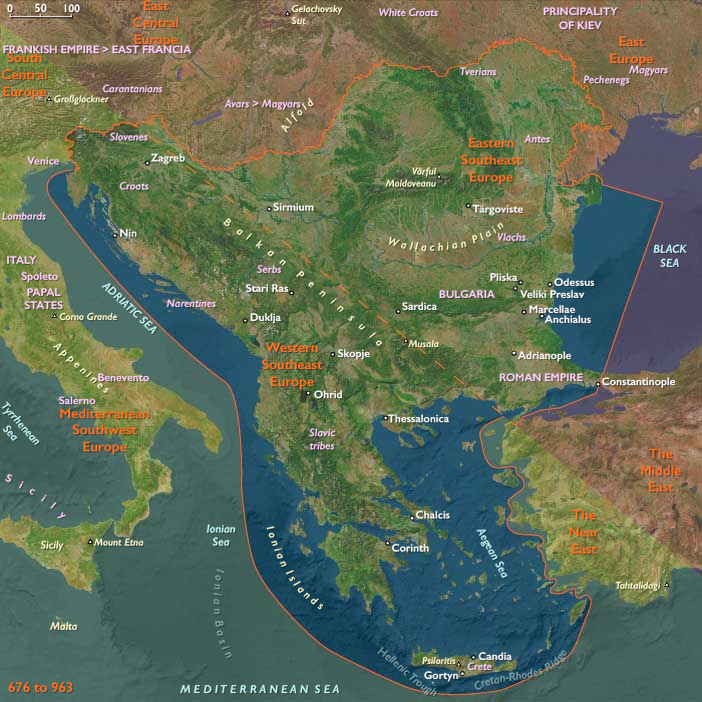
Subregions
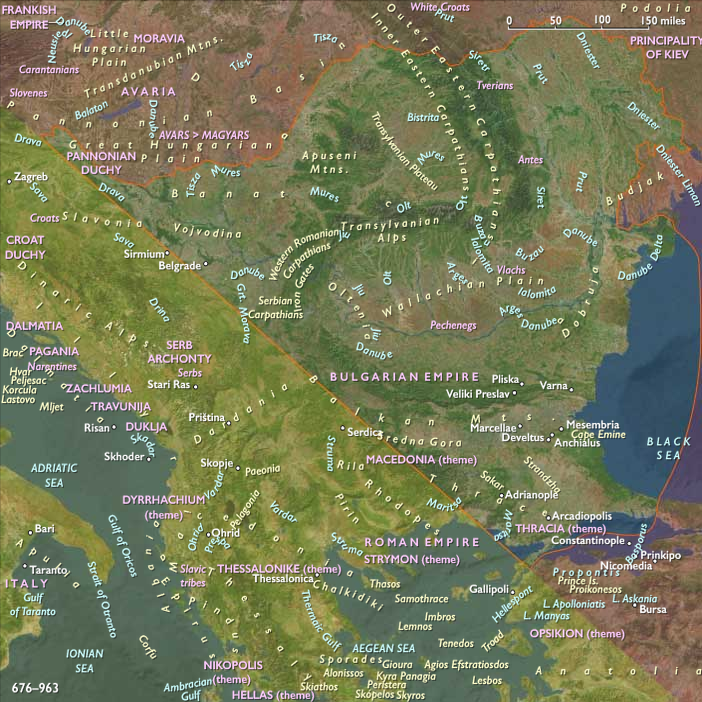
Years: 880 - 891
People
Groups
- Thrace, Theme of
- Slavs, South
- Christianity, Chalcedonian
- Bulgarian Empire (First)
- Bulgarians (South Slavs)
- Roman Empire, Eastern: Macedonian dynasty
- Bulgarian Orthodox Church
- Romanians
Topics
Commodoties
Subjects
Regions
Subregions