
Southeast Europe (2637 – 910 BCE): Bronze …
Years: 2637BCE - 910BCE
Southeast Europe (2637 – 910 BCE): Bronze and Early Iron — From Tell Cultures to Tribal Kingdoms
Regional Overview
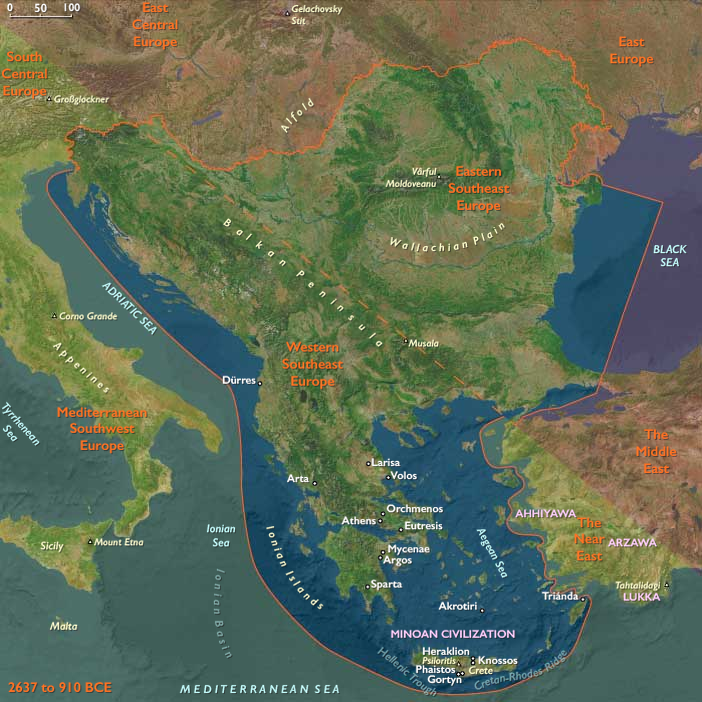
Across the Danube and Adriatic, the early Bronze and Iron Ages transformed Southeast Europe into a crossroads between the Aegean, Carpathian, and Pontic–steppe worlds.
Fortified hilltops replaced tell settlements; metal and horse cultures linked inland tribes with Mycenaean and Anatolian traders; and by the close of this age, Thracian and Illyrian chiefdoms stood poised to enter the classical orbit of Greece and Rome.
Geography and Environment
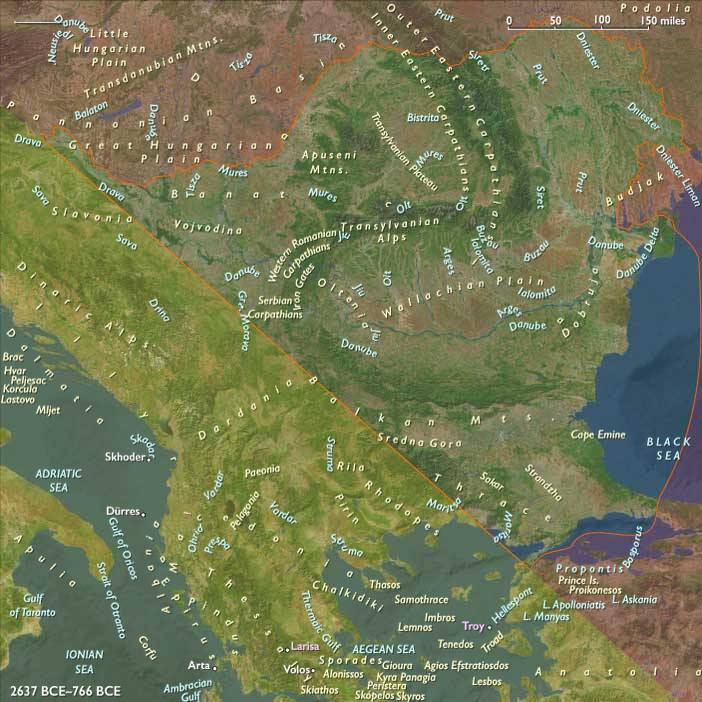
Southeast Europe’s geography formed a layered frontier:
-
The Danube corridor tied the Carpathian Basin to the Black Sea.
-
The Thracian Plain opened south to the Aegean and north toward Dacia.
-
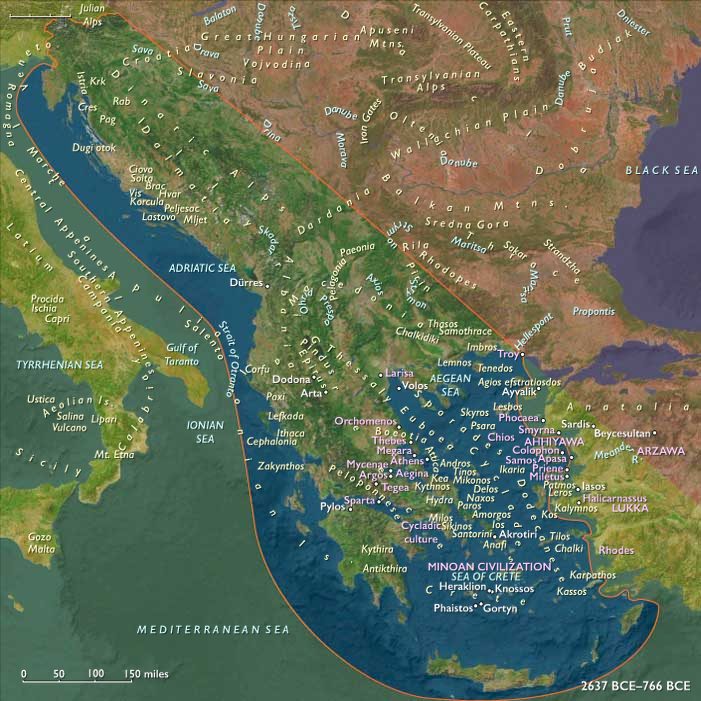
The Adriatic and Ionian coasts offered sheltered bays and island chains for navigation.
-
Mountain belts—the Balkans, Dinaric Alps, and Carpathians—defined ecological tiers of pasture, forest, and mining zones.
River terraces, upland plateaus, and coastal plains together sustained mixed agro-pastoral economies and maritime exchange.
Climate and Environmental Shifts
Holocene warmth gave way to cooler, more continental regimes.
Periodic steppe aridity alternated with wetter interludes; river avulsions reshaped the Danube and Sava floodplains.
These fluctuations encouraged settlement on defensible uplands and promoted diversification among farming, herding, and fishing.
Societies and Political Developments
Eastern Southeast Europe
-
The Ezero and Early Thracian tells evolved into hillforts by the second millennium BCE.
-
Steppe kurgan groups—successors of Yamnaya, Catacomb, and Srubnaya traditions—introduced horse gear and chariotry.
-
Aegean–Mycenaean merchants reached Black Sea ports, stimulating metallurgy and luxury exchange.
-
By the Early Iron Age, Thracian and Geto-Dacian polities had emerged, blending steppe mobility with Balkan agriculture.
Western Southeast Europe
-
The Vučedol culture (c. 3000–2200 BCE) dominated the Sava–Danube frontier with advanced copper–bronze technology.
-
The Cetina maritime network exploited Adriatic coasting routes, linking Dalmatia to the Ionian islands.
-
Illyrian and Dalmatian tribal systems crystallized on the Glasinac plateaus by the late second millennium BCE.
-
Upland chiefdoms coexisted with coastal trading ports, creating a dual economy of herding and seafaring.
Economy and Technology
Agriculture and herding formed the subsistence base—barley, wheat, grapes, and livestock—while metal industries flourished in copper and tin districts.
Bronze swords, sickles, ornaments, and later iron tools and weapons diffused across the Balkans.
Chariots and bridles signaled elite power.
Coastal shipbuilding matured; inland, the Danube and Sava carried grain, salt, and metals to the Aegean and Black Sea.
Trade in amber, obsidian, and wine bound northern Europe to the Mediterranean.
Belief and Symbolism
Burial mounds and warrior graves reflected rising social hierarchy.
In Thrace, tumuli contained horses and gold phialae; in Illyria, stone circles and hilltop sanctuaries served clan cults.
Rock sanctuaries and solar motifs linked local deities with Aegean pantheons.
These ritual landscapes merged ancestor veneration, fertility symbolism, and the emerging ideology of heroic kingship.
Movement and Interaction Corridors
-
Black Sea maritime routes connected Thrace to Anatolia and the Caucasus.
-
The Danube highway moved salt, grain, and metal between Central Europe and the coast.
-
Adriatic cabotage joined Dalmatia to Italy and the Ionian islands.
-
The Morava–Vardar axis provided an inland bridge between the Danube and the Aegean.
Together, these routes created the first coherent economic system spanning steppe, mountain, and sea.
Environmental Adaptation and Resilience
Communities balanced herding and farming to withstand drought and flood.
Hillforts offered defense against invasion; coastal redundancy cushioned against inland failure.
Agro-pastoral mobility and riverine transport allowed flexible responses to climatic and political shocks.
Regional Synthesis and Long-Term Significance
By 910 BCE, Southeast Europe was a tapestry of fortified hill societies, maritime traders, and steppe riders.
Eastern Thracian kingdoms and Western Illyrian chiefdoms bridged the Aegean and Danubian worlds, mediating the flow of bronze, iron, and ideas between Europe and the Near East.
This integrated frontier became the enduring hinge of classical and medieval history—linking the civilizations of the Mediterranean, the steppe, and Central Europe
Groups
Topics
Commodoties
Subjects
Regions
Subregions
Years: 2637BCE - 910BCE
Groups
Topics
Commodoties
Subjects
Regions
Subregions