
Southeast Europe (1396–1539 CE) Ottoman Ascendancy, …
Years: 1396 - 1539
Southeast Europe (1396–1539 CE)
Ottoman Ascendancy, Balkan Frontiers, and the Fault Line of Christendom
Geography & Environmental Context
Southeast Europe in this era was a land of rivers, mountains, and fortified cities dividing Christian and Islamic worlds.
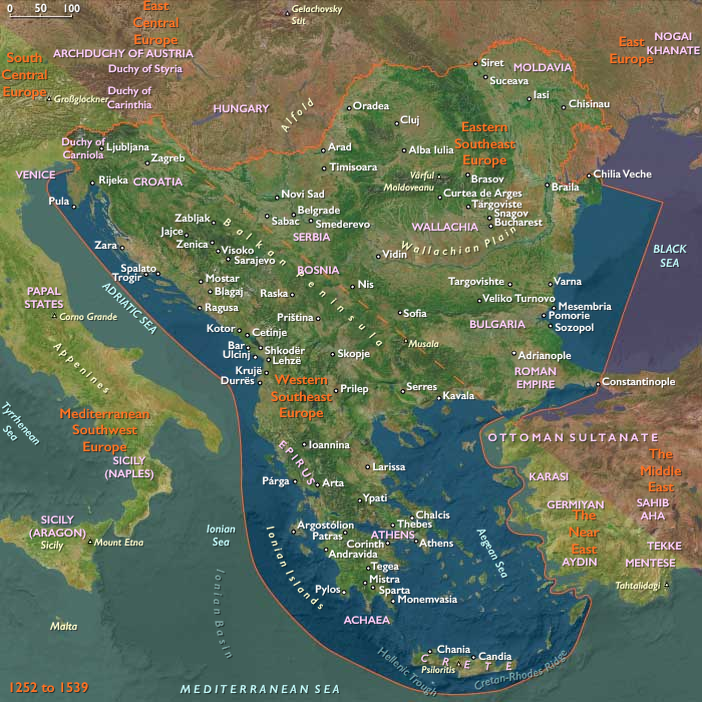
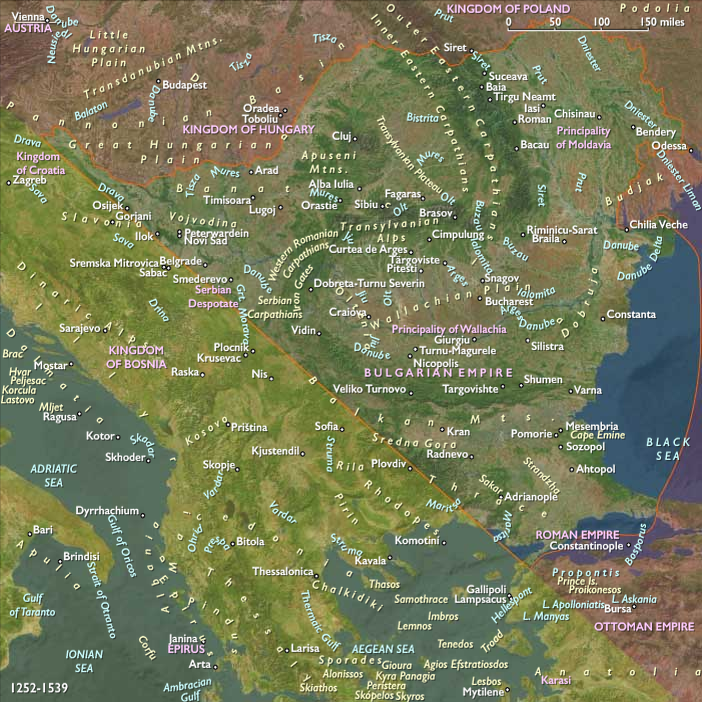
Eastern Southeast Europe stretched from Turkey-in-Europe and Thrace through Bulgaria, Moldova, and Romania to the Danube Delta—a landscape of river valleys, forest plains, and mountain ramparts feeding into the Bosporus and the Black Sea.
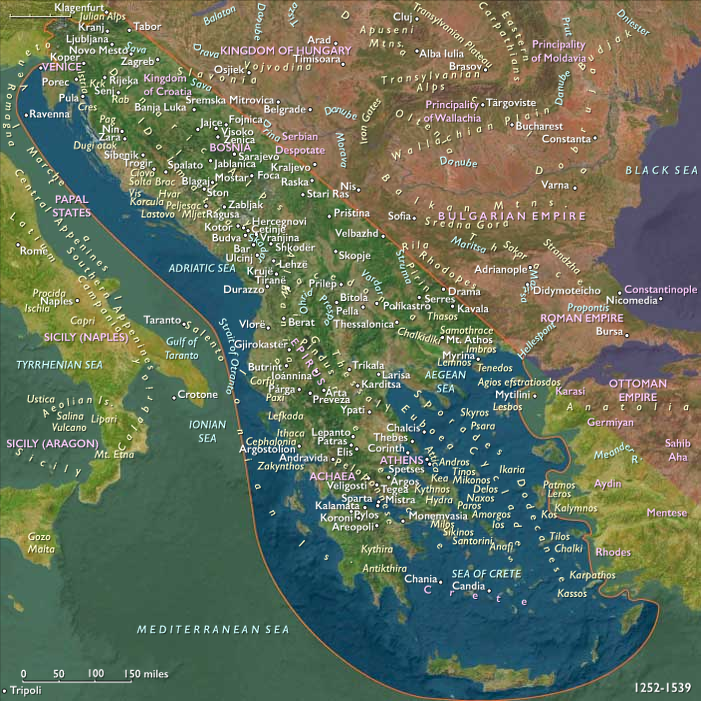
Western Southeast Europe encompassed Greece, Albania, Montenegro, North Macedonia, Kosovo, Bosnia, Croatia, and Slovenia, where the Dinaric Alps, Pindus, and Adriatic coasts met the mountain hinterlands of the Balkans.
This region formed the great hinge between Central Europe and the eastern Mediterranean, a crossroads of empires and faiths.
Climate & Environmental Shifts
The Little Ice Age cooled the region, tightening agricultural margins:
-
Danube Basin: Floods alternated with droughts, reshaping floodplain farming.
-
Carpathian & Balkan uplands: Heavy snow prolonged transhumance cycles; spring torrents enriched meadows.
-
Thrace & Aegean coasts: Frosts damaged olives and vines; Mediterranean crops retreated upslope.
-
Adriatic & Ionian Seas: Stormier seasons and colder currents complicated navigation and coastal trade.
Subsistence & Settlement
-
Plains & river valleys: Wheat, barley, rye, and millet formed staples; vineyards in Bulgaria and Thrace produced wine for local and export trade.
-
Uplands: Sheep, goats, and cattle moved along seasonal routes between the Carpathians, Balkans, and Dinaric Alps.
-
Coasts & islands: Olive oil, figs, salt, and fisheries supported maritime towns from Dubrovnik to Thessaloniki.
-
Mining zones: Bosnia and Serbia exported silver and lead via Dalmatian ports.
-
Urban nodes: Constantinople/Istanbul, Sofia, Iași, Belgrade, and Dubrovnik were vital centers of administration, craft, and exchange.
Technology & Material Culture
-
Agriculture: Iron-tipped plows and watermills improved productivity; Ottoman timar tenure reorganized rural estates.
-
Military: Gunpowder artillery transformed sieges; the Ottomans perfected field logistics and fortress artillery; local principalities deployed cavalry and wagon defenses.
-
Architecture: Frescoed Orthodox monasteries such as Voroneț and Humor adorned Moldavia; Ottoman mosques, baths, and bridges reshaped Balkan towns; Venetian Gothic façades persisted on the Adriatic.
-
Crafts: Balkan goldsmithing, woodcarving, and textile production continued under mixed Ottoman and local patronage.
Movement & Interaction Corridors
-
The Danube Corridor: Lifeline for armies, grain, and trade; fortresses like Belgrade and Vidin guarded crossings.
-
Via Egnatia & Balkan passes: Connected Adriatic ports with Thrace and Constantinople, sustaining overland caravans.
-
Black Sea–steppe routes: Linked Moldavia, Dobruja, and the Crimea, feeding Ottoman supply lines.
-
Adriatic and Aegean sea lanes: Carried Venetian, Ragusan, and Ottoman fleets, merchants, and pilgrims between Italy, Greece, and Anatolia.
-
Mountain and forest roads: Enabled transhumance and the smuggling of goods and people across imperial frontiers.
Cultural & Symbolic Expressions
-
Orthodox Christianity: Monasteries in Moldavia, Wallachia, Serbia, and Athos preserved liturgy, manuscript illumination, and identity under Ottoman rule.
-
Islamic urban culture: Mosques, caravanserais, and vakıf foundations spread through conquered towns, introducing Ottoman civic life.
-
Catholic & Humanist enclaves: Dalmatian cities like Zadar, Split, and Dubrovnik maintained Latin schools and libraries; émigré scholars from Constantinople brought Greek manuscripts to Italy, fueling the Renaissance.
-
Folk traditions: Heroic songs of Hunyadi, Skanderbeg, and Stephen the Great celebrated resistance; South Slavic and Albanian epics sustained oral memory.
-
Civic artistry: Icon painting, manuscript copying, and folk embroidery bridged church and household devotion.
Environmental Adaptation & Resilience
-
Agrarian diversity: Mixed grain, vine, and pastoral systems buffered risk; maize was still unknown but cereals diversified diets.
-
Transhumant mobility: Pastoralists followed snowmelt, shifting herds between alpine meadows and Danubian plains.
-
Forest refuge: Villages rebuilt after raids amid forest cover; woodlands supplied construction and fuel.
-
Maritime exchange: Salt, fish, and ship timber stabilized economies when inland fields failed.
-
Ottoman provisioning networks: Redirected Balkan surpluses toward Istanbul and garrisons, maintaining trade under imperial integration.
Technology & Power Shifts (Conflict Dynamics)
-
Ottoman victories:
-
Nicopolis (1396) and Varna (1444) shattered crusader resistance.
-
Constantinople fell in 1453, transforming it into Istanbul.
-
Belgrade (1521) and Mohács (1526) opened Hungary to Ottoman partition.
-
-
Danubian principalities: Wallachia and Moldavia maintained tributary autonomy; leaders like Mircea the Elderand Stephen the Great resisted Ottoman and Tatar incursions.
-
Crimean Tatars: Allied with the Ottomans, raided Moldavia, Poland, and Ukraine, feeding the Black Sea slave trade.
-
Western frontiers: Venice clashed with Ottoman fleets; Dubrovnik navigated neutrality and profit as intermediary; Skanderbeg’s Albanian revolt (1443–1468) became emblematic of mountain resistance.
-
Naval dominance: The Battle of Preveza (1538) secured Ottoman mastery of the Ionian and Aegean seas.
Transition (to 1539 CE)
By 1539, Southeast Europe had become the principal marchland of empire.
The Ottoman crescent stretched from the Danube to the Aegean and Adriatic, with Istanbul at its center.
Bulgaria, Thrace, Greece, and Bosnia were integrated into Ottoman administration; Wallachia and Moldavia paid tribute; Transylvania balanced between Habsburg and Ottoman influence.
The Adriatic remained contested—Venice held coastal enclaves, while Dubrovnik thrived as a neutral broker.
Amid conquest, Balkan peoples preserved faith, language, and tradition through monastery, market, and mountain refuge.
The age closed with the Battle of Preveza (1538) and Ottoman control of the eastern Mediterranean, confirming Southeast Europe as the heart of the empire’s European frontier—a landscape of faith, resistance, and imperial transformation.
People
Groups
- Jews
- Islam
- Muslims, Sunni
- Christians, Eastern Orthodox
- Bulgarian Empire (Second), or Empire of Vlachs and Bulgars
- Hungary, Kingdom of
- Wallachia, Principality of
- Ottoman Empire
- Moldavia, Principality of
- Serbia, Moravian
- Egypt and Syria, Mamluk Burji Sultanate of
- Bulgaria, Ottoman
- Wallachia, Principality of
- Serbian Despotate
- Wallachia (Ottoman vassal), Principality of
- Serbian Despotate
- Transylvania (Hungarian governate)
- Serbia, Ottoman
- Qizilbash or Kizilbash, (Ottoman Turkish for "Crimson/Red Heads")
- Spanish Empire
- Persia, Safavid Kingdom of
- Egypt, Ottoman eyalet of
- Habsburg Monarchy, or Empire
Topics
- Reconquista, the
- Middle Subatlantic Period
- Nicopolis, Battle of
- Kosovo, Battle of (1448)
- Constantinople, Fall of
- Ottoman-Mamluk War of 1516-17
- Mohács, Battle of
Commodoties
Subjects
Regions
Subregions
Related Events
Showing 10 events out of 43406 total
Years: 1396 - 1539
People
Groups
- Jews
- Islam
- Muslims, Sunni
- Christians, Eastern Orthodox
- Bulgarian Empire (Second), or Empire of Vlachs and Bulgars
- Hungary, Kingdom of
- Wallachia, Principality of
- Ottoman Empire
- Moldavia, Principality of
- Serbia, Moravian
- Egypt and Syria, Mamluk Burji Sultanate of
- Bulgaria, Ottoman
- Wallachia, Principality of
- Serbian Despotate
- Wallachia (Ottoman vassal), Principality of
- Serbian Despotate
- Transylvania (Hungarian governate)
- Serbia, Ottoman
- Qizilbash or Kizilbash, (Ottoman Turkish for "Crimson/Red Heads")
- Spanish Empire
- Persia, Safavid Kingdom of
- Egypt, Ottoman eyalet of
- Habsburg Monarchy, or Empire
Topics
- Reconquista, the
- Middle Subatlantic Period
- Nicopolis, Battle of
- Kosovo, Battle of (1448)
- Constantinople, Fall of
- Ottoman-Mamluk War of 1516-17
- Mohács, Battle of
Commodoties
Subjects
Regions
Subregions