
Melanesia (7,821 – 6,094 BCE): Early Holocene …
Years: 7821BCE - 6094BCE
Melanesia (7,821 – 6,094 BCE): Early Holocene — Gardens of Beginnings and Seas of Exchange
Geographic & Environmental Context
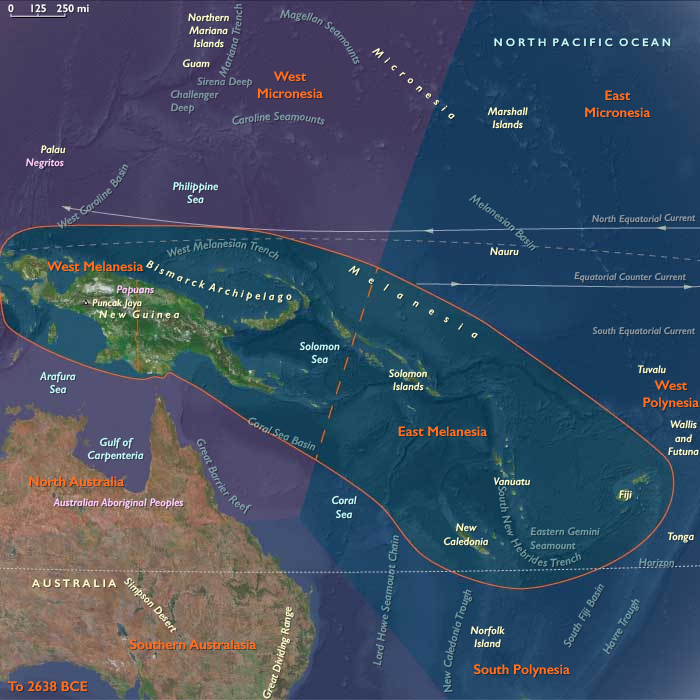
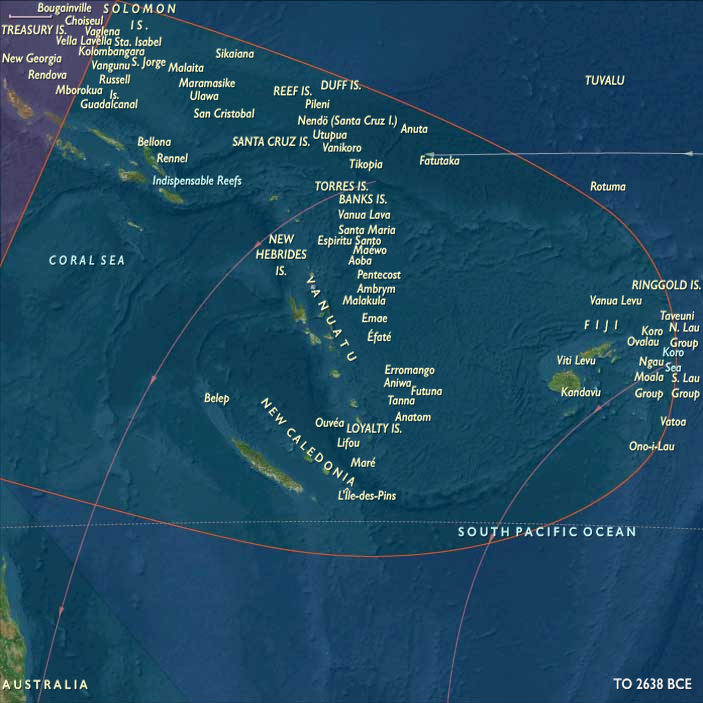
During the Early Holocene, Melanesia—stretching from the Papuan highlands and Bismarck Archipelago through the Solomon Islands, Vanuatu, Fiji, and New Caledonia—stood at the heart of a tropical world newly stabilized after the great glacial melt.
Rising seas sculpted the modern outlines of island chains, transforming once-connected landmasses into archipelagic corridors rich in lagoons, mangroves, and estuaries.
Inland, warm and wet conditions regenerated dense montane and coastal forests, while offshore reefs thrived in calm, sunlit waters.
Two broad zones matured in tandem:
-
West Melanesia, dominated by the New Guinea highlands and the Bismarck islands, where human innovation began to reshape wetlands and forest clearings into managed gardens.
-
East Melanesia, encompassing Vanuatu, Fiji, New Caledonia, and the central–eastern Solomons, where communities along lagoons and reefs developed rich mixed economies and strengthened maritime linkages.
Climate & Environmental Shifts
The Early Holocene thermal optimum (roughly 8,000–6,000 BCE) brought warmer, wetter conditions with little interannual instability.
Rainfall was regular, fueling perennial streams and stabilizing soils in both highlands and islands.
Forests expanded upslope; coastal plains, now flooded by postglacial seas, hosted mangroves and estuaries.
Volcanic activity refreshed landscapes in the Bismarck and Vanuatu–Fiji arcs, providing fertile ash for rapid regrowth.
This equilibrium fostered one of the earliest and most enduring forest–garden ecologies on Earth.
Subsistence & Settlement
Across Melanesia, communities transitioned from mobile foraging to semi-sedentary horticultural lifeways grounded in wetland and forest productivity:
-
West Melanesia (New Guinea & the Bismarcks):
The Kuk Swamp complex in the Wahgi Valley saw the world’s earliest ditch-fed horticulture, cultivating taro, yam, and banana in managed plots by 7,000 BCE.
Coastal and lowland groups balanced shellfish and reef fishing with nut and fruit harvests (Canarium, pandanus, breadfruit).
Highland–lowland exchange networks moved stone, salt, tubers, and forest products through expanding social spheres. -
East Melanesia (Solomons, Vanuatu, Fiji, New Caledonia):
Large, recurrent lagoon-side villages emerged, supported by shellfish, reef fish, and forest foraging.
People began tending wild yam and taro stands, transplanting useful plants near dwellings.
Canarium nut and palm exploitation intensified, integrating coastal and inland resource cycles.
These communities lived in a rhythm of harvest, fallow, and return—early forms of land tenure rooted in the continuity of place.
Technology & Material Culture
Material life reflected both refinement and experimentation:
-
Ground-stone adzes and polished axes appeared widely, used for forest clearing and canoe building.
-
Shell and bone fishhooks, net sinkers, and woven traps reveal specialization in lagoon and reef fisheries.
-
Digging sticks and wooden spades complemented early horticulture.
-
Pottery was still absent, but ochre, beads, and ornaments point to established symbolic practices.
-
In the Bismarcks, obsidian from Talasea and Lou Island moved hundreds of kilometers via canoe, forming one of the world’s earliest long-distance exchange systems.
-
Canoe technology advanced rapidly: dugouts with simple outriggers enabled regular inter-island contact and cargo transport.
Movement & Interaction Corridors
Melanesia’s geography encouraged movement rather than isolation.
-
In West Melanesia, coastal and riverine networks linked highland farmers to island voyagers: shells, salt, and obsidian moved inland, while tubers and forest goods traveled seaward.
-
In East Melanesia, voyaging circuits bound Vanuatu, Fiji, New Caledonia, and the central Solomons into a shared cultural horizon, visible in tool styles and obsidian sourcing.
These connections established a maritime and overland trade lattice, precursor to the later Lapita sphere that would unite the entire southwest Pacific.
Cultural & Symbolic Expressions
Spiritual life was anchored in ancestry, place, and the rhythms of abundance:
-
Burials with shell beads, ochre, and ornaments suggest reverence for lineage and continuity of land.
-
Shell-midden feasts at lagoon settlements marked seasonal harvests and reaffirmed community bonds.
-
Rock art in highland shelters and island caves depicted fauna, hand stencils, and linear motifs, linking hunting, ritual, and fertility.
-
Ritual clearings at swamps and river mouths symbolized renewal, the human act of ordering water and soil echoing cosmic creation myths yet to be recorded.
Environmental Adaptation & Resilience
Melanesian societies engineered resilience through diversification and exchange:
-
Mixed economies—combining gardening, nut and fruit collection, and reef foraging—smoothed seasonal shortfalls.
-
Ditch and drainage systems in wetlands prevented crop loss from flooding.
-
Inter-island voyaging acted as insurance, enabling mutual aid during storms or volcanic failure.
-
Forest management through selective clearing and fallow maintained biodiversity and soil fertility.
These strategies embedded human livelihood into the self-renewing cycles of the forest and sea.
Long-Term Significance
By 6,094 BCE, Melanesia had become a fully articulated horticultural and maritime system—one of the earliest centers of food production on the planet.
From the Kuk Swamp gardens to the Fiji–Vanuatu exchange arcs, communities combined stability with exploration, their networks stretching from mountain valleys to open seas.
The region’s enduring legacy was a cultural ecology of balance: gardens rooted in volcanic soil, canoes crossing lagoons, and communities attuned to both land and tide—an enduring pattern that would carry Melanesia into the Lapita horizon and beyond.
Topics
Subjects
Regions
Subregions

Related Events
Showing 10 events out of 69350 total
Years: 7821BCE - 6094BCE
Topics
Subjects
Regions
Subregions