
East Europe (1852–1863 CE): Conflict, Reform, and …
Years: 1852 - 1863
East Europe (1852–1863 CE): Conflict, Reform, and National Realignment
Political and Military Developments
Crimean War (1853–1856)
The Crimean War dominated this era, involving a coalition of France, Britain, the Ottoman Empire, and Sardinia against Russia. The conflict centered around territorial ambitions, religious rights, and control of strategic areas such as the Black Sea. Russia suffered significant defeats, notably at Sevastopol, leading to the Treaty of Paris (1856), which curtailed Russian naval power and influence in the region.
Post-War Reforms under Alexander II
Following the war, Tsar Alexander II initiated comprehensive reforms aimed at modernizing Russia. The period saw the early stages of significant administrative, military, and judicial reforms, setting the groundwork for systemic transformation.
Economic and Technological Developments
Accelerated Industrialization
Industrialization accelerated notably, driven by war demands and subsequent reconstruction efforts. Growth was especially pronounced in the armaments industry, heavy machinery, and infrastructure development, facilitating broader economic modernization.
Railway Expansion
Railway networks expanded significantly, improving logistical capabilities and economic integration within Russia and Eastern Europe. The expansion facilitated military mobility and commercial activities, connecting major urban and industrial hubs more effectively.
Cultural and Artistic Developments
Cultural Reflection on War and Reform
Literature and arts of the period deeply reflected the experiences of war and societal transformation. Prominent authors such as Leo Tolstoy, whose experiences in the Crimean War influenced his later works, critically explored the human and societal impacts of conflict and reform.
Educational Reforms
Educational reforms gained momentum under Alexander II, expanding public and technical education, though censorship remained active. Universities and technical schools proliferated, furthering intellectual discourse and scientific inquiry.
Settlement Patterns and Urban Development
Post-War Urban Reconstruction
Urban reconstruction following the Crimean War was significant, particularly in areas directly impacted by the conflict. Cities like Sevastopol underwent extensive rebuilding, incorporating modern urban planning and fortifications.
Enhanced Defensive Infrastructure
Post-war fortification efforts strengthened defensive infrastructure, particularly around strategic locations and borders. These enhancements aimed at bolstering security and resilience against future conflicts.
Social and Religious Developments
Emancipation of the Serfs (1861)
One of the most transformative social developments was the Emancipation of the Serfs by Alexander II in 1861. This landmark reform liberated millions, significantly altering Russia's social fabric and labor systems, despite subsequent challenges regarding peasant livelihoods and land redistribution.
Church Reforms and Social Integration
The relationship between the state and the Russian Orthodox Church adapted to social transformations, with the Church playing a crucial role in supporting state reforms and managing social transitions, particularly around serf emancipation.
Long-Term Consequences and Historical Significance
The era from 1852 to 1863 CE was profoundly shaped by the Crimean War and subsequent comprehensive reforms. Russia’s defeat prompted critical introspection and a commitment to modernization, significantly reshaping the nation's military, administrative, economic, and social structures. These developments fundamentally altered the trajectory of Eastern Europe, setting the stage for further reforms and enduring geopolitical shifts.
People
Groups
- Christians, Eastern Orthodox
- Ottoman Empire
- Russian Empire
- Britain (United Kingdom of Great Britain and Ireland)
- Sardinia, Kingdom of
- France, Second Empire of
Topics
Commodoties
Subjects
Regions
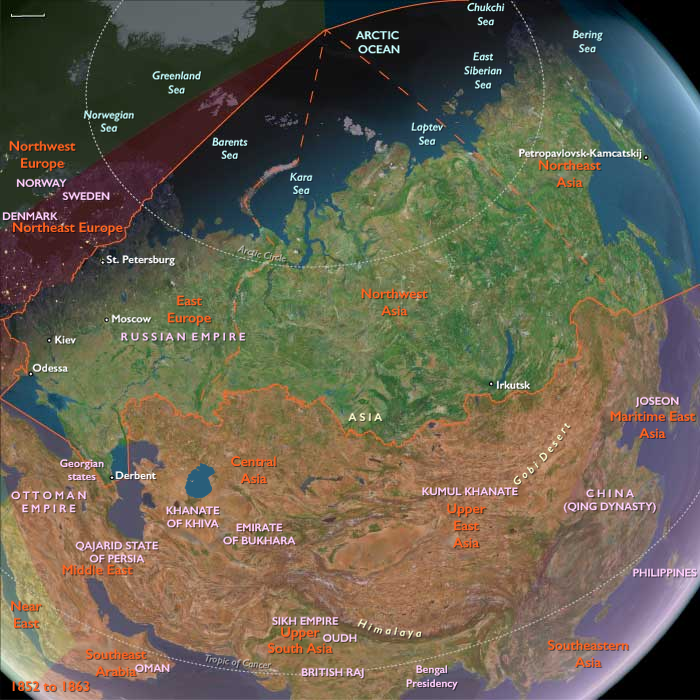
Subregions
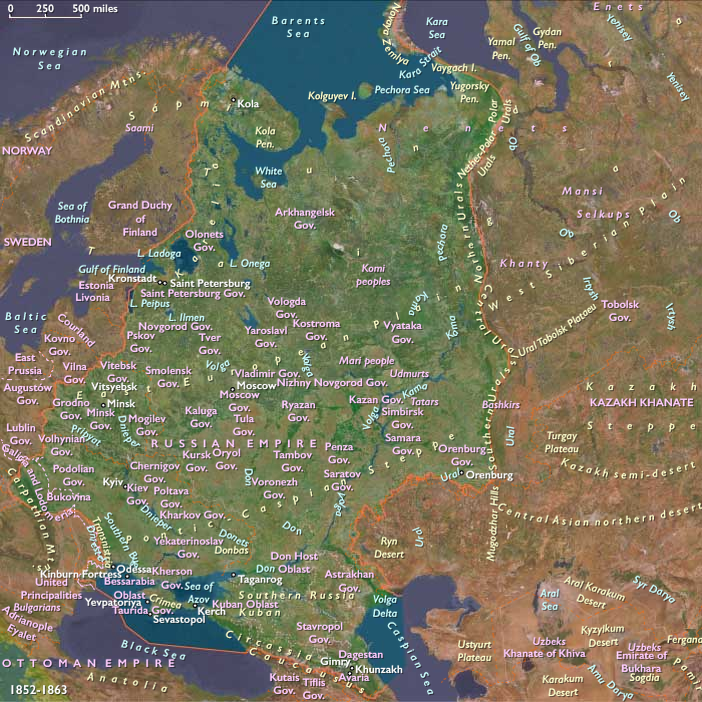
Years: 1852 - 1863
People
Groups
- Christians, Eastern Orthodox
- Ottoman Empire
- Russian Empire
- Britain (United Kingdom of Great Britain and Ireland)
- Sardinia, Kingdom of
- France, Second Empire of
Topics
Commodoties
Subjects
Regions
Subregions