
Northeastern Eurasia (1684–1827 CE) Imperial Frontiers, …
Years: 1684 - 1827
Northeastern Eurasia (1684–1827 CE)
Imperial Frontiers, Salmon Rivers, and the Making of a Northern Sea–Steppe System
Geography & Environmental Context
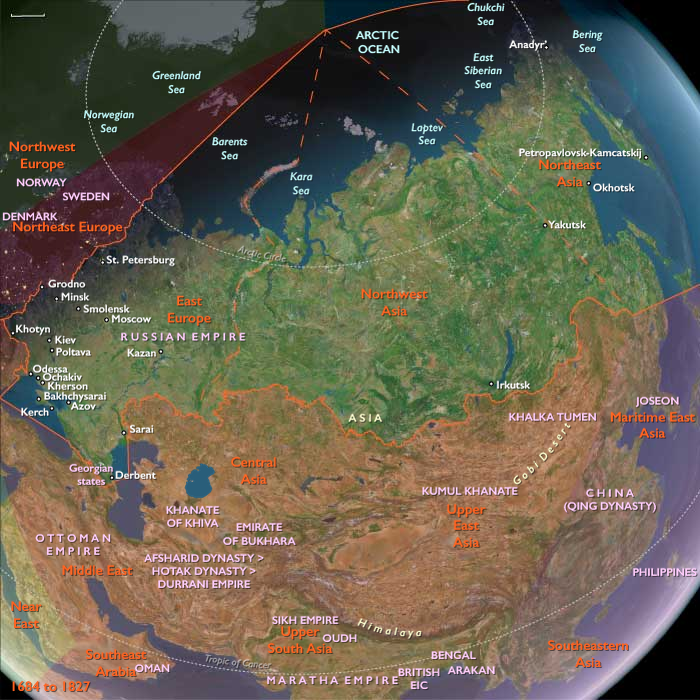
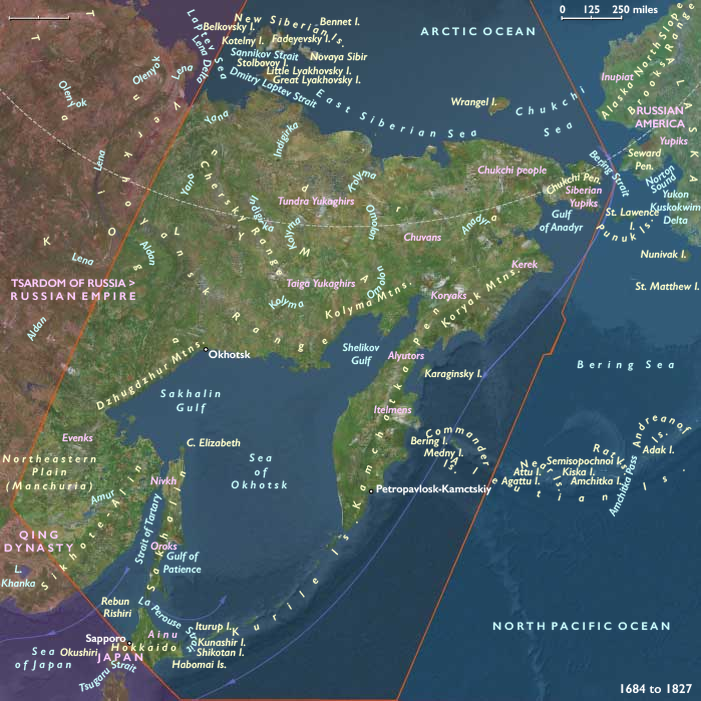
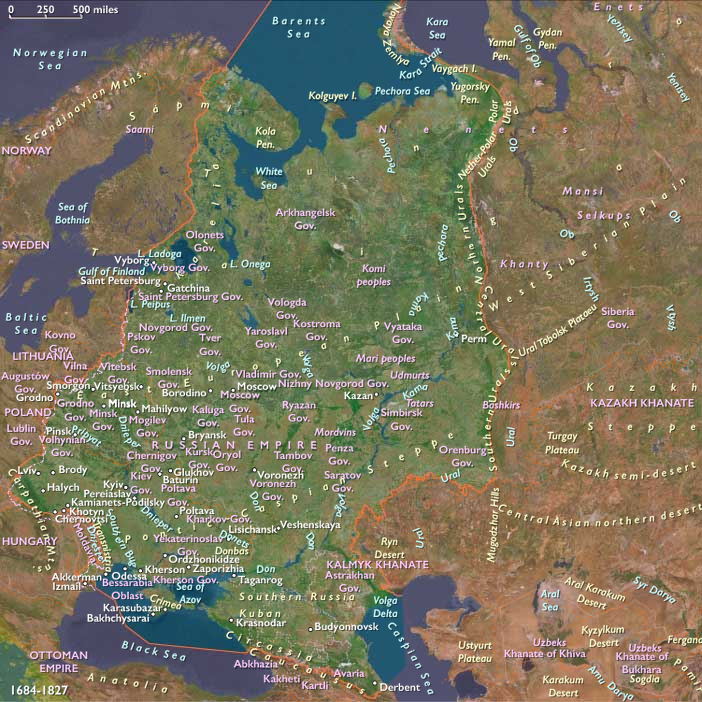
From the Baltic–Black Sea corridor across the forest–steppe of East Europe to the taiga, tundra, and Pacific rims of Siberia and Northeast Asia, this macro-region bridged three oceanic worlds: the Arctic, the North Atlantic–Baltic, and the North Pacific. Anchors ranged from the Dnieper–Don–Volga and Neva to the Ob–Yenisei–Lena–Kolyma river highways; from the Pontic steppe and Polesia wetlands to the Amur–Ussuri lowlands, Sakhalin, Okhotsk coast, Chukotka, Wrangel, and Hokkaidō. Permafrosted interiors, salmon-rich rivers, and storm-beaten coasts met fertile chernozem belts—a continent-spanning frontier of grain, furs, timber, fish, and salt.
Climate & Environmental Shifts
The Little Ice Age lingered with severe winters (notably 1708–1709) and short growing seasons. Baltic freeze-ups delayed shipping; Tambora (1816–1817) and earlier cool pulses triggered dearth from Finland to Ukraine. In Siberia, rivers were ice roads most of the year, and taiga fires alternated with deep frosts; along the Sea of Okhotsk and Chukchi coasts, gales and sea ice shortened sailing windows even as ice-edge fisheries boomed. Hokkaidō endured snowy winters yet sustained abundant salmon and herring runs.
Subsistence & Settlement
-
East Europe (Belarus–Ukraine–European Russia): Peasant communes rotated rye, oats, barley, wheat, flax, and hemp; chernozem frontiers (Novorossiya) turned to estate grain and sheep; Odessa (1794) rose as a Black Sea grain port. Cossack borderlands mixed fishing, apiaries, horse breeding, and mobile farming.
-
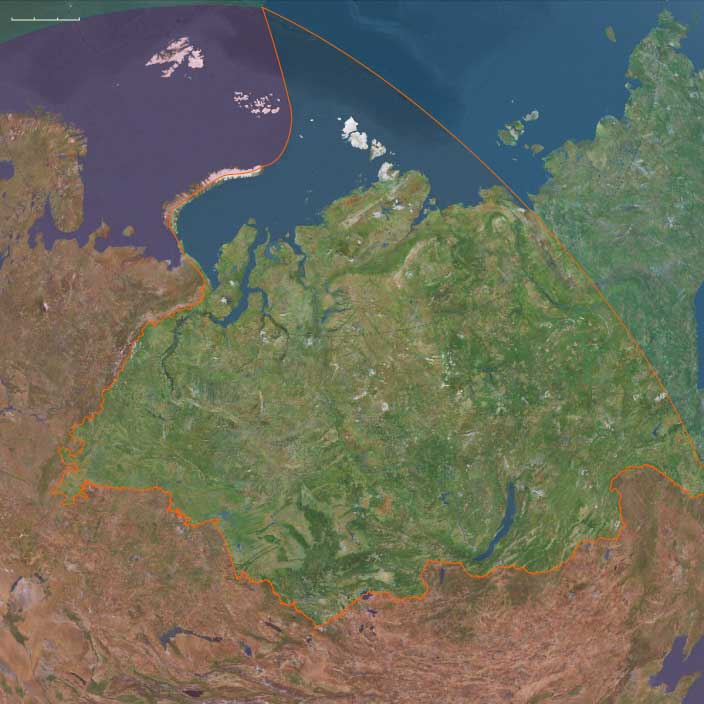
Northwest Asia (W/C Siberia): Indigenous Khanty, Mansi, Nenets, Evenki and others combined fishing, hunting (sable), and reindeer herding; Russian ostrogs (Tobolsk–Tomsk–Krasnoyarsk–Irkutsk) spread plough agriculture along river terraces; promyshlenniki pursued fur frontiers.
-
Northeast Asia (Amur–Okhotsk–Chukotka–Hokkaidō): Daur, Nanai, Nivkh, Udege, Evenki, Chukchi, Siberian Yupik, and Ainu economies centered on salmon, sturgeon, marine mammals, reindeer, and garden grains/beans; Russian wintering posts dotted the Lena–Kolyma–Anadyr; Matsumae traders controlled Hokkaidō’s SW littoral.
Technology & Material Culture
-
Agro-forestry & mills: Estate granaries, wind/watermills, and flax/hemp scutching in East Europe; drainage and rotations raised yields.
-
River–snow logistics: Birch-bark canoes, skis, sledges, and portages linked basins; in the south, barges moved bulk grain to Baltic and Black Sea outlets.
-
Maritime gear: Copper-sheathed hulls, chronometers, and sturdy Okhotsk craft; Ainu and Amur communities maintained weirs, net fisheries, and smokehouses.
-
Trade kits: Iron pots, beads, textiles, tobacco, vodka, firearms into indigenous markets; outflow of furs, hides, fish oils, potash, tar, timber, and grain.
-
Sacred and civic builds: Orthodox churches and wooden chapels along Siberian rivers; Ukrainian Baroque façades; ancestor shrines, masks, and bear-sending paraphernalia among Amur and Ainu communities.
Movement & Interaction Corridors
-
Baltic & Black Sea “windows”: St. Petersburg (1703) opened a northern outlet (timber, hemp, tar, flax); successive Russo-Ottoman wars unlocked a Black Sea export front (Kherson–Mykolaiv–Odessa).
-
Trans-Siberian rivers: Ob–Irtysh–Yenisei–Lena functioned as summer barge routes/winter roads; overland portages and the Omsk–Semipalatinsk steppe link tied Siberia to Central Asia.
-
Amur–Okhotsk–Pacific: The Treaty of Nerchinsk (1689) fixed a Qing–Russian line; Okhotsk became Russia’s Pacific lifeline; Bering’s voyages (1728, 1741) projected to Alaska.
-
Hokkaidō littoral: Canoe routes knit Ainu villages; Matsumae intermediaries funneled rice, sake, and lacquerware north in exchange for fish, furs, and crafts.
Cultural & Symbolic Expressions
-
Orthodox & imperial: Icons, pilgrimages, parish schools, and baroque/neoclassical cityscapes in Kyiv–St. Petersburg–Moscow; Cossack dumy and kobzar song preserved frontier memory.
-
Indigenous cosmologies: Shamanic drums, bear rituals, river and mountain shrines structured relations with animal masters and waters; Ainu iomante remained a central rite.
-
Border syncretisms: Crosses beside carved idols; firearms, silk robes, and lacquer bowls reinterpreted as prestige ritual items; Jesuit/Orthodox/mission outposts mingled with men’s houses and clan lodges.
Environmental Adaptation & Resilience
-
Risk portfolios: Salmon weirs, stone/wooden fish traps, oil rendering, and cached stores carried Arctic and taiga households through long winters; reindeer routes adjusted to snow cover.
-
Commune & kin relief: Mir/obshchina land repartition and labor exchange in East Europe; parish charity, confraternities, and brotherhoods mitigated dearth.
-
Frontier agronomy: Shelterbelts and spring sowings on steppe; rye/oats on floodplains; mixed household economies (spinning, weaving, seasonal wage-work) buffered shocks.
Political & Military Shocks
-
East European re-maps: Partitions of the Polish–Lithuanian Commonwealth (1772, 1793, 1795); Crimean annexation (1783); Russo-Ottoman wars (1768–1774; 1787–1792; 1806–1812) opened the Northern Black Sea corridor; 1812 invasion forged a continental war economy.
-
Siberian incorporation: Fort lines, yasak fur tribute, and missionary courts consolidated imperial rule; Kiakhta (1727) regulated China–Russia caravan exchange.
-
Amur frontier & Pacific turn: Qing patrols contained Russian access after Nerchinsk; Okhotsk staged Pacific expeditions; coastal violence and disease shadowed contact zones.
-
Hokkaidō: Matsumae monopoly tightened over Ainu trade, sowing tensions that presaged 19th-century conflict.
Transition
Between 1684 and 1827, Northeastern Eurasia shifted from mosaic frontiers to an integrated river-and-sea system of empires. East Europe became a grain-export engine tied to the Baltic and a newly forged Black Sea corridor; Siberia turned into a transcontinental fur and transit realm; Northeast Asia emerged as Russia’s Pacific hinge, bounded by Qing defenses and Matsumae controls yet newly linked to Alaska by Bering’s routes.
Amid wars, partitions, and missions, indigenous lifeways—reindeer herding, salmon fisheries, shamanic rites—endured and adapted. By 1827, the region stood enmeshed in global trade and imperial logistics, its salmon rivers and steppe grain, tar forests and Okhotsk ships, together powering a northern world poised for the accelerations and ruptures of the nineteenth century.
People
Groups
- Christians, Eastern Orthodox
- Russian Empire
- French First Republic
- France, (first) Empire of
- France, constitutional monarchy of
Topics
Commodoties
Subjects
Regions
Subregions
Years: 1684 - 1827
People
Groups
- Christians, Eastern Orthodox
- Russian Empire
- French First Republic
- France, (first) Empire of
- France, constitutional monarchy of
Topics
Commodoties
Subjects
Regions
Subregions