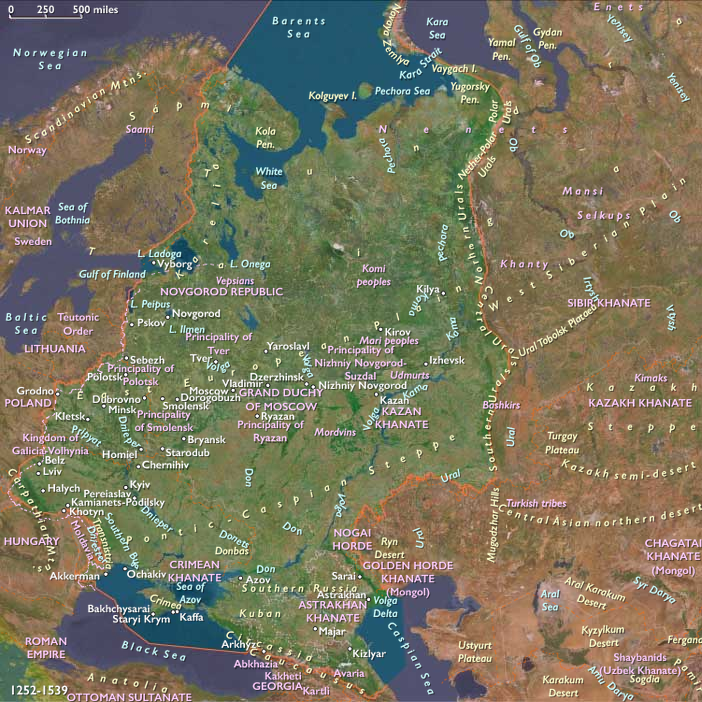
East Europe (1480–1491 CE): Muscovite Independence and …
Years: 1480 - 1491
East Europe (1480–1491 CE): Muscovite Independence and Regional Realignment
Political and Military Developments
Formal End of Mongol Overlordship
Between 1480 and 1491 CE, Muscovy definitively ended Mongol overlordship, most notably marked by the stand at the Ugra River in 1480, which symbolized Muscovy's independence from the Golden Horde's remnants.
Further Territorial Expansion
Following independence, Muscovy expanded territorially, consolidating control over regional territories and enhancing centralized governance under Ivan III (the Great). This period saw substantial administrative and political restructuring, significantly bolstering Muscovy's authority.
Khanate Relations and Regional Diplomacy
Interactions with emergent khanates, particularly Kazan, Crimea, and Astrakhan, intensified. Muscovy navigated complex diplomatic and military relationships, balancing cooperation and competition with these Turkic states.
Economic and Technological Developments
Continued Economic Prosperity
Economic growth persisted through strong internal commerce and continued international trade relations. Key urban centers, especially Moscow, became increasingly prosperous, reflecting Muscovy’s growing regional influence.
Advancement in Military and Defense Technology
Further development of military technology, including enhanced fortifications, improved siege warfare capabilities, and advanced cavalry tactics, significantly strengthened Muscovy’s military position.
Cultural and Artistic Developments
Cultural and Artistic Flourishing
Cultural and artistic traditions continued to flourish, with increased patronage from the Muscovite elite fostering innovation in architecture, religious art, and secular cultural expressions. This period contributed notably to the distinctive Muscovite cultural identity.
Intellectual and Literary Productivity
Intellectual and literary activities remained vibrant, with chroniclers and scholars actively documenting significant historical, religious, and cultural narratives, reinforcing regional identity and historical continuity.
Settlement Patterns and Urban Development
Urban Growth and Infrastructure Development
Urban centers continued their demographic and economic expansion, with Moscow leading in infrastructure enhancements, urban planning, and administrative efficiency.
Fortifications and Defensive Strategies
Urban fortifications were continually improved, providing enhanced protection and stability, crucial amidst shifting regional dynamics and diplomatic relationships.
Social and Religious Developments
Social Cohesion and Ethnic Integration
The societal fabric further integrated diverse ethnic groups, including the Mari, Mordvins, Udmurts, Komi, and Vepsians, fostering a cohesive and stable society under central Muscovite governance.
Central Influence of the Orthodox Church
The Orthodox Church maintained its influential role, shaping education, moral values, and community life, significantly contributing to societal stability and cultural coherence.
Long-Term Consequences and Historical Significance
The period from 1480 to 1491 CE marked a pivotal era of Muscovite independence, territorial expansion, and diplomatic realignment. These developments substantially shaped the region’s political and cultural trajectories, laying foundational elements for the future Russian state.
Related Events
Showing 10 events out of 40684 total
Years: 1480 - 1491
Groups
- Komi peoples
- Mordvins
- Veps, or Vepsians
- Mari people
- Christians, Eastern Orthodox
- Udmurt people
- Ryazan, Principality of
- Tver, Principality of
- Moscow, Grand Principality of
- Kazan, Khanate of
- Crimean Khanate
- Astrakhan Khanate
Subjects
Regions
Subregions