East Europe (1468–1479 CE): Muscovite Expansion, Khanate …
Years: 1468 - 1479
East Europe (1468–1479 CE): Muscovite Expansion, Khanate Emergence, and Internal Consolidation
Political and Military Developments
Territorial Growth and Authority Strengthening
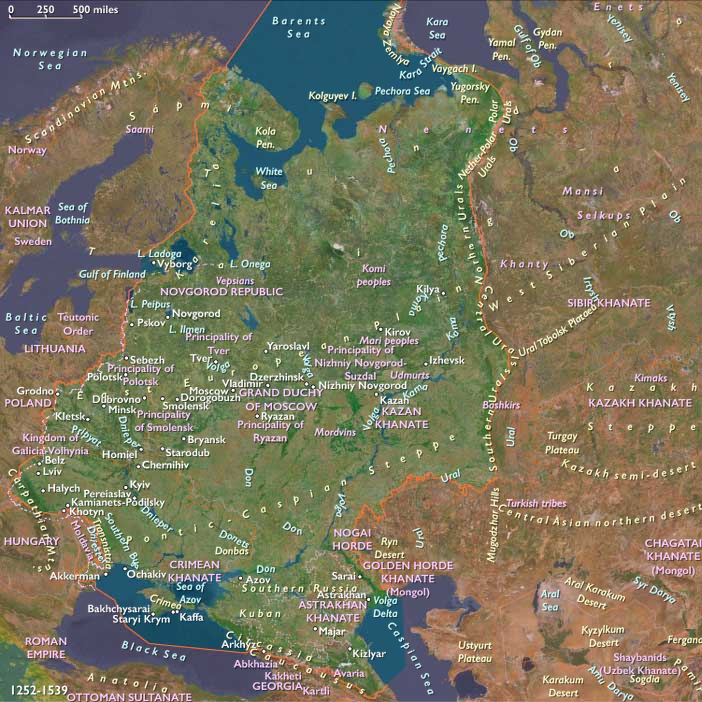
Between 1468 and 1479 CE, Muscovy expanded its territorial boundaries, further solidifying its political and military dominance in East Europe. Enhanced administrative efficiency contributed significantly to the consolidation of power.
Diplomatic Successes and Regional Stability
Muscovy successfully navigated diplomatic relationships with neighboring states, employing strategic marriages, treaties, and alliances to mitigate conflicts and strengthen its regional position.
Emergence of the Khanates
The collapse of the Golden Horde subsequent to Timur’s conquest led to the emergence of separate khanates such as Astrakhan, Crimea, and Kazan. These entities became significant regional powers, influencing political dynamics and interactions with Muscovy.
Continued Integration of Ethnic Communities
Ethnic communities including the Mari, Mordvins, Udmurts, Komi, and Vepsians experienced increased integration within Muscovite society, bolstering administrative unity and social cohesion.
Economic and Technological Developments
Robust Economic Growth
The Muscovite economy thrived, driven by flourishing internal markets and sustained international trade relationships. Key urban centers such as Moscow, Novgorod, and Tver experienced significant economic development.
Military and Defensive Innovations
Muscovy continued advancing military technology, particularly in fortification design, siege capabilities, and cavalry tactics. These advancements were crucial for territorial defense and regional stability.
Cultural and Artistic Developments
Ongoing Cultural Fusion and Artistic Achievement
Cultural development flourished through the continued integration of Rus', Mongol, and ethnic artistic traditions. Architectural innovation, religious art, and secular artistic expressions notably advanced during this period.
Intellectual and Literary Productivity
Scholarly and literary activities thrived, with extensive documentation of historical, religious, and cultural narratives. Intellectual productivity significantly reinforced regional identity and historical continuity.
Settlement Patterns and Urban Development
Urban Development and Infrastructure Enhancement
Urban centers, especially Moscow, continued their demographic and economic growth, supported by improved infrastructure and sophisticated governance systems, facilitating greater administrative effectiveness.
Enhanced Urban Fortifications
Cities further upgraded their defensive infrastructure, strengthening strategic fortifications and protecting regional urban centers from external threats.
Social and Religious Developments
Social Integration and Cohesiveness
Societal frameworks evolved to effectively accommodate diverse ethnic groups, creating enhanced social harmony and political stability under Muscovite centralized rule.
Orthodox Church’s Central Influence
The Orthodox Church continued playing a pivotal role, influencing education, morality, and community cohesion, thus significantly contributing to societal stability and cultural continuity.
Ethnic and Cultural Shifts
Historical Background of the Tatars and Turkic Peoples
Numerous Turkic tribes inhabited the region from the eleventh to sixteenth centuries, including territories now part of Russia and Kazakhstan. The area known today as Tatarstan was originally inhabited by the Volga Bulgars, who had settled along the Volga River since the eighth century and converted to Islam in 922, influenced by the missionary work of Ahmad ibn Fadlan.
Following the Mongol invasion of Europe from 1241, Volga Bulgaria was defeated and incorporated into the Golden Horde, significantly disrupting the region's demographic structure. Various theories exist regarding the subsequent mixing between the Volga Bulgars and the Cuman-Kipchaks of the Horde. While one theory suggests considerable intermingling, another (known as Bulgarism) argues that such mixing was minimal. Nonetheless, the population eventually adopted the Kipchak language and the ethnonym "Tatars," while Islam became widely embraced.
Long-Term Consequences and Historical Significance
The period from 1468 to 1479 CE marked a crucial phase in Muscovite territorial expansion, political centralization, and cultural enrichment. The emergence of independent khanates and the integration of diverse ethnicities shaped regional dynamics profoundly, laying foundational structures for a unified and culturally diverse Russian state.
Years: 1468 - 1479
Groups
- Komi peoples
- Mordvins
- Veps, or Vepsians
- Mari people
- Christians, Eastern Orthodox
- Novgorod Republic
- Udmurt people
- Ryazan, Principality of
- Tver, Principality of
- Moscow, Grand Principality of
- Kazan, Khanate of
- Crimean Khanate
- Astrakhan Khanate
Subjects
Regions
Subregions