
Central Europe (964 – 1107 CE): Christian …
Years: 964 - 1107
Central Europe (964 – 1107 CE): Christian Kings, Alpine Gateways, and the Imperial Heartland
Geographic and Environmental Context
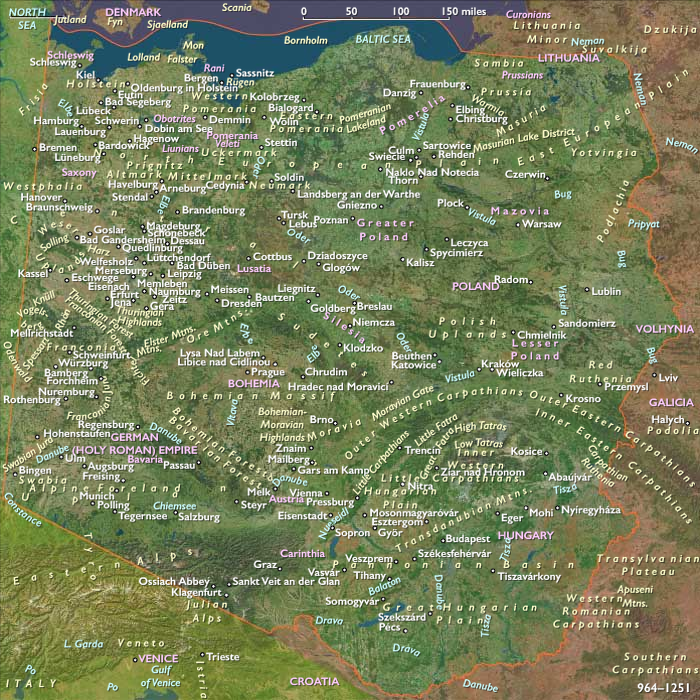
Central Europe stretched from the Baltic and Elbe plains through the Carpathian and Alpine basins to the Rhine and Moselle corridors.
It comprised Poland, Czechia, Slovakia, Hungary, Austria, Germany, Switzerland, and Liechtenstein, forming a vast zone where northern forests, central uplands, and southern passes met.
The Carpathian Basin linked the steppe world with Christendom, while the Alpine and Rhine valleys served as Europe’s main north–south arteries between the North Sea and Italy.
Danube, Elbe, Oder, Rhine, and Moselle rivers provided transport routes that shaped settlement, pilgrimage, and trade.
Climate and Environmental Shifts
During the Medieval Warm Period (c. 950–1250 CE), milder temperatures and reliable rainfall supported longer growing seasons, especially on the loess soils of Saxony, Bohemia, and Poland.
Forest clearance and three-field rotation expanded cultivation, while navigable rivers lengthened trading seasons.
In the south, Alpine pastures and vineyards flourished, and snow-line retreat eased passage over the Brenner, St. Bernard, and Julier Passes, binding the northern and Mediterranean economies more tightly than before.
Societies and Political Developments
East Central Europe: Christian Monarchies and Frontiers
After the defeat of the Magyars at Lechfeld (955), the Ottonian Empire consolidated control across Germany and radiated eastward influence.
-
Otto I (r. 936–973) crowned Holy Roman Emperor (962), anchored his rule in Saxony and Bavaria, and launched missionary bishoprics such as Magdeburg.
-
Successors Otto II, Otto III, Henry II, and Henry IV balanced ducal and ecclesiastical powers, strengthening imperial institutions.
In the Carpathian Basin, the Árpád dynasty converted nomadic Magyar power into a Christian monarchy.
Géza (r. 972–997) initiated baptism and diplomacy with the empire; Stephen I (r. 997–1038) received a royal crown (1000/1001), founding the Kingdom of Hungary and embedding Latin law, counties, and bishoprics.
Poland’s Piasts followed similar paths:
Mieszko I (baptized 966) bound Poland to Latin Christendom; Bolesław I Chrobry (r. 992–1025) crowned king, hosted the Congress of Gniezno (1000) with Otto III, and created an archbishopric.
After dynastic turbulence, Casimir I the Restorer (r. 1034–1058) revived the realm.
Bohemia’s Přemyslids alternated between autonomy and imperial vassalage; Prague’s bishopric (973) anchored Christianization.
Slovakia and the Vienna basin formed shifting borderlands between Magyar and German rule, the latter organized as the Ostmark (Austria).
South Central Europe: Alpine Gateways and Imperial Leverage
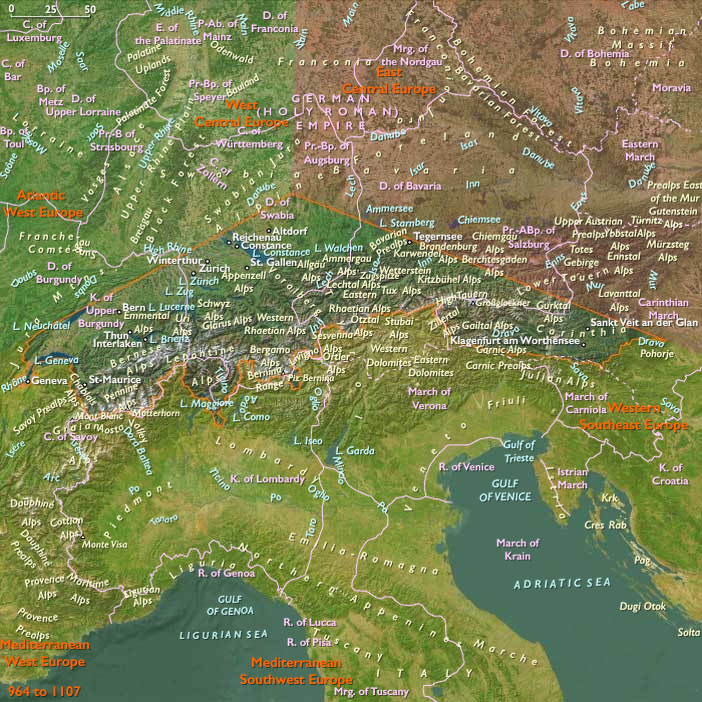
Across the Alps, Carinthia, Tyrol, and Switzerland became vital corridors of imperial power.
Ottonian and Salian emperors relied on bishoprics and abbeys—Chur, Sion, Brixen, Trento, Geneva, and Sion—to police roads and collect tolls.
Carinthia guarded the Drava–Inn passes as a marcher duchy, while local lords in the Inn Valley (forerunners of the Counts of Tyrol) gained prominence.
Zürich and Geneva grew as markets; Bern began under the Zähringers.
Monastic reform (Cluny) invigorated Einsiedeln, St. Gall, Disentis, and Pfäfers, which offered pilgrim hospitality and maintained bridges and shelters.
Castles multiplied, marking the rise of a feudal–ecclesiastical order that kept the high routes open for merchants and armies.
West Central Europe: Imperial Core and Rhineland Cities
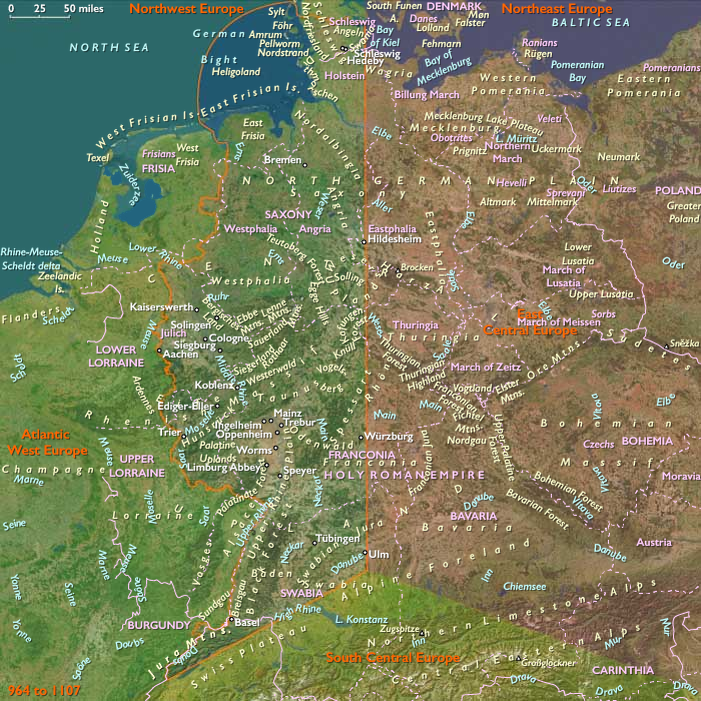
West of 10° E, the Rhine–Moselle basin became the empire’s political and economic center.
Ottonian and Salian rulers—Conrad II, Henry III, Henry IV—built palaces and cathedrals at Speyer, Mainz, Worms, and Trier.
The Investiture Controversy (1070s–1080s) between Henry IV and Pope Gregory VII turned the Rhineland into a crucible of imperial–papal politics; bishops of Cologne, Mainz, and Trier emerged as territorial princes.
The urban clergy and lay guilds of Cologne and Mainz financed cathedral construction and trade, while Basel tied Burgundy and Swabia into the imperial web.
Economy and Trade
Agriculture expanded across all three zones.
-
In the north and east, adoption of the heavy plow, horse collar, and three-field rotation boosted yields.
-
Alpine and Rhine regions thrived on dairy, wine, and timber; Valais and Rheintal produced export cheese and wine.
-
Mining centers in the Harz, Kraków, and Moravia supplied silver for imperial and regional mints.
-
Transit trade through Alpine passes brought spices, silk, and papyrus north, while salt, metals, and livestock flowed south.
-
Rhine shipping connected Cologne and Mainz to Flanders and England; Danube routes joined Vienna, Buda, and Byzantium.
Coinage proliferated—denarii from Cologne, Regensburg, and Zürich circulated beside early Hungarian and Polish issues—while fairs at cathedral towns regularized exchange.
Subsistence and Technology
Technological diffusion underpinned prosperity:
-
The carruca heavy plow transformed loess cultivation.
-
Water-mills spread along Rhineland and Alpine streams; proto-windmills appeared.
-
Stone fortifications replaced timber gords; Romanesque churches rose from Poland to Burgundy.
-
Alpine engineers improved stone causeways, culverts, and bridge towers to secure mountain travel.
Movement and Interaction Corridors
-
Elbe–Oder marches advanced imperial settlement and Christian missions among the Polabian Slavs.
-
Morava–Danube corridor linked imperial centers with Pannonian diplomacy.
-
Carpathian passes tied Hungary to Poland and the Balkans.
-
Brenner, Reschen, Julier, Splügen, and Great St. Bernard carried imperial and Venetian trade.
-
Rhine–Moselle axis funneled goods from Alpine Italy to the North Sea ports.
These arteries made Central Europe both a crossroads of empires and a unified economic organism.
Belief and Symbolism
Christianization unified the region culturally.
-
Baptisms of Mieszko I (966) and Stephen I (1000) symbolized entry into Latin Christendom.
-
Archbishoprics at Gniezno, Prague, and Esztergom institutionalized the faith; monastic reform spread Cluniac ideals.
-
Cathedrals at Speyer, Mainz, and Worms, and pilgrimage shrines at Aachen and Trier, expressed the sacred authority of emperors and bishops.
-
Pagan enclaves—Lutici, Obodrites, and Baltic tribes—persisted beyond the Elbe, preserving frontier contrast.
-
In the Alps, devotion to St. Bernard and local hermit saints protected travelers through perilous cols.
Adaptation and Resilience
-
Dynastic alliances among Ottonians, Salians, Piasts, Přemyslids, and Árpáds stabilized borders through marriage and shared Christianity.
-
Agrarian and mining growth buffered against famine and financed armies and churches.
-
Feudal and monastic networks secured alpine and river corridors, ensuring passage despite wars or avalanches.
-
Urban resilience grew through guilds, tolls, and self-governance; cathedrals anchored civic identity.
-
Cultural adaptation—Latin literacy, Romanesque art, canon law—embedded local societies within a continental Christian order.
Long-Term Significance
By 1107 CE, Central Europe had completed its transformation from a frontier of pagans and raiders to the Christian and commercial heartland of the continent.
-
The Holy Roman Empire radiated authority from the Rhine–Danube core, linking imperial kingship, episcopal wealth, and monastic reform.
-
Poland, Bohemia, and Hungary stood as enduring monarchies, mediating between Latin Christendom and the Slavic East.
-
The Alpine corridors became Europe’s indispensable north–south hinge, and the Rhine axis its busiest artery.
-
Across valleys and passes, cathedrals, monasteries, and castles symbolized a civilization knit together by faith, commerce, and imperial law.
Central Europe thus entered the twelfth century as the pivotal bridge between Western Europe and the Eurasian frontiers—a realm of kings and abbots, merchants and pilgrims, whose rivers and mountains defined the very structure of medieval Europe itself.
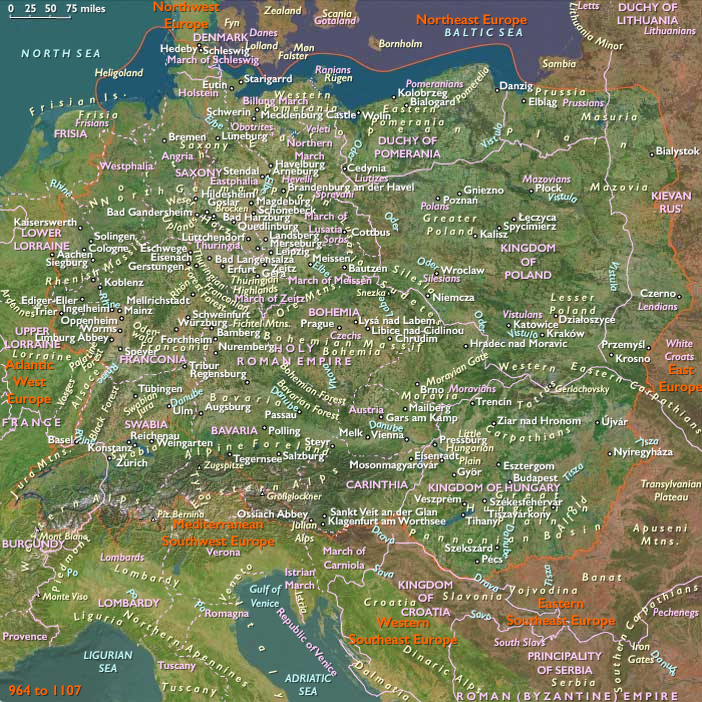
East Central Europe (with civilization) ©2024-25 Electric Prism, Inc. All rights reserved.
People
- Boleslaus II
- Boleslaw I Chrobry
- Casimir I the Restorer
- Géza
- Henry II, Holy Roman Emperor
- Henry IV, Holy Roman Emperor
- Mieszko I
- Otto I
- Otto II
- Otto III
- Stephen I of Hungary
Groups
- Germans
- Hungarian people
- Polabian Slavs (West Slavs)
- Slavs, West
- Christianity, Chalcedonian
- Obotrites (Slavic tribal confederation)
- Saxony, Duchy of
- Pechenegs, or Patzinaks
- Bohemia, Duchy of
- Hungary, Principality of
- Cumania (Cuman-Kipchak confederation)
- Franconia, Duchy of
- Bavaria, Ottonian Duchy of
- Germany, Kingdom of (within the Holy Roman Empire)
- German, or Ottonian (Roman) Empire
- Holy Roman Empire
- Poland, Principality of
- Lutici (West Slavic Polabian tribe)
- Eastern March
- Slovaks (West Slavs)
- Czechs [formerly Bohemians] (West Slavs)
- Austria, Margravate of
- Cuman people, or Western Kipchaks, also called Polovtsy, Polovtsians)
- Hungary, Kingdom of
- Poland of the first Piasts, Kingdom of
- Poland of the first Piasts, Kingdom of
- Christians, Roman Catholic
- Christians, Eastern Catholic (Uniate)
- Christians, Eastern Orthodox
- Bavaria, Welf Duchy of
- Bohemia, Kingdom of
- Bohemia, Duchy of
Topics
Commodoties
- Hides and feathers
- Gem materials
- Domestic animals
- Grains and produce
- Textiles
- Ceramics
- Strategic metals
- Salt
- Sweeteners
- Money
Subjects
Regions
Subregions
Related Events
Showing 10 events out of 52798 total
Years: 964 - 1107
East Central Europe (with civilization) ©2024-25 Electric Prism, Inc. All rights reserved.
People
- Boleslaus II
- Boleslaw I Chrobry
- Casimir I the Restorer
- Géza
- Henry II, Holy Roman Emperor
- Henry IV, Holy Roman Emperor
- Mieszko I
- Otto I
- Otto II
- Otto III
- Stephen I of Hungary
Groups
- Germans
- Hungarian people
- Polabian Slavs (West Slavs)
- Slavs, West
- Christianity, Chalcedonian
- Obotrites (Slavic tribal confederation)
- Saxony, Duchy of
- Pechenegs, or Patzinaks
- Bohemia, Duchy of
- Hungary, Principality of
- Cumania (Cuman-Kipchak confederation)
- Franconia, Duchy of
- Bavaria, Ottonian Duchy of
- Germany, Kingdom of (within the Holy Roman Empire)
- German, or Ottonian (Roman) Empire
- Holy Roman Empire
- Poland, Principality of
- Lutici (West Slavic Polabian tribe)
- Eastern March
- Slovaks (West Slavs)
- Czechs [formerly Bohemians] (West Slavs)
- Austria, Margravate of
- Cuman people, or Western Kipchaks, also called Polovtsy, Polovtsians)
- Hungary, Kingdom of
- Poland of the first Piasts, Kingdom of
- Poland of the first Piasts, Kingdom of
- Christians, Roman Catholic
- Christians, Eastern Catholic (Uniate)
- Christians, Eastern Orthodox
- Bavaria, Welf Duchy of
- Bohemia, Kingdom of
- Bohemia, Duchy of
Topics
Commodoties
- Hides and feathers
- Gem materials
- Domestic animals
- Grains and produce
- Textiles
- Ceramics
- Strategic metals
- Salt
- Sweeteners
- Money
Subjects
Regions
Subregions