
East Central Europe (892–903 CE): Fragmentation of …
Years: 892 - 903
East Central Europe (892–903 CE): Fragmentation of Great Moravia, Magyar Incursions, and Saxon Political Ascendancy
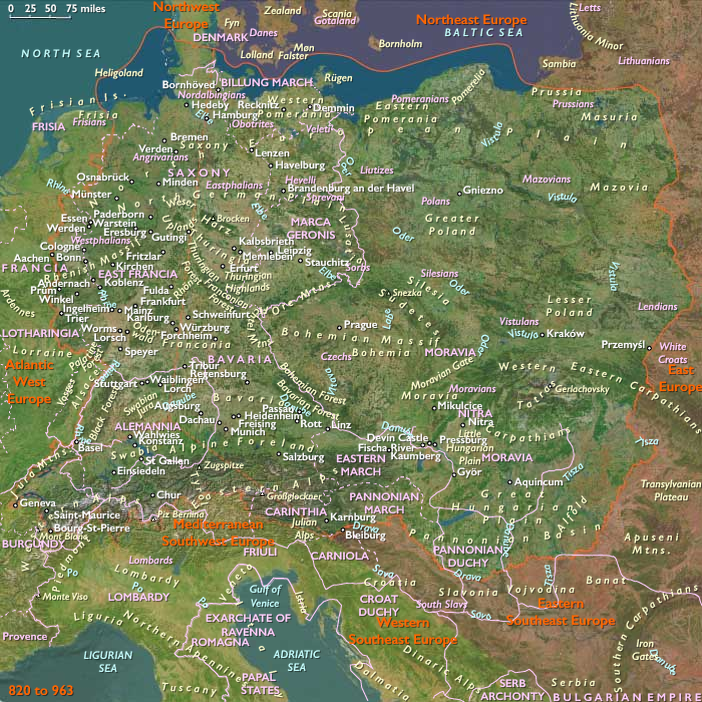
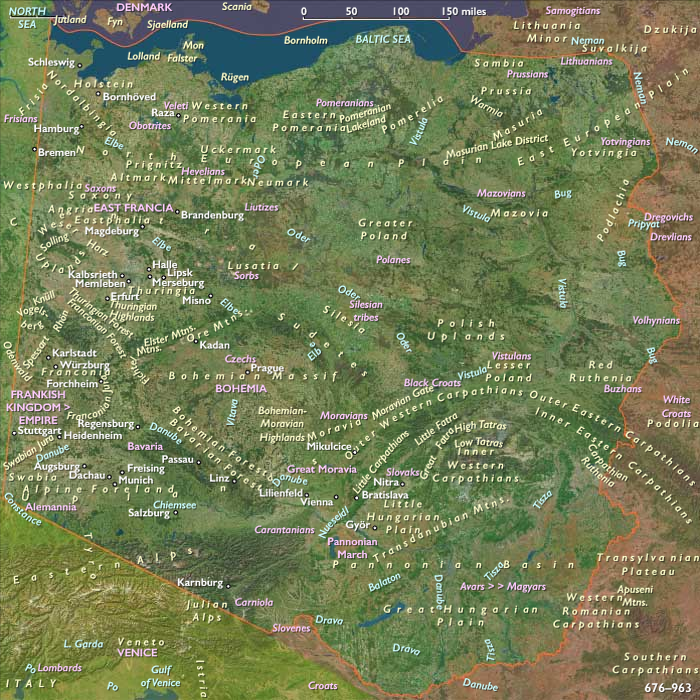
Between 892 and 903 CE, East Central Europe—comprising modern-day Poland, Czechia, Slovakia, Hungary, and eastern parts of Germany and Austria east of 10°E and north of a line from roughly 48.2°N at 10°E to the Austro-Slovenian border near 46.7°N, 15.4°E—underwent dramatic shifts driven by the fragmentation of Great Moravia, intensified Magyar (Hungarian) incursions, and the continued rise of the Liudolfing dynasty in Saxony. As centralized Carolingian authority weakened further, regional powers emerged or restructured, laying crucial foundations for the medieval geopolitical order.
Political and Military Developments
Fragmentation and Decline of Great Moravia
-
Following Svatopluk I’s death in 894 CE, Great Moravia rapidly fragmented due to internal rivalries, succession conflicts, and external pressures, severely weakening its cohesion and territorial integrity.
Arrival and Incursions of the Magyars
-
Around 895–896 CE, the Magyars migrated into the Carpathian Basin, launching devastating raids into Moravian, Bavarian, and Carolingian territories. These Magyar invasions decisively reshaped regional geopolitics, initiating significant demographic and political changes.
Saxon Dynastic Consolidation
-
Under Otto the Illustrious, the Saxon Liudolfing dynasty solidified its regional prominence amidst the decline of Carolingian power. Saxony emerged increasingly autonomous, strengthening administrative and military capabilities in response to external threats, notably the Magyar incursions.
Economic and Technological Developments
Economic Disruption and Realignment
-
Magyar raids significantly disrupted existing trade networks, particularly in Moravia and eastern Carolingian territories. Economic activity gradually realigned towards safer western Saxon and Bavarian regions, altering regional trade patterns and infrastructure priorities.
Intensified Defensive Construction
-
Heightened insecurity prompted extensive fortification improvements across Saxony, Bavaria, and remaining Moravian territories. These fortifications reflected a strategic shift toward defensive, militarized settlements.
Cultural and Artistic Developments
Disruption and Preservation of Moravian Culture
-
Although fragmented politically, Moravia’s cultural legacy persisted, particularly through continued ecclesiastical activities and preservation of the Cyril-Methodian tradition, despite political instability.
Saxon Cultural Confidence
-
The Liudolfings actively fostered Saxon cultural identity, integrating Carolingian traditions with local artistic styles, ecclesiastical patronage, and administrative practices, further solidifying Saxon distinctiveness.
Settlement and Urban Development
Decline of Moravian Centers
-
Key Moravian centers such as Mikulčice and Nitra experienced declines due to Magyar invasions and internal political fragmentation, shifting settlement patterns towards smaller, defensively organized settlements.
Growth of Saxon and Bavarian Towns
-
Despite disruptions, Saxon and Bavarian urban centers maintained relative stability and growth, benefiting from redirected trade routes and enhanced defensive measures.
Social and Religious Developments
Ecclesiastical Resilience amid Turmoil
-
Church institutions in Moravia, Saxony, and Bavaria demonstrated resilience, providing social cohesion and continuity amid political instability and military threats, preserving regional Christian traditions.
Consolidation of Saxon Social Hierarchy
-
In Saxony, the Liudolfings reinforced their social hierarchy, strengthening aristocratic and dynastic governance structures that provided essential stability in an otherwise volatile regional context.
Long-Term Consequences and Historical Significance
The era 892–903 CE marked a turning point in East Central European history. The collapse of Great Moravia, the destabilizing Magyar incursions, and Saxon political ascendancy significantly reshaped regional identities, political boundaries, and cultural trajectories. These events fundamentally reoriented East Central Europe's historical development, laying the groundwork for medieval political realignments, dynastic dominance, and new geopolitical realities.
People
Groups
- Polytheism (“paganism”)
- Franks
- Saxons
- Germans
- Hungarian people
- Wends, or Sorbs (West Slavs)
- Christianity, Chalcedonian
- Bavarians (West Germanic tribe)
- Thuringia, Duchy of
- Thuringia, (Frankish) Duchy of
- Carantania
- Carantanians
- Bavaria, Carolingian Duchy of
- Frankish, or Carolingian (Roman) Empire
- Saxony, Duchy of
- Hungarians, Realm of the (Etelköz)
- Moravia, Great, Kingdom of
- Francia Orientalis (East Francia), Kingdom of
- Roman Empire, Eastern: Macedonian dynasty
Topics
Commodoties
Subjects
Regions
Subregions
Related Events
Showing 10 events out of 53685 total
Years: 892 - 903
People
Groups
- Polytheism (“paganism”)
- Franks
- Saxons
- Germans
- Hungarian people
- Wends, or Sorbs (West Slavs)
- Christianity, Chalcedonian
- Bavarians (West Germanic tribe)
- Thuringia, Duchy of
- Thuringia, (Frankish) Duchy of
- Carantania
- Carantanians
- Bavaria, Carolingian Duchy of
- Frankish, or Carolingian (Roman) Empire
- Saxony, Duchy of
- Hungarians, Realm of the (Etelköz)
- Moravia, Great, Kingdom of
- Francia Orientalis (East Francia), Kingdom of
- Roman Empire, Eastern: Macedonian dynasty
Topics
Commodoties
Subjects
Regions
Subregions