
Between 856 and 867 CE, …
Years: 856 - 867
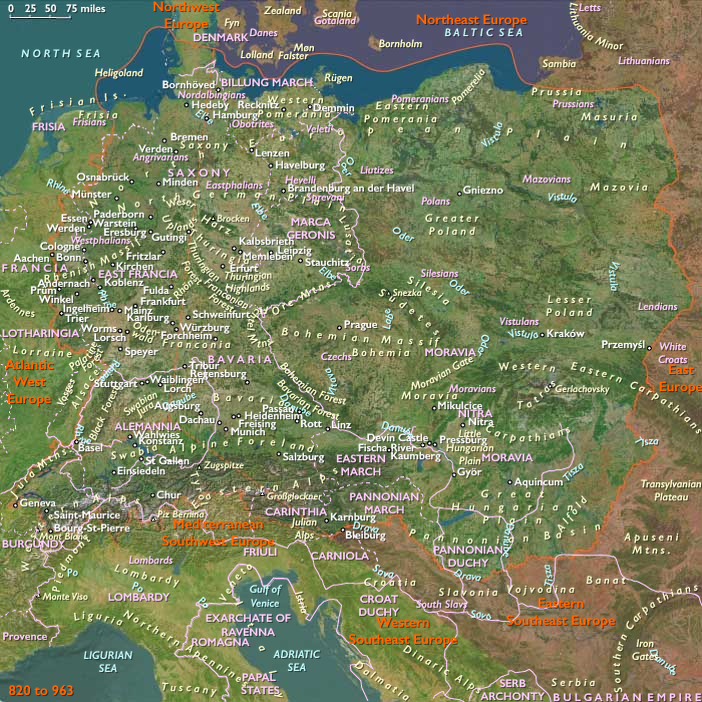
Between 856 and 867 CE, East Central Europe—comprising modern-day Poland, Czechia, Slovakia, Hungary, and the eastern parts of Germany and Austria east of 10°E and north of a line from approximately 48.2°N at 10°E to the Austro-Slovenian border near 46.7°N, 15.4°E—continued its political and cultural consolidation. Great Moravia, under Rastislav, asserted further autonomy from Carolingian rule, while the Liudolfing dynasty in Saxony solidified its influential position. Simultaneously, Louis the German’s reign in East Francia strengthened frontier stability, laying the foundations for future territorial expansion and the political structures of medieval Europe.
Political and Military Developments
Rastislav’s Assertion of Moravian Independence
-
Rastislav (r. 846–870) deepened Moravia’s diplomatic autonomy from the Carolingians, establishing closer ties with Byzantium, and inviting missionaries Cyril and Methodius (in 863) to strengthen Moravian cultural and religious independence.
Solidification of Liudolfing Power in Saxony
-
Saxon nobility under the leadership of the Liudolfing dynasty, notably Liudolf (d. 866), consolidated its regional influence, with significant territorial expansions and ecclesiastical foundations, reinforcing its dominance and prestige.
Stability and Governance in East Francia
-
Under the steady governance of Louis the German, East Francia, including Bavaria, Thuringia, and Saxony, remained politically stable, strengthening frontier territories and enhancing administrative integration.
Economic and Technological Developments
Continued Regional Economic Prosperity
-
Trade networks across Moravia, Bavaria, Saxony, and Thuringia flourished, supporting commerce in metals, agricultural produce, textiles, and luxury items, fostering sustained economic growth and urban prosperity.
Development of Infrastructure and Defense
-
Continued improvements in fortifications, roads, and administrative infrastructure enhanced regional security, facilitating more efficient economic activity and military readiness along Carolingian frontier zones.
Cultural and Artistic Developments
Moravian Cultural and Religious Independence
-
Rastislav’s invitation of Byzantine missionaries Cyril and Methodius initiated significant cultural and religious developments, notably the introduction of the Slavic (Glagolitic) alphabet, fostering Moravia’s unique cultural identity.
Carolingian-Saxon Cultural Integration
-
Saxony’s integration into Carolingian culture deepened through ecclesiastical patronage, monastery foundations, and adoption of Frankish administrative practices, reinforcing the cultural identity of the Saxon aristocracy.
Settlement and Urban Development
Growth of Moravian Urban Centers
-
Major Moravian settlements experienced continued expansion, becoming prominent political and cultural hubs, pivotal in the administrative and religious life of Great Moravia.
Stability in Saxon, Bavarian, and Thuringian Towns
-
Carolingian governance maintained stable urban growth in Saxony, Bavaria, and Thuringia, supported by robust trade and administrative efficiency, laying the groundwork for future medieval urban centers.
Social and Religious Developments
Christianization and Ecclesiastical Consolidation
-
Christian missionary activities intensified across Moravia and Saxony, notably through the influence of Cyril and Methodius in Great Moravia, laying important ecclesiastical foundations and reinforcing religious integration.
Strengthened Dynastic Structures
-
The increasing prominence of powerful dynasties, notably the Liudolfings in Saxony and Mojmirid rulers in Moravia, further reinforced hierarchical social structures, shaping regional political and social developments significantly.
Long-Term Consequences and Historical Significance
The era 856–867 CE was pivotal in solidifying political autonomy in Great Moravia under Rastislav and strengthening the Saxon Liudolfing dynasty, profoundly shaping East Central Europe's medieval trajectory. These developments, complemented by stable Carolingian frontier governance under Louis the German, laid lasting political, cultural, and economic foundations, significantly influencing the historical landscape of East Central Europe for generations.
People
Groups
- Polytheism (“paganism”)
- Franks
- Germans
- Saxons
- Wends, or Sorbs (West Slavs)
- Christianity, Chalcedonian
- Bavarians (West Germanic tribe)
- Thuringia, Duchy of
- Thuringia, (Frankish) Duchy of
- Carantania
- Carantanians
- Bavaria, Carolingian Duchy of
- Saxony, Duchy of
- Roman Empire, Eastern: Phrygian or Armorian dynasty
- Moravia, Great, Kingdom of
- Francia Orientalis (East Francia), Kingdom of
Topics
Commodoties
Subjects
Regions
Subregions

Years: 856 - 867
People
Groups
- Polytheism (“paganism”)
- Franks
- Germans
- Saxons
- Wends, or Sorbs (West Slavs)
- Christianity, Chalcedonian
- Bavarians (West Germanic tribe)
- Thuringia, Duchy of
- Thuringia, (Frankish) Duchy of
- Carantania
- Carantanians
- Bavaria, Carolingian Duchy of
- Saxony, Duchy of
- Roman Empire, Eastern: Phrygian or Armorian dynasty
- Moravia, Great, Kingdom of
- Francia Orientalis (East Francia), Kingdom of
Topics
Commodoties
Subjects
Regions
Subregions