
Central Europe (820 – 963 CE): Carolingian …
Years: 820 - 963
Central Europe (820 – 963 CE): Carolingian Frontiers, River Kingdoms, and the Alpine Arteries
Geographic and Environmental Context
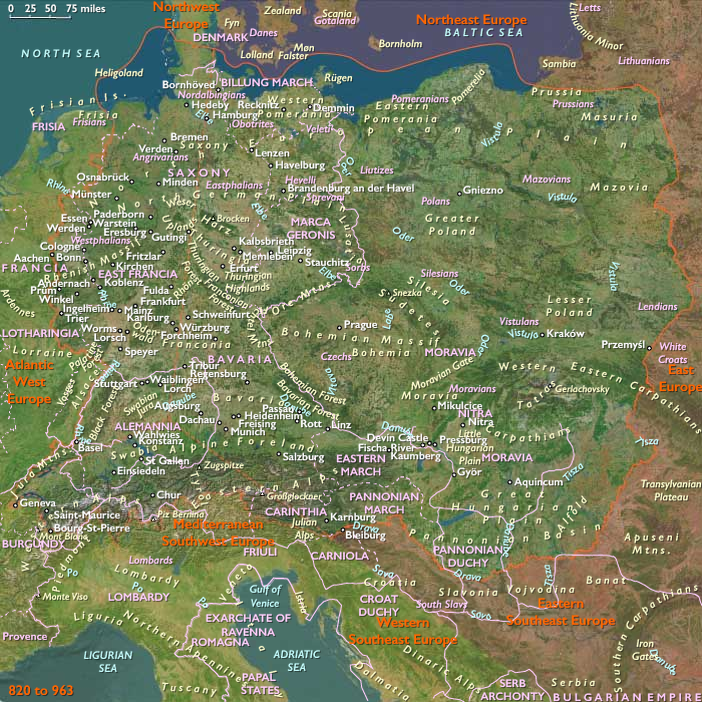
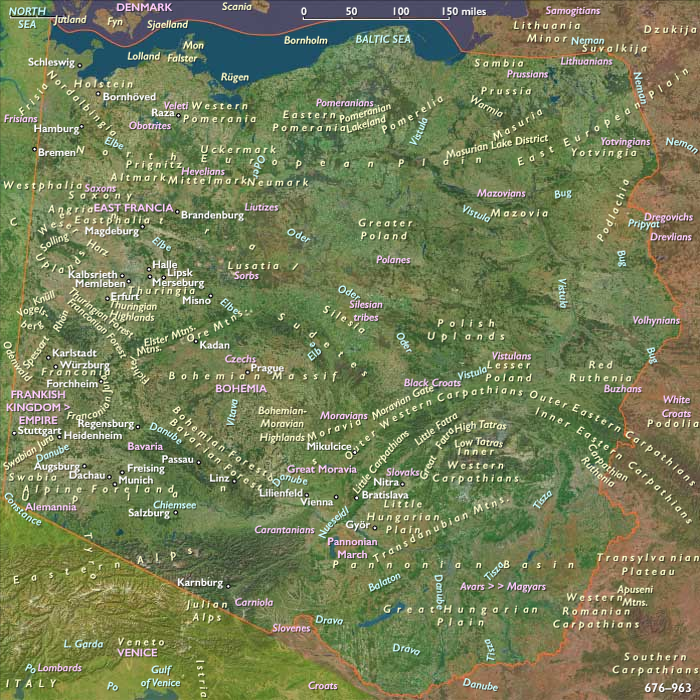
Central Europe spanned the Baltic lowlands of Poland and Germany, the Bohemian Massif and Carpathian arc, and the Danube–Morava corridor down into the Pannonian Plain, while the Rhine–Moselle–Main system and the Alpine passes tied the region to Burgundy and Italy.
-
Northern arteries: Elbe, Oder, Vistula.
-
Southern spine: Danube–Morava–Pannonian corridor.
-
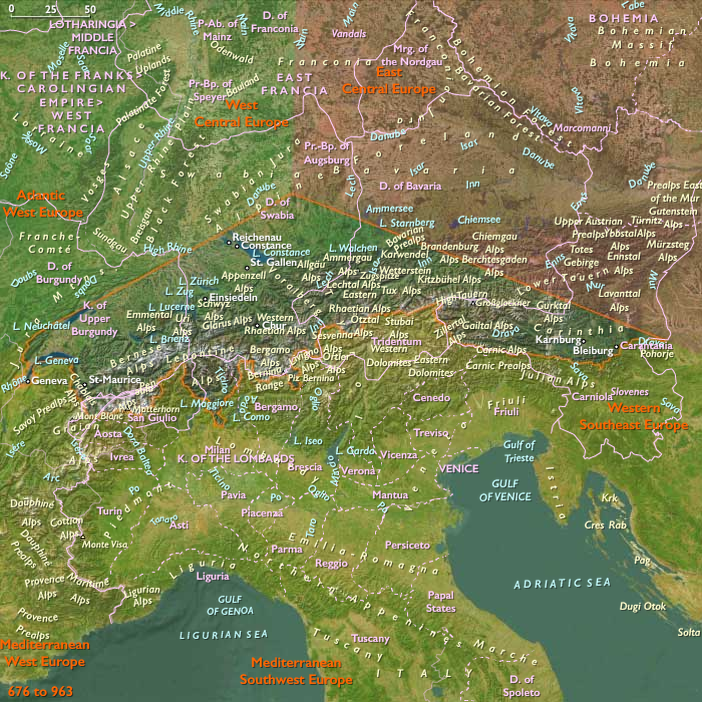
Alpine hinges: Brenner, Reschen, Septimer, Julier, Splügen, Great St. Bernard.
A cool–temperate regime prevailed; by mid-10th century, onset of the Medieval Warm Period modestly lengthened growing seasons on loess uplands and improved Carpathian pastures. Flood pulses on the Elbe, Oder, Danube structured transport, milling, and settlement.
Societies and Political Developments
East Central Europe: Carolingian Legacy, Great Moravia, and the Magyar Ingress
-
East Francia → Ottonian Germany (Germany/Austria): After Carolingian partitions, East Francia stabilized as the Kingdom of Germany (Saxony, Franconia, Bavaria, Swabia). Henry I (919–936) and Otto I (936–973)consolidated power, pushing marches eastward against Polabian Slavs and laying the basis for the Holy Roman Empire.
-
Great Moravia (833–c. 906): At its height under Svatopluk I (870–894), it spanned Moravia, western Slovakia, and parts of Bohemia and Pannonia. Cyril and Methodius (863) introduced Slavonic liturgy and Glagolitic, rooting Christianity in local tongues. Collapse followed Magyar raids and Frankish pressure after 894.
-
Magyars (Carpathian Basin): Entered c. 895–907 under Árpád, occupied the Pannonian Plain, and crushed East Frankish–Bavarian armies at Pressburg (907). Through the 10th century, cavalry raids reached Bavaria, Saxony, Italy, and France until later checked at Lechfeld (955).
-
Bohemia: The Přemyslids in Prague balanced Moravian precedent and German suzerainty. Wenceslas (r. c. 921–935) advanced Christianization and tribute ties to Saxony; Boleslaus I expanded Bohemian power after Wenceslas’s murder.
-
Poland: Fortified grody anchored Polans, Vistulans, Pomeranians. By c. 960, Mieszko I began unifying the Polans and neighboring tribes—prelude to baptism (966, next age).
South Central Europe: Alpine Marches and Episcopal Road-Keeping
-
Post-Verdun (843), the zone split between East Francia (Tyrol, Carinthia, Swabian/Bavarian forelands, Swiss Plateau) and Upper Burgundy (Geneva–Valais).
-
The Inn and Carinthian marches guarded the Brenner approach; bishops of Trento and Brixen administered tolls and estates along the Tyrolean routes.
-
Monasteries—St. Gall, Disentis, Einsiedeln (934)—managed alpine estates, kept passes open, and provisioned travelers.
-
Otto I’s consolidation and victory at Lechfeld (955) ended Magyar pressure on Bavaria/Carinthia and secured the Alpine corridors.
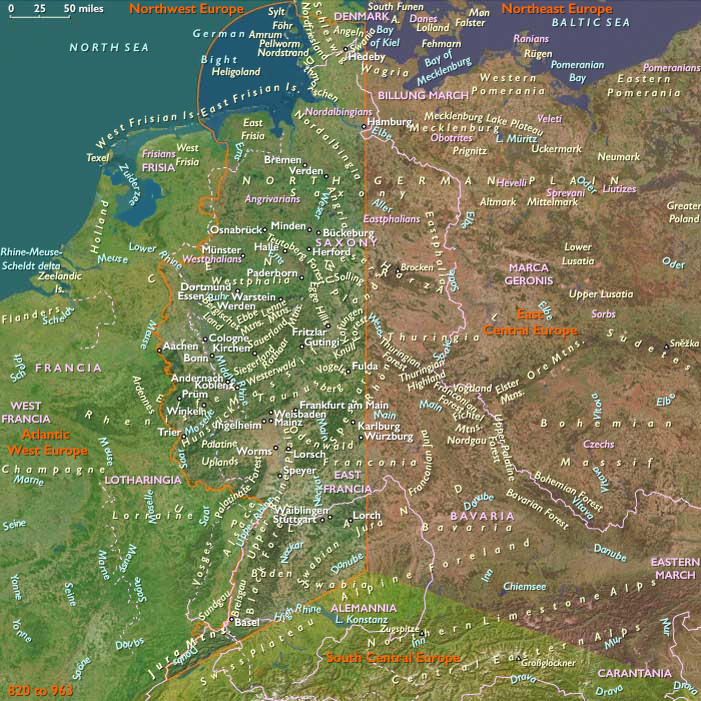
West Central Europe: Lotharingian Marches and the Rhineland Core
-
Verdun (843) fractured the Carolingian world; Lotharingia oscillated between East and West, with Aachen, Cologne, Mainz mediating border defense and royal claims (Meerssen 870, Ribbemont 880).
-
Under the Ottonians (919–963), episcopal princes—Mainz, Trier, Cologne—and great abbeys stabilized governance as comital lordship proliferated.
-
Lechfeld (955) secured hinterlands; Otto’s imperial coronation (962/963) reaffirmed the Rhineland’s role in ceremony, law, and church politics. Aachen remained symbolic capital; Worms, Speyer rose as royal centers; Basel guarded the Upper Rhine/Jura hinge.
Economy and Trade
-
Agrarian base: rye, barley, oats, millet, wheat on river terraces and loess soils; viticulture along Rhine/Moselle, Moravia, Bavaria; cattle/swine in forest and meadow belts.
-
Resources & crafts: Kraków and alpine salt, Baltic amber, iron in Thuringia/Silesia; smithing and pottery spread with market towns.
-
River & road systems:
-
Rhine served as Europe’s main north–south artery; Moselle/Main fed Rhineland markets.
-
Elbe/Oder/Vistula linked Saxony and Poland to the Baltic; Vistula connected to Prussia and Rus’.
-
Danube funneled Bavarian–Moravian–Magyar exchange toward the Adriatic/Balkans; Morava–Danube corridor carried Christian missions and Frankish influence.
-
-
Money & flows: Islamic dirhams reached Poland/Germany via Rus’ and Volga Bulgar routes; Carolingian deniers and Ottonian denarii spread from Rhineland and Bavarian mints into Bohemia and Moravia.
-
Alpine commerce: northbound wine, oil, spices, silks; southbound timber, hides, cheese, iron, horses; fairs at Zürich, Geneva, Chur knit Burgundian/German merchants to Lombardy.
Subsistence and Technology
-
Heavy plow (carruca) and horse/ox traction expanded deep tillage on heavy soils; three-field rotations appeared on richer estates.
-
Fortifications: timber–earth grody and hillforts dominated tribal centers; in Alpine and Rhineland nodes, episcopal burgs and royal pfalzen guarded crossings.
-
Mills & fisheries: water-mills multiplied on tributaries; river fish weirs provisioned towns.
-
River craft & winter haulage: planked barges and dugouts on major rivers; sledges moved salt, grain, and timber over ice in winter.
-
Military systems: Magyar steppe cavalry (stirrups, composite bows) reshaped defense; Ottonian armored retinues evolved in response, culminating in Lechfeld.
Movement and Interaction Corridors
-
Elbe–Saale front: Ottonian marches facing Polabian Slavs.
-
Oder–Vistula–Baltic: fur, amber, and slave trades northward to the sea.
-
Morava–Danube: mission and commerce into Moravia and Hungary.
-
Carpathian passes: vectors for Magyar migration and later raiding.
-
Rhine–Moselle–Main: wine, salt, timber, millstones; Alsace–Basel gate to the Alps; trans-Meuse roads to Flanders/North Sea.
-
Alpine passes: Brenner, Septimer/Julier, Splügen, Great St. Bernard—redundant routes ensuring continuity despite storms or war.
Belief and Symbolism
-
Christianization:
-
Great Moravia pioneered Slavonic liturgy; after its fall, Bohemia and Poland leaned toward Latin-riteChristianity via Saxony/Bavaria.
-
Ottonian Germany deepened monastic–episcopal structures; sees at Magdeburg and Brandenburgadvanced missions eastward.
-
-
Pagan traditions: Slavic polytheism (Perun, Veles, Svantovit) persisted among Poles, Pomeranians; Magyarsmaintained Tengrist and shamanic rites.
-
Burials: hybrid zones reveal cremation in pagan districts, Christian inhumation in Moravia, Bohemia, Saxony; reliquaries and saints’ cults reinforced urban prestige in the Rhineland and Alpine valleys.
-
Monastic charisma: St. Gall, Disentis, Einsiedeln anchored piety, hospitality, and safe passage along alpine roads.
Adaptation and Resilience
-
Military adaptation: Ottonians forged armored cavalry retinues to counter Magyar tactics; Lechfeld (955)stabilized East Francia and opened recovery in Bavaria/Carinthia.
-
Agrarian buffers: mixed cropping (rye + millet), stock herding, and valley fruit/wine moderated climate variability.
-
Jurisdictional layering: bishops, abbots, counts, and royal pfalzen spread risk and ensured continuity amid dynastic flux.
-
Route redundancy: when upland war or storms disrupted roads, merchants shifted to river corridors or alternate passes; fairs re-routed exchange.
Long-Term Significance
By 963 CE, Central Europe had become a crucible of state formation and connectivity:
-
Otto I’s consolidation stabilized the German kingdom, checked the Magyars, and restored long-distance commerce.
-
Great Moravia had dissolved, but its Slavonic Christian legacy endured in Bohemia and Poland’s emerging dynasties.
-
Magyars controlled the Carpathian Basin, raiding while adapting to a settled frontier that would soon pivot toward Christian kingship.
-
Alpine marches and monastic road-keepers secured the north–south arteries linking the Rhine and Danube to Italy.
-
The Rhineland reemerged as imperial–commercial core, while Piast Poland and Přemyslid Bohemiacrystallized into durable realms.
These arrangements—river logistics, alpine gateways, armored retinues, and monastic–episcopal governance—forged the steppe–agrarian and Christian–pagan frontier dynamics that would define Central Europe’s integration into Latin Christendom in the next age.
East Central Europe (with civilization) ©2024-25 Electric Prism, Inc. All rights reserved.
People
- Boleslaus I the Cruel
- Henry the Fowler
- Mieszko I
- Otto I
- Saints Cyril and Methodius
- Svatopluk I
- Wenceslaus I
- Árpád
Groups
- Franks
- Germans
- Hungarian people
- Polabian Slavs (West Slavs)
- Slavs, West
- Christianity, Chalcedonian
- Polans, Western (West Slavic tribe)
- Thuringia, Duchy of
- Francia (Carolingians)
- Bavaria, Carolingian Duchy of
- Nitra, Principality of
- Saxony, Duchy of
- Roman Empire, Eastern: Non-dynastic
- Roman Empire, Eastern: Phrygian or Armorian dynasty
- Hungarians, Realm of the (Etelköz)
- Moravia, Great, Kingdom of
- Francia Orientalis (East Francia), Kingdom of
- Roman Empire, Eastern: Macedonian dynasty
- Bohemia, Duchy of
- Hungary, Principality of
- Franconia, Duchy of
- Bavaria, Luitpolding Duchy of
- Swabia, Duchy of
- Bavaria, Ottonian Duchy of
- Rawadid dynasty
- Holy Roman Empire
- German, or Ottonian (Roman) Empire
- Germany, Kingdom of (within the Holy Roman Empire)
- Poland, Principality of
Topics
- Roman Age Optimum
- Renaissance, Carolingian
- Frankish-Avarian War of 791-96
- Hungarian invasions of Europe
- Hungarian conquest of the Carpathian Basin
- Pressburg, Battle of
- Medieval Warm Period (MWP) or Medieval Climate Optimum
- Lechfeld, Battle of
Commodoties
- Weapons
- Hides and feathers
- Gem materials
- Domestic animals
- Grains and produce
- Textiles
- Ceramics
- Strategic metals
- Salt
- Money
Subjects
- Commerce
- Symbols
- Watercraft
- Environment
- Decorative arts
- Conflict
- Mayhem
- Faith
- Government
- Custom and Law
- Metallurgy
Regions
Subregions
Related Events
Showing 10 events out of 54673 total
Years: 820 - 963
East Central Europe (with civilization) ©2024-25 Electric Prism, Inc. All rights reserved.
People
- Boleslaus I the Cruel
- Henry the Fowler
- Mieszko I
- Otto I
- Saints Cyril and Methodius
- Svatopluk I
- Wenceslaus I
- Árpád
Groups
- Franks
- Germans
- Hungarian people
- Polabian Slavs (West Slavs)
- Slavs, West
- Christianity, Chalcedonian
- Polans, Western (West Slavic tribe)
- Thuringia, Duchy of
- Francia (Carolingians)
- Bavaria, Carolingian Duchy of
- Nitra, Principality of
- Saxony, Duchy of
- Roman Empire, Eastern: Non-dynastic
- Roman Empire, Eastern: Phrygian or Armorian dynasty
- Hungarians, Realm of the (Etelköz)
- Moravia, Great, Kingdom of
- Francia Orientalis (East Francia), Kingdom of
- Roman Empire, Eastern: Macedonian dynasty
- Bohemia, Duchy of
- Hungary, Principality of
- Franconia, Duchy of
- Bavaria, Luitpolding Duchy of
- Swabia, Duchy of
- Bavaria, Ottonian Duchy of
- Rawadid dynasty
- Holy Roman Empire
- German, or Ottonian (Roman) Empire
- Germany, Kingdom of (within the Holy Roman Empire)
- Poland, Principality of
Topics
- Roman Age Optimum
- Renaissance, Carolingian
- Frankish-Avarian War of 791-96
- Hungarian invasions of Europe
- Hungarian conquest of the Carpathian Basin
- Pressburg, Battle of
- Medieval Warm Period (MWP) or Medieval Climate Optimum
- Lechfeld, Battle of
Commodoties
- Weapons
- Hides and feathers
- Gem materials
- Domestic animals
- Grains and produce
- Textiles
- Ceramics
- Strategic metals
- Salt
- Money
Subjects
- Commerce
- Symbols
- Watercraft
- Environment
- Decorative arts
- Conflict
- Mayhem
- Faith
- Government
- Custom and Law
- Metallurgy
Regions
Subregions