
East Central Europe (820–831 CE): Rise of …
Years: 820 - 831
East Central Europe (820–831 CE): Rise of Great Moravia, Saxon Noble Ascendancy, and Carolingian Frontier Stabilization
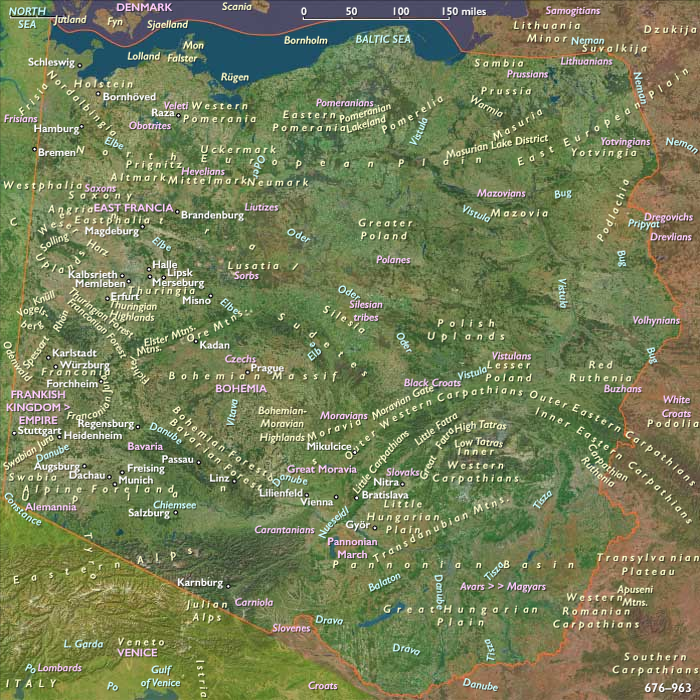
Between 820 and 831 CE, East Central Europe—comprising modern-day Poland, Czechia, Slovakia, Hungary, and eastern parts of Germany and Austria lying east of 10°E and north of a line from roughly 48.2°N at 10°E southeastward to the Austro-Slovenian border near 46.7°N, 15.4°E—experienced significant political consolidation and cultural development. Notably, Great Moravia emerged under Mojmir I, solidifying its identity and independence, while in Saxony, influential noble families like the Liudolfings strengthened their power bases. Concurrently, the Carolingian Empire successfully stabilized its eastern frontier through continued integration of Bavaria, Thuringia, and former Avar territories.
Political and Military Developments
Emergence and Consolidation of Great Moravia
-
Under Mojmir I (r. ca. 820–846), Great Moravia consolidated politically, uniting regional Slavic tribes and strengthening internal governance. Mojmir skillfully balanced autonomy and strategic alliances with the Carolingian Empire, setting the foundation for a major Slavic polity.
Saxon Noble Consolidation and Liudolfing Rise
-
Prominent Saxon noble Liudolf (d. 866) expanded his territorial control along the Leine River, laying early foundations for the influential Ottonian dynasty. His growing power represented a significant step toward Saxon regional prominence.
Stability and Integration of Carolingian Eastern Frontiers
-
Carolingian authority stabilized its eastern frontier territories, firmly integrating former Avar lands, Bavaria, and Thuringia into the empire’s administrative, economic, and military frameworks.
Economic and Technological Developments
Expanding Regional Trade Networks
-
Trade networks connecting Bavaria, Saxony, Moravia, and Carolingian heartlands flourished, facilitating commerce in agricultural goods, metals, textiles, and luxury items, enhancing economic prosperity and regional integration.
Infrastructure and Defensive Enhancements
-
Improved fortifications, administrative centers, and roads continued to develop across the region, significantly increasing security, administrative efficiency, and trade facilitation.
Cultural and Artistic Developments
Development of Moravian Cultural Identity
-
Great Moravia’s distinct cultural identity flourished, expressed through unique artistic styles, ceramics, metalwork, jewelry, and fortifications, distinguishing it from surrounding Carolingian and Slavic regions.
Carolingian Influence and Saxon Integration
-
Saxon territories experienced deeper Carolingian cultural integration, notably through Christianization, ecclesiastical patronage, and Frankish administrative practices. Saxon nobles, especially Liudolf, embraced these changes, establishing influential monasteries such as Gandersheim.
Settlement and Urban Development
Moravian Urban and Political Centers
-
Major Moravian settlements expanded rapidly, serving as political, administrative, and commercial hubs, laying the foundations for future urban centers.
Carolingian Urban Growth in Saxony, Bavaria, and Thuringia
-
Urbanization intensified under Carolingian administration, with fortified towns and trading centers becoming vital nodes of commerce, governance, and military organization.
Social and Religious Developments
Strengthening of Christianity
-
Intensive missionary efforts deepened Christian influence across Saxon and former Avar territories, fostering ecclesiastical networks and reinforcing social integration into the Carolingian cultural sphere.
Centralization of Slavic Governance
-
Mojmir’s centralized political leadership in Great Moravia improved administrative coherence and military effectiveness, providing a robust governance model for future Slavic states.
Long-Term Consequences and Historical Significance
The era 820–831 CE was crucial for East Central Europe, defined by Great Moravia’s rise as a central Slavic power, the consolidation of Saxon nobility under Liudolfing leadership, and sustained Carolingian frontier stability. Collectively, these developments significantly shaped the region’s political structures, cultural identities, and territorial cohesion, profoundly influencing the medieval trajectory of East Central Europe.
People
Groups
- Polytheism (“paganism”)
- Franks
- Saxons
- Germans
- Wends, or Sorbs (West Slavs)
- Christianity, Chalcedonian
- Bavarians (West Germanic tribe)
- Thuringia, Duchy of
- Thuringia, (Frankish) Duchy of
- Carantania
- Carantanians
- Francia (Carolingians)
- Bavaria, Carolingian Duchy of
- Saxony, Duchy of
- Roman Empire, Eastern: Non-dynastic
- Pannonia, March of
- Roman Empire, Eastern: Phrygian or Armorian dynasty
Topics
Commodoties
Subjects
Regions

Subregions
Years: 820 - 831
People
Groups
- Polytheism (“paganism”)
- Franks
- Saxons
- Germans
- Wends, or Sorbs (West Slavs)
- Christianity, Chalcedonian
- Bavarians (West Germanic tribe)
- Thuringia, Duchy of
- Thuringia, (Frankish) Duchy of
- Carantania
- Carantanians
- Francia (Carolingians)
- Bavaria, Carolingian Duchy of
- Saxony, Duchy of
- Roman Empire, Eastern: Non-dynastic
- Pannonia, March of
- Roman Empire, Eastern: Phrygian or Armorian dynasty
Topics
Commodoties
Subjects
Regions
Subregions