
East Central Europe (796–807 CE): Carolingian Triumph …
Years: 796 - 807
East Central Europe (796–807 CE): Carolingian Triumph over the Avars, Saxon Integration, and Slavic Adaptation
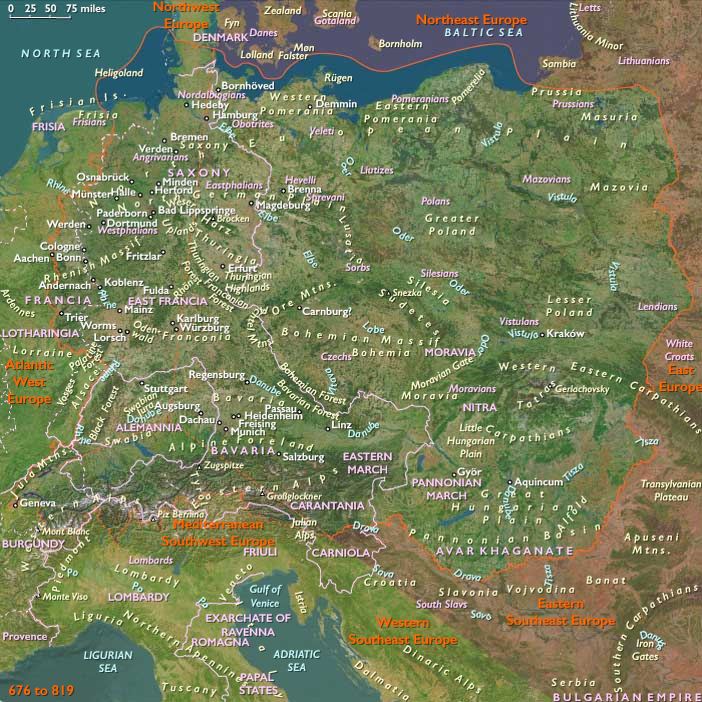
Between 796 and 807 CE, East Central Europe—encompassing modern-day Poland, Czechia, Slovakia, Hungary, and eastern portions of Germany and Austria lying east of 10°E and north of a line extending from roughly 48.2°N at 10°E to the Austro-Slovenian border near 46.7°N, 15.4°E—experienced transformative political, social, and cultural shifts driven by Charlemagne’s decisive military campaigns. The Carolingian conquest dismantled the powerful Avar Khaganate, dramatically reshaping the region. Simultaneously, the prolonged Saxon wars concluded, leading to the forceful incorporation of Saxony into the Carolingian Empire. Amid these sweeping changes, Slavic principalities adapted diplomatically and culturally to an expanding Frankish presence, while Bavaria and Thuringia solidified their integration within Carolingian structures.
Political and Military Developments
Carolingian Destruction of the Avar Khaganate (796 CE)
-
In 796 CE, Charlemagne decisively defeated the Avars, crushing their political center and absorbing extensive territories across the Carpathian Basin (today’s Hungary and eastern Austria).
-
Capturing enormous treasures, Charlemagne greatly enriched his empire, fueling subsequent cultural and political developments, notably the Carolingian Renaissance.
Completion of the Saxon Wars (772–804 CE)
-
After decades of brutal resistance under the leadership of Widukind, the Old Saxons were definitively subdued by Charlemagne in a campaign concluding in 804 CE.
-
The conquest initiated profound transformations in Saxony, as Frankish rulers—including notable officials like Wala of Corbie (d. 836)—imposed new administrative frameworks, enforced Christianization, and integrated the region firmly within the Carolingian realm.
Expanded Carolingian Influence in Bavaria and Thuringia
-
Territories like Bavaria and Thuringia experienced intensified integration within the Carolingian Empire, witnessing reduced autonomy but increased political stability and economic prosperity.
Slavic Diplomatic Adaptation and Political Consolidation
-
Slavic principalities in Bohemia and Moravia proactively adjusted their diplomatic and military strategies, carefully navigating relations with the expanding Carolingian power, thus laying foundations for later Slavic political entities.
Economic and Technological Developments
Integration of Regional Economies
-
The former Avar territories and Saxon lands were integrated into robust Carolingian trade networks, stimulating commerce in precious metals, agricultural goods, textiles, and crafted commodities.
-
Trade routes flourished, connecting Saxon, Slavic, Bavarian, and newly Carolingian territories, creating a cohesive regional economy.
Infrastructure and Fortification Expansion
-
Charlemagne and his administrators strengthened regional fortifications, built administrative centers, and improved roads, promoting greater stability, administrative efficiency, and military preparedness.
Cultural and Artistic Developments
Carolingian Cultural Expansion
-
Newly incorporated territories rapidly absorbed Carolingian cultural influences, including the enforced spread of Christianity, new artistic styles, religious iconography, and Frankish administrative practices.
Emergence of Saxon Nobility and Foundations of the Ottonian Dynasty
-
Post-conquest Saxony saw the early emergence of powerful local nobility. Count Ekbert and Saint Ida of Herzfeld became notable Saxon figures, with Ida possibly connected to Liudolf (d. 866), ancestor of the influential Ottonian dynasty.
-
Liudolf, alongside Bishop Altfrid of Hildesheim, founded Gandersheim Abbey (852 CE), a significant center of religious and cultural life.
Preservation of Slavic Cultural Identity
-
Bohemian and Moravian Slavs maintained distinctive identities through ceramics, metalwork, jewelry, and fortified settlements, preserving their unique cultural heritage despite pressures from Carolingian dominance.
Settlement and Urban Development
Urbanization Under Carolingian Influence
-
New administrative and commercial centers arose across former Avar territories and Saxony, establishing the basis for lasting urban structures integral to Carolingian governance and economic integration.
Slavic Urban Growth
-
Moravian and Bohemian political centers expanded and developed into vital administrative, commercial, and cultural hubs, strategically managing their relations with the Carolingian Empire.
Stability in Bavaria and Thuringia
-
Bavarian and Thuringian settlements remained economically stable, continuing their growth as significant administrative and commercial centers within the Carolingian framework.
Social and Religious Developments
Enforced Christianization and Social Transformation
-
Christianity's enforced adoption among Saxons and former Avar populations profoundly reshaped local social structures, religious practices, and communal identity.
-
Extensive missionary activity significantly advanced the region's integration into the broader Christian world.
Strengthened Slavic Leadership and Political Centralization
-
Slavic principalities enhanced governance structures and administrative efficiency, effectively responding to increased Frankish influence and asserting local autonomy.
Post-Avar Integration and Assimilation
-
Surviving Avars gradually assimilated into local populations, particularly Slavic communities, leaving behind subtle but lasting cultural and technological influences.
Long-Term Consequences and Historical Significance
The era 796–807 CE proved transformative for East Central Europe, defined by the Carolingian Empire’s dramatic expansion and regional integration. The destruction of the Avar Khaganate ended a centuries-old power, reshaping the region’s political landscape, while Saxony’s subjugation and forced Christianization initiated a long-term integration into Frankish Europe, planting seeds for future Saxon dynastic prominence. Concurrently, Slavic principalities consolidated culturally and politically, adapting strategically to the Frankish presence. Collectively, these events profoundly influenced medieval Central Europe's subsequent historical trajectories, political identities, and cultural developments.
People
Groups
- Polytheism (“paganism”)
- Franks
- Saxony, Old
- Germans
- Saxons
- Wends, or Sorbs (West Slavs)
- Christianity, Chalcedonian
- Avars, Eurasian
- Bavarians (West Germanic tribe)
- Avar Khaganate (Eurasian Avars)
- Thuringia, Duchy of
- Thuringia, (Frankish) Duchy of
- Carantania
- Carantanians
- Roman Empire, Eastern: Isaurian dynasty
- Francia (Carolingians)
- Bavaria, Carolingian Duchy of
Topics
Commodoties
Subjects
Regions
Subregions
Related Events
Showing 10 events out of 54939 total
Years: 796 - 807
People
Groups
- Polytheism (“paganism”)
- Franks
- Saxony, Old
- Germans
- Saxons
- Wends, or Sorbs (West Slavs)
- Christianity, Chalcedonian
- Avars, Eurasian
- Bavarians (West Germanic tribe)
- Avar Khaganate (Eurasian Avars)
- Thuringia, Duchy of
- Thuringia, (Frankish) Duchy of
- Carantania
- Carantanians
- Roman Empire, Eastern: Isaurian dynasty
- Francia (Carolingians)
- Bavaria, Carolingian Duchy of
Topics
Commodoties
Subjects
Regions
Subregions