
East Central Europe (784–795 CE): Carolingian Victory …
Years: 784 - 795
East Central Europe (784–795 CE): Carolingian Victory over Saxons, Intensified Slavic Statehood, and Rising Pressure on the Avars
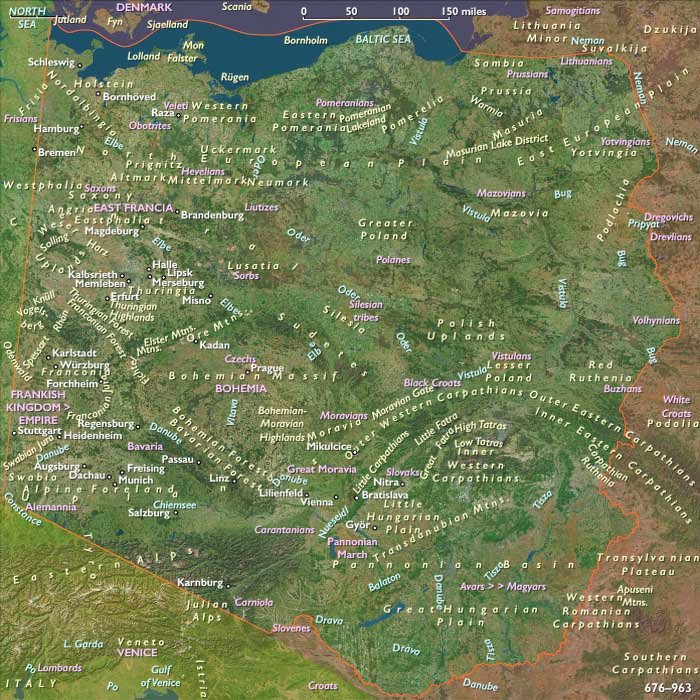
Between 784 and 795 CE, East Central Europe—encompassing Poland, Czechia, Slovakia, Hungary, and those portions of Germany and Austria lying east of 10°E and north of a line stretching from roughly 48.2°N at 10°E southeastward to the Austro-Slovenian border near 46.7°N, 15.4°E—witnessed critical transformations shaped by the expanding power of Charlemagne’s Carolingian Empire. After prolonged conflict, Charlemagne decisively subdued the Saxons, incorporating much of their territory into his growing empire. The Slavic principalities of Bohemia and Moravia intensified their efforts to solidify political institutions and defenses, anticipating Carolingian expansion. Meanwhile, the Avar Khaganate faced mounting Carolingian pressure, foreshadowing dramatic shifts to come, and Thuringia's longstanding autonomy increasingly diminished under direct Carolingian influence.
Political and Military Developments
Carolingian Conquest of Saxony
-
By 785 CE, Charlemagne decisively ended the protracted Saxon resistance, incorporating substantial territories east of the Elbe into the Carolingian Empire. Saxon regions underwent forced Christianization and integration into Frankish governance structures.
Slavic State Consolidation
-
Bohemian and Moravian principalities rapidly strengthened political and military structures in response to the nearby Carolingian presence. These developments laid firm foundations for future statehood, enhancing their internal governance and external diplomatic capabilities.
Increasing Carolingian Influence in Thuringia and Bavaria
-
The autonomous duchy of Thuringia came under greater Carolingian political control, while Bavaria experienced heightened Frankish influence, gradually eroding its political independence and autonomy.
Avar Khaganate Under Pressure
-
The Avar Khaganate increasingly faced military and diplomatic threats from the expanding Carolingian Empire, prompting strategic shifts and internal concerns about their long-term viability.
Economic and Technological Developments
Economic Integration Under Carolingian Influence
-
Conquered Saxon territories experienced closer economic integration with Carolingian domains, facilitating trade expansion and the introduction of Frankish monetary systems, agricultural practices, and economic governance.
Continued Fortification and Defensive Infrastructure
-
Bohemian, Moravian, Bavarian, and remaining Saxon communities reinforced existing defensive structures and settlements, responding proactively to Carolingian expansion and regional instability.
Cultural and Artistic Developments
Carolingian Cultural Impact
-
Saxon territories rapidly absorbed Carolingian religious, artistic, and administrative influences, marked by increased Christianization, shifts in burial practices, and the spread of Frankish-style artifacts.
Continued Slavic Cultural Identity
-
Bohemian and Moravian Slavs maintained and further articulated distinct cultural identities through unique settlement patterns, artistic styles, ceramics, jewelry, and fortified constructions.
Avar Artistic and Cultural Continuity
-
Despite external pressures, the Avars maintained strong cultural traditions, continuing to influence regional artistic styles, especially evident in metalworking and decorative arts.
Settlement and Urban Development
Saxon Urban Transformation
-
Carolingian control accelerated urban development in Saxon territories, integrating them into Frankish administrative structures and establishing new fortified towns and economic centers.
Expansion of Slavic Political Centers
-
Bohemian and Moravian settlements expanded as political and economic hubs, consolidating their position as centers of regional governance, trade, and culture.
Stability in Bavarian and Thuringian Settlements
-
Bavarian and Thuringian urban and rural settlements continued to grow economically, though increasingly aligned with Carolingian political structures and trade networks.
Social and Religious Developments
Forced Christianization of Saxony
-
Carolingian dominance introduced aggressive missionary activities and enforced conversion among the Saxons, significantly reshaping Saxon society and religious practices.
Centralized Slavic Leadership
-
Slavic principalities in Bohemia and Moravia further centralized their leadership, strengthening governance structures and defensive capabilities amid increasing Carolingian presence.
Avar Societal Stability Amid Pressure
-
The Avars retained internal cohesion and stability, though increasingly aware of and responsive to growing external Carolingian threats.
Long-Term Consequences and Historical Significance
The era 784–795 CE dramatically reshaped the political landscape of East Central Europe, primarily through the decisive Carolingian victory over the Saxons. Intensified Slavic state-building, increased Carolingian dominance over Thuringia and Bavaria, and mounting pressures on the Avar Khaganate collectively foreshadowed the profound transformations that defined the subsequent medieval history of the region.
People
Groups
- Polytheism (“paganism”)
- Franks
- Saxony, Old
- Germans
- Saxons
- Wends, or Sorbs (West Slavs)
- Christianity, Chalcedonian
- Avars, Eurasian
- Bavarians (West Germanic tribe)
- Bavaria, Agilolfing Duchy of
- Avar Khaganate (Eurasian Avars)
- Thuringia, Duchy of
- Thuringia, (Frankish) Duchy of
- Carantania
- Carantanians
- Roman Empire, Eastern: Isaurian dynasty
- Francia (Carolingians)
Topics
Commodoties
Subjects
Regions

Subregions
Years: 784 - 795
People
Groups
- Polytheism (“paganism”)
- Franks
- Saxony, Old
- Germans
- Saxons
- Wends, or Sorbs (West Slavs)
- Christianity, Chalcedonian
- Avars, Eurasian
- Bavarians (West Germanic tribe)
- Bavaria, Agilolfing Duchy of
- Avar Khaganate (Eurasian Avars)
- Thuringia, Duchy of
- Thuringia, (Frankish) Duchy of
- Carantania
- Carantanians
- Roman Empire, Eastern: Isaurian dynasty
- Francia (Carolingians)
Topics
Commodoties
Subjects
Regions
Subregions