
East Central Europe (772–783 CE): Carolingian Expansion, …
Years: 772 - 783
East Central Europe (772–783 CE): Carolingian Expansion, Saxon Resistance, and Slavic State Consolidation
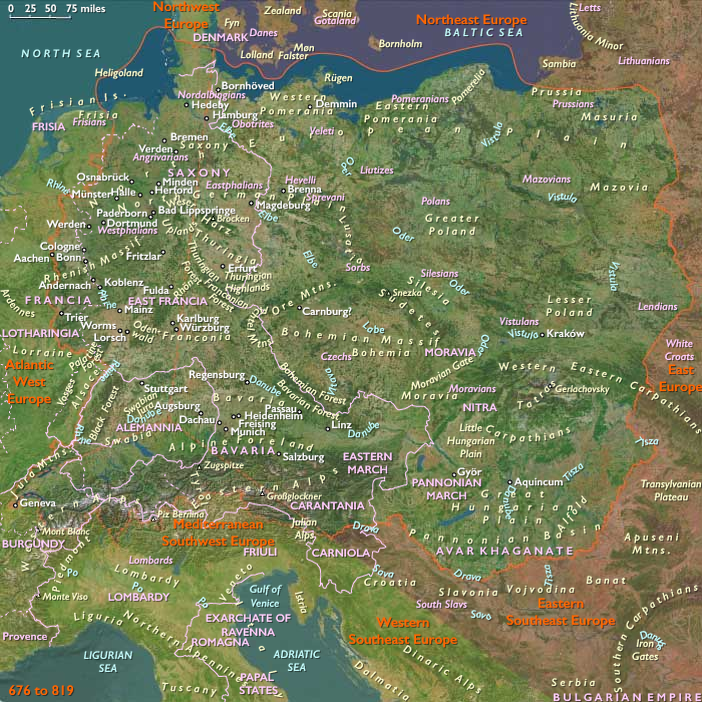
Between 772 and 783 CE, East Central Europe—encompassing Poland, Czechia, Slovakia, Hungary, and those portions of Germany and Austria lying east of 10°E and north of a line stretching from roughly 48.2°N at 10°E southeastward to the Austro-Slovenian border near 46.7°N, 15.4°E—entered a pivotal period marked by the rise of Carolingian influence under Charlemagne, intensified Saxon resistance to Frankish expansion, and continued political maturation of Slavic principalities. The Avar Khaganate remained internally stable yet increasingly wary of Carolingian power, while Thuringia maintained its practical autonomy, though increasingly under pressure from the west.
Political and Military Developments
Carolingian Conquests and Saxon Resistance
-
Beginning in 772 CE, Charlemagne initiated campaigns to subdue the Saxons east of the Rhine and Elbe rivers, triggering fierce resistance and ongoing military conflicts that dramatically reshaped regional political dynamics in eastern Germany and western Poland.
Continued Bavarian Influence over Slavic Territories
-
Bavaria maintained its established protectorate over Carantania, continuing to wield significant political influence and integrating the region economically and culturally, despite the increasing pressures of Carolingian expansion.
Consolidation of Slavic States
-
Slavic principalities, particularly in Bohemia and Moravia, further solidified governance structures, clearly defining territorial boundaries and developing effective defensive strategies against external threats, preparing for future encounters with Frankish and Carolingian influence.
Thuringian Autonomy under Carolingian Pressure
-
Thuringian rulers preserved autonomy yet faced increasing diplomatic and military pressure from the expanding Carolingian Empire, signaling an imminent change in their independent status.
Avar Diplomatic Caution
-
The Avar Khaganate maintained internal stability but increasingly adopted cautious diplomatic relations, recognizing the rising Carolingian threat and potential regional instability resulting from Frankish–Saxon conflicts.
Economic and Technological Developments
Economic Prosperity Amid Conflict
-
Despite military conflicts, regional economic networks remained active, sustaining trade exchanges among Saxon, Slavic, Bavarian, Thuringian, Avar, and Frankish communities, including agricultural goods, iron, precious metals, textiles, and luxury items.
Expansion of Fortifications and Military Infrastructure
-
Ongoing conflicts prompted significant investment in defensive fortifications and military infrastructure by Saxon, Slavic, Bavarian, and Avar communities, enhancing regional security and technological sophistication.
Cultural and Artistic Developments
Increased Frankish–Germanic Influence
-
Carolingian and Saxon military interactions introduced new Germanic cultural influences across eastern Germany, Poland, and western Slavic territories, reflected archaeologically through evolving burial customs, weaponry, and metalworking styles.
Slavic Cultural Distinction
-
Bohemian and Moravian Slavic communities reinforced their distinct cultural identities, evident through differentiated archaeological finds, artistic styles, ceramics, jewelry, and settlement patterns.
Avar Artistic Continuity
-
The Avars maintained their distinct cultural traditions, prominently influencing regional decorative arts, jewelry, metalworking techniques, and equestrian equipment.
Settlement and Urban Development
Urban Expansion under Saxon and Frankish Influence
-
Saxon settlements, despite ongoing conflicts, continued their growth, reinforcing existing fortified towns and forming the basis of later medieval urban centers within eastern Germany and adjacent areas.
Slavic Administrative and Urban Growth
-
Bohemian and Moravian urban centers expanded in response to growing political stability and economic activity, laying important groundwork for the medieval era.
Stability in Bavarian and Thuringian Settlements
-
Bavarian-influenced Carantania and autonomous Thuringian territories continued enjoying relative economic stability, though increasingly influenced by Carolingian expansion and Saxon–Frankish conflicts.
Social and Religious Developments
Heightened Military Aristocracies
-
Ongoing Saxon–Carolingian conflicts emphasized the role of warrior aristocracies among Saxon, Bavarian, and Frankish societies, reinforcing hierarchical social structures and military prowess.
Strengthened Slavic Leadership
-
Slavic principalities in Bohemia and Moravia continued centralizing leadership, improving governance, administrative efficiency, and defensive capabilities amid growing external pressures.
Continued Stability of Avar Society
-
The Avars retained stable societal structures, maintaining internal cohesion through effective elite governance and careful diplomacy.
Long-Term Consequences and Historical Significance
The era 772–783 CE marked a transformative phase for East Central Europe, characterized by Charlemagne's aggressive eastward expansion, persistent Saxon resistance, and reinforced Slavic state formation. These events significantly reshaped regional power dynamics, preparing the ground for subsequent Carolingian dominion and dramatically influencing the medieval political, cultural, and economic trajectory of the region.
People
Groups
- Polytheism (“paganism”)
- Franks
- Saxony, Old
- Germans
- Saxons
- Wends, or Sorbs (West Slavs)
- Christianity, Chalcedonian
- Avars, Eurasian
- Bavarians (West Germanic tribe)
- Bavaria, Agilolfing Duchy of
- Avar Khaganate (Eurasian Avars)
- Thuringia, Duchy of
- Thuringia, (Frankish) Duchy of
- Carantania
- Carantanians
- Roman Empire, Eastern: Isaurian dynasty
- Francia (Carolingians)
Topics
Commodoties
Subjects
Regions
Subregions
Related Events
Showing 10 events out of 55098 total
Years: 772 - 783
People
Groups
- Polytheism (“paganism”)
- Franks
- Saxony, Old
- Germans
- Saxons
- Wends, or Sorbs (West Slavs)
- Christianity, Chalcedonian
- Avars, Eurasian
- Bavarians (West Germanic tribe)
- Bavaria, Agilolfing Duchy of
- Avar Khaganate (Eurasian Avars)
- Thuringia, Duchy of
- Thuringia, (Frankish) Duchy of
- Carantania
- Carantanians
- Roman Empire, Eastern: Isaurian dynasty
- Francia (Carolingians)
Topics
Commodoties
Subjects
Regions
Subregions