
East Central Europe (760–771 CE): Bavarian and …
Years: 760 - 771
East Central Europe (760–771 CE): Bavarian and Saxon Dominance, Emerging Slavic States, and the Eve of Carolingian Influence
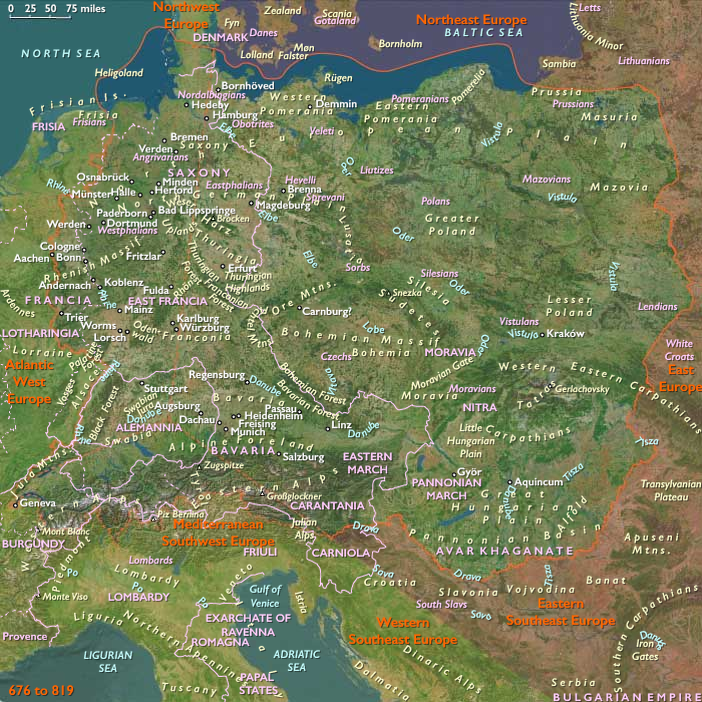
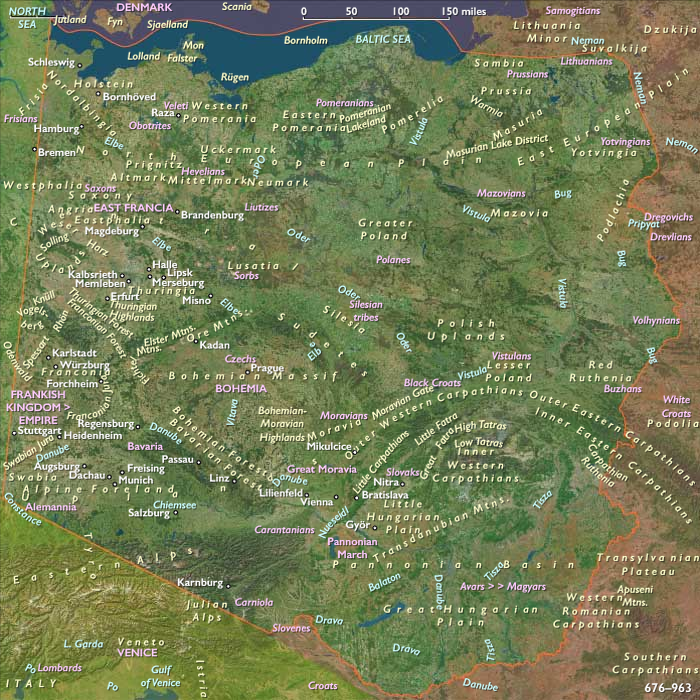
Between 760 and 771 CE, East Central Europe—encompassing Poland, Czechia, Slovakia, Hungary, and those portions of Germany and Austria lying east of 10°E and north of a line stretching from roughly 48.2°N at 10°E southeastward to the Austro-Slovenian border near 46.7°N, 15.4°E—experienced further consolidation of Bavarian and Saxon influence, continued political and economic stabilization among Slavic communities, and sustained internal coherence within the Avar Khaganate. Thuringia remained effectively independent of diminishing Merovingian power, setting the regional stage for the transformative emergence of Carolingian power to the west.
Political and Military Developments
Bavarian Consolidation over Carantania
-
The Duchy of Bavaria solidified its protectorate over the Slavic principality of Carantania, further embedding the region within Bavarian political and cultural influence and reinforcing the strategic divide between southern Slavs and their northern and eastern kin.
Sustained Saxon Power
-
Saxon dominance remained firmly established east of the Elbe River, maintaining influential control over eastern Germany and extending political, economic, and cultural influence into western Poland and northern Czechia.
Early Slavic State Formation
-
Principalities in Bohemia and Moravia matured significantly, further clarifying territorial boundaries, administrative structures, and defensive systems, laying foundational structures for medieval statehood.
Continued Autonomy in Thuringia
-
Thuringian dukes preserved their political autonomy, reinforcing the ongoing decentralization and decline of Merovingian royal authority.
Diplomatic Stability of the Avar Khaganate
-
The Avars retained internal political stability and carefully managed diplomatic relations with neighboring Bavarian, Saxon, and Slavic territories, maintaining regional equilibrium.
Economic and Technological Developments
Flourishing Regional Economy
-
Prosperous trade networks continued connecting Bavarian, Saxon, Slavic, Thuringian, Avar, and Frankish territories, exchanging agricultural produce, metals, textiles, luxury items, and crafts.
Expansion of Fortifications and Infrastructure
-
Saxon, Slavic, Bavarian, and Avar communities expanded and refined their fortified settlements, reflecting stable governance, economic prosperity, population growth, and advanced technological capabilities.
Cultural and Artistic Developments
Germanic Cultural Expansion
-
Bavarian and Saxon cultural traditions further permeated Slavic regions, significantly shaping artistic styles, pottery, metalwork, burial practices, and jewelry throughout the area.
Continued Development of Slavic Regional Identities
-
Bohemian, Moravian, and Carantanian Slavic groups deepened their distinct regional identities, archaeologically visible in differentiated ceramics, settlement patterns, and material culture.
Avar Artistic Continuity
-
Avar cultural and artistic traditions remained influential, particularly evident in sophisticated metalworking techniques, jewelry designs, and equestrian accessories.
Settlement and Urban Development
Saxon and Bavarian Territorial Integration
-
Saxon and Bavarian territories expanded settlement networks, developing fortified urban centers and economically productive rural communities, solidifying regional stability.
Slavic Urban and Administrative Growth
-
Bohemian, Moravian, and Carantanian urban centers grew increasingly prominent, reflecting stable political leadership, economic prosperity, and demographic growth.
Continued Stability in Thuringia
-
Thuringian communities maintained their economic vitality and regional political stability, benefiting from sustained peaceful trade and minimal external pressures.
Social and Religious Developments
Solidified Germanic Leadership Structures
-
Bavarian and Saxon societies reinforced hierarchical structures under powerful warrior aristocracies, ensuring cohesive regional governance and military effectiveness.
Centralization of Slavic Authority
-
Slavic communities in Bohemia, Moravia, and Carantania continued centralizing political authority, enhancing governance, defense, and regional integration.
Continued Stability of Avar Society
-
Avar societal organization remained cohesive, effectively managed by a stable hierarchy and strong leadership, maintaining internal stability and diplomatic effectiveness.
Long-Term Consequences and Historical Significance
The era 760–771 CE further entrenched key political and cultural structures that would shape East Central Europe's medieval future. Bavarian and Saxon dominance, Slavic state formation, persistent Thuringian independence, and ongoing Avar stability created the conditions for the transformative developments soon to emerge with the rise of the Carolingian Empire. These dynamics fundamentally influenced the region's long-term historical trajectory.
Groups
- Polytheism (“paganism”)
- Franks
- Saxony, Old
- Germans
- Saxons
- Wends, or Sorbs (West Slavs)
- Christianity, Chalcedonian
- Avars, Eurasian
- Bavarians (West Germanic tribe)
- Bavaria, Agilolfing Duchy of
- Avar Khaganate (Eurasian Avars)
- Thuringia, Duchy of
- Thuringia, (Frankish) Duchy of
- Carantania
- Carantanians
- Roman Empire, Eastern: Isaurian dynasty
Topics
Commodoties
Subjects
Regions
Subregions
Years: 760 - 771
Groups
- Polytheism (“paganism”)
- Franks
- Saxony, Old
- Germans
- Saxons
- Wends, or Sorbs (West Slavs)
- Christianity, Chalcedonian
- Avars, Eurasian
- Bavarians (West Germanic tribe)
- Bavaria, Agilolfing Duchy of
- Avar Khaganate (Eurasian Avars)
- Thuringia, Duchy of
- Thuringia, (Frankish) Duchy of
- Carantania
- Carantanians
- Roman Empire, Eastern: Isaurian dynasty
Topics
Commodoties
Subjects
Regions
Subregions